


























Views
Downloads



Essential Structural Signals Worksheet | Grade 6 ELA
Paste this activity's link or code into your existing LMS (Google Classroom, Canvas, Teams, Schoology, Moodle, etc.).
Students can open and work on the activity right away, with no student login required.
You'll still be able to track student progress and results from your teacher account.
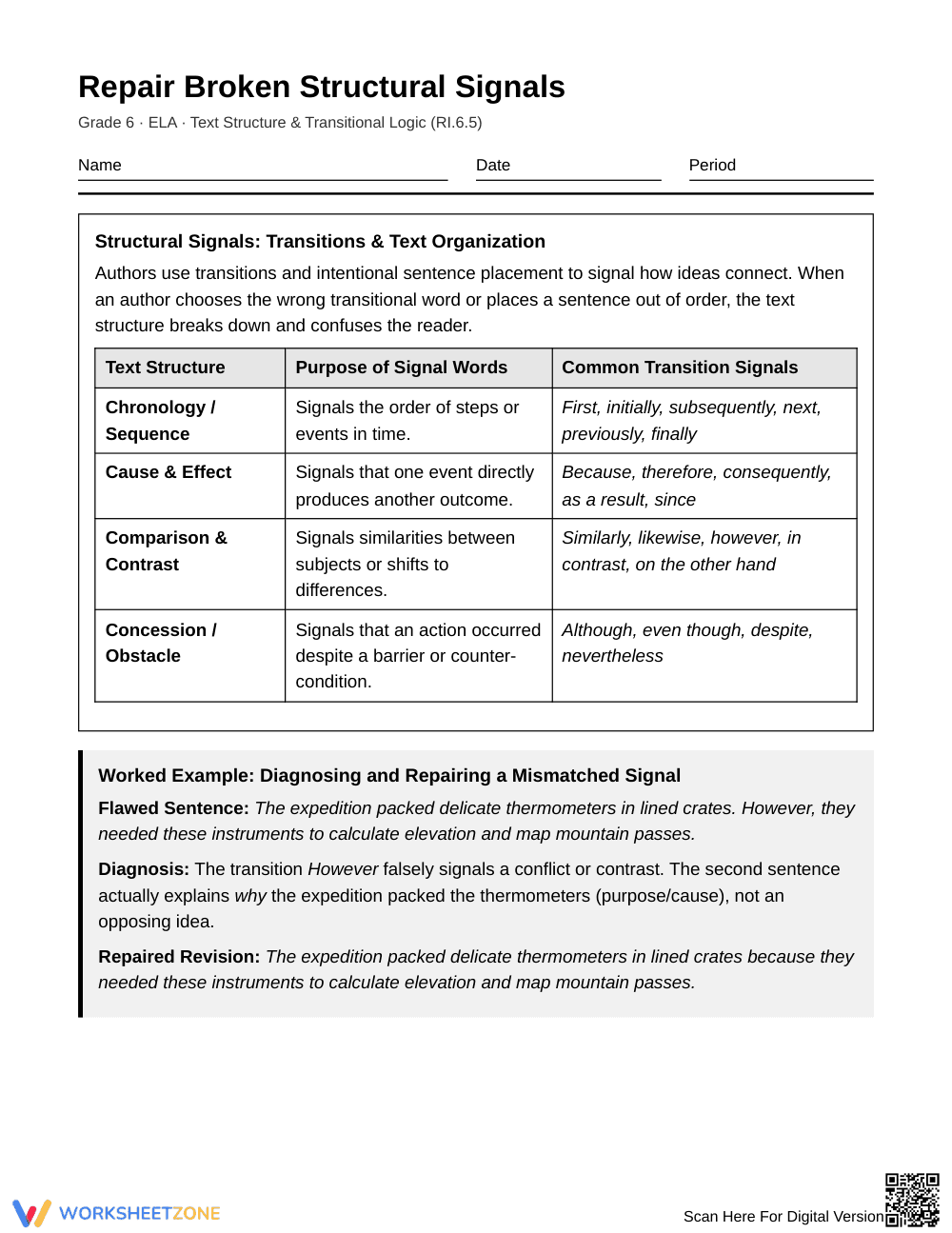
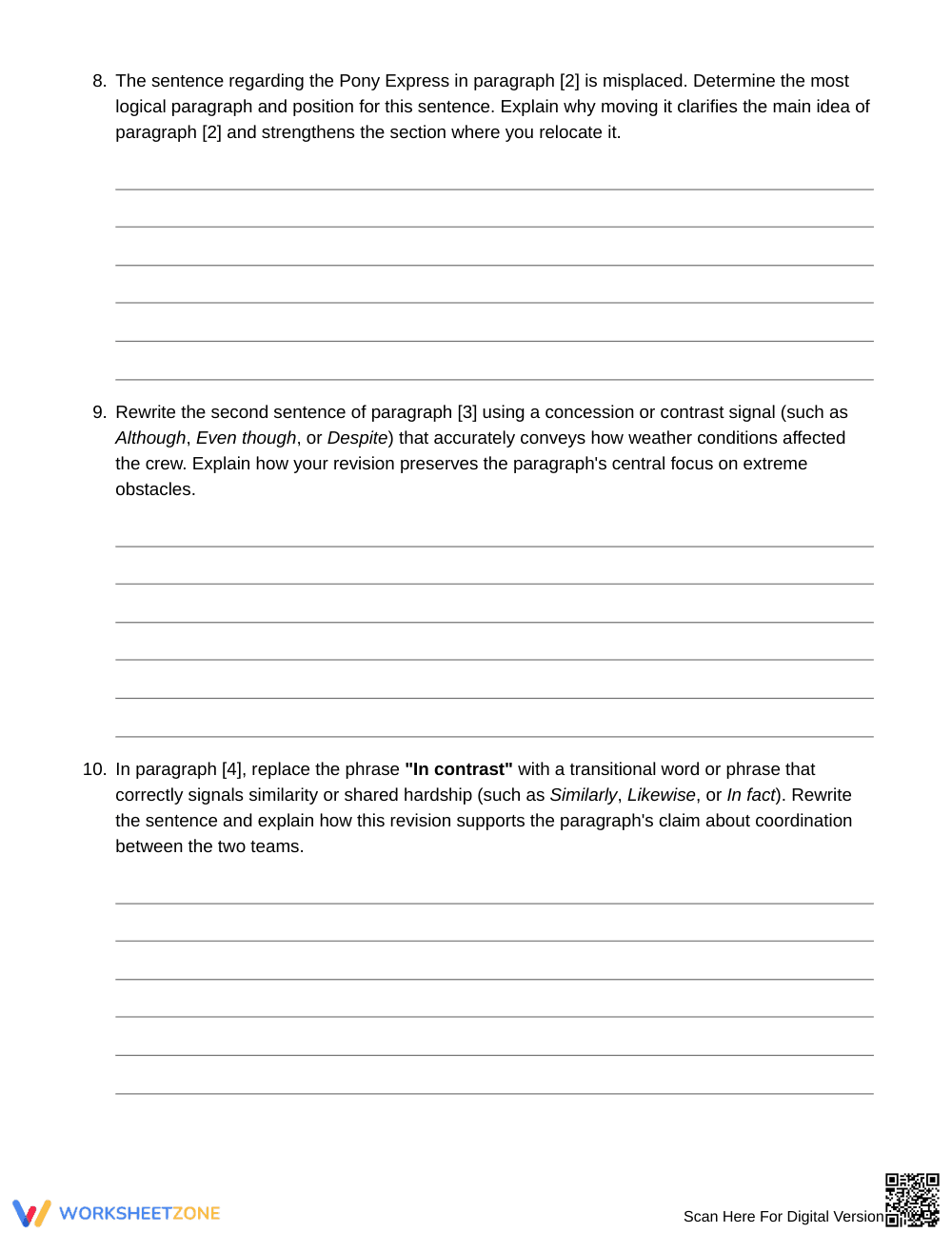
This informational text structure worksheet equips sixth-grade students to analyze how transitions establish organizational logic and sentence relationships. By evaluating an authentic historical passage on the 1861 Transcontinental Telegraph, learners diagnose mismatched transition signals and misplaced details, revising text elements to restore cohesion, logical progression, and clarity across multi-paragraph informational texts.
At a Glance
- Grade: 6 · Subject: ELA
- Standard:
RI.6.5— Analyze how a particular sentence, paragraph, chapter, or section fits into text structure- Skill Focus: Repair Broken Structural Signals
- Format: 5 pages · 10 problems · Answer key included · PDF
- Best For: Informational text structure analysis practice
- Time: 40–50 minutes
What's Inside
This 5-page printable resource includes a comprehensive structural reference chart defining chronological, cause-and-effect, comparative, and concessive transition words. Students read an informational passage featuring deliberate organizational errors, analyze five structural missteps in Part A, and rewrite five faulty sentences with written justifications in Part B. A detailed three-page answer key provides complete revision models and diagnostic explanations.
Skill Progression
- Guided practice (Worked Example): Students examine an explicit model that defines how a mismatched transitional word distorts sentence logic, paired with an annotated repair strategy.
- Supported practice (Part A, Problems 1–5): Learners analyze passage excerpts to identify illogical sequence markers, contradictory time signals, and misplaced sentences that break paragraph unity.
- Independent practice (Part B, Problems 6–10): Students choose accurate transitional phrases, reposition misplaced sentences, and write evidence-based rationales defending their structural adjustments.
This sequence reinforces the gradual release of responsibility model, shifting students from diagnostic reading to active editorial revision.
Standards Alignment
This worksheet directly targets RI.6.5: Analyze how a particular sentence, paragraph, chapter, or section fits into the overall structure of a text and contributes to the development of the ideas. Students also apply supporting standard W.6.2.C by utilizing appropriate transitions to clarify the relationships among ideas. Both standard codes can be copied directly into lesson plans, IEP goals, or district curriculum mapping tools.
How to Use It
Deploy this activity during guided reading or immediately following direct instruction on transitional phrases. As students work, conduct formative observations by checking whether learners identify the logical contradiction in Part A Problem 2 before selecting an alternate signal word. Alternatively, use this resource for mid-unit remediation or test prep. Expected completion time is 40 to 50 minutes.
Who It's For
This activity supports general education sixth-grade ELA students, English language learners developing academic syntax, and reading intervention groups targeted for structural comprehension. Pair this worksheet directly with informational anchor charts displaying transition categories or a historical non-fiction reading unit to deepen student understanding of author craft and sentence placement.
According to research highlighted in Fisher & Frey (2014) on close reading and text architecture, middle school readers often struggle to comprehend informational text when transition words are processed as decorative vocabulary rather than functional logical signposts. Teaching students to actively diagnose and repair broken transitional logic directly addresses common comprehension breakdowns documented across middle-grade cohorts. Aligned with standard RI.6.5, this worksheet trains sixth-grade students to analyze how specific sentences fit into informational text structures, examining whether authors correctly establish chronology, cause-and-effect, comparison, and concession. When students practice replacing faulty transitions and repositioning disconnected sentences, they internalize the functional relationship between sentence-level syntax and paragraph-level cohesion. This rigorous exercise builds both analytical reading skills and written drafting precision, ensuring students can independently trace informational text organization across complex primary and secondary sources.


