




























Views
Downloads

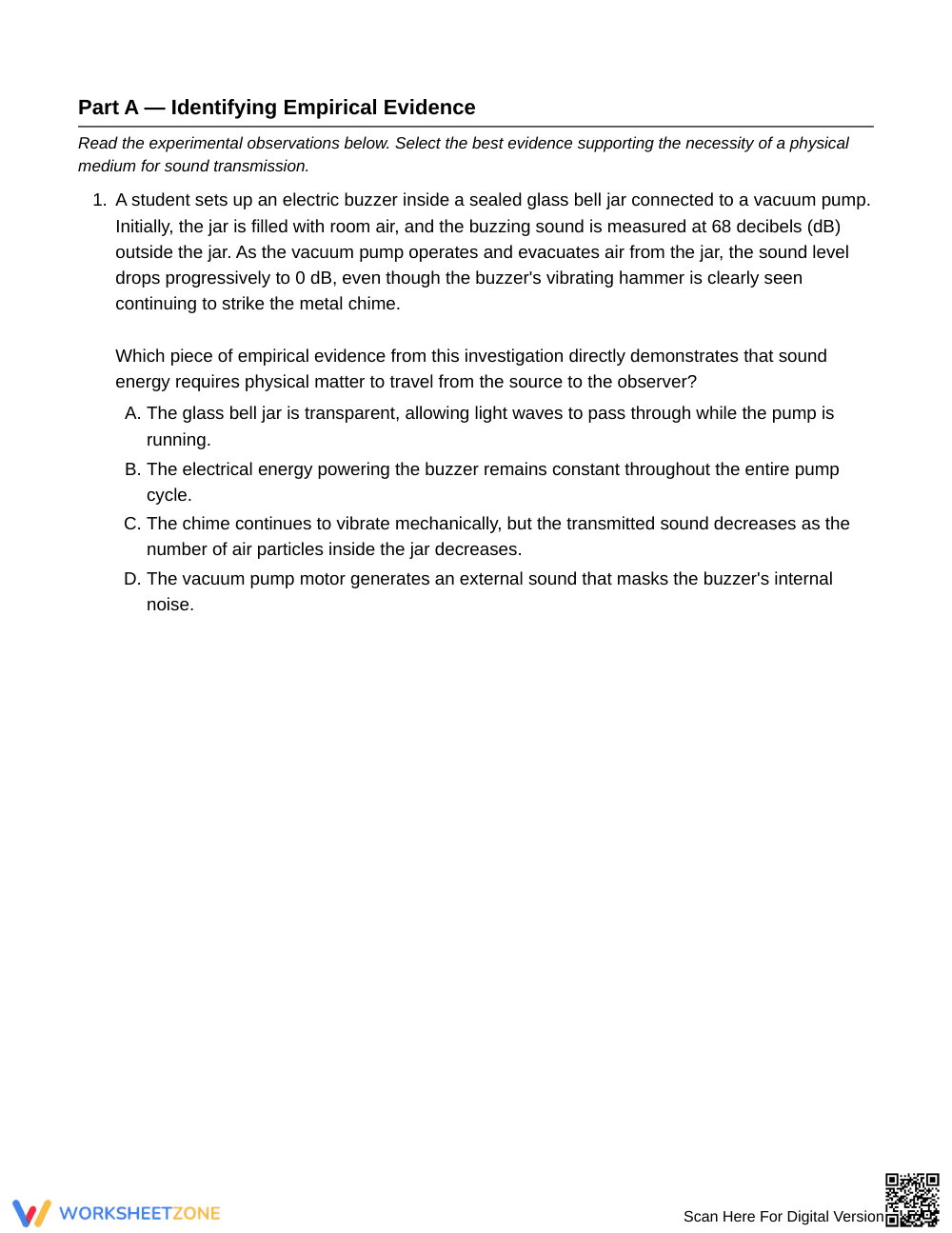
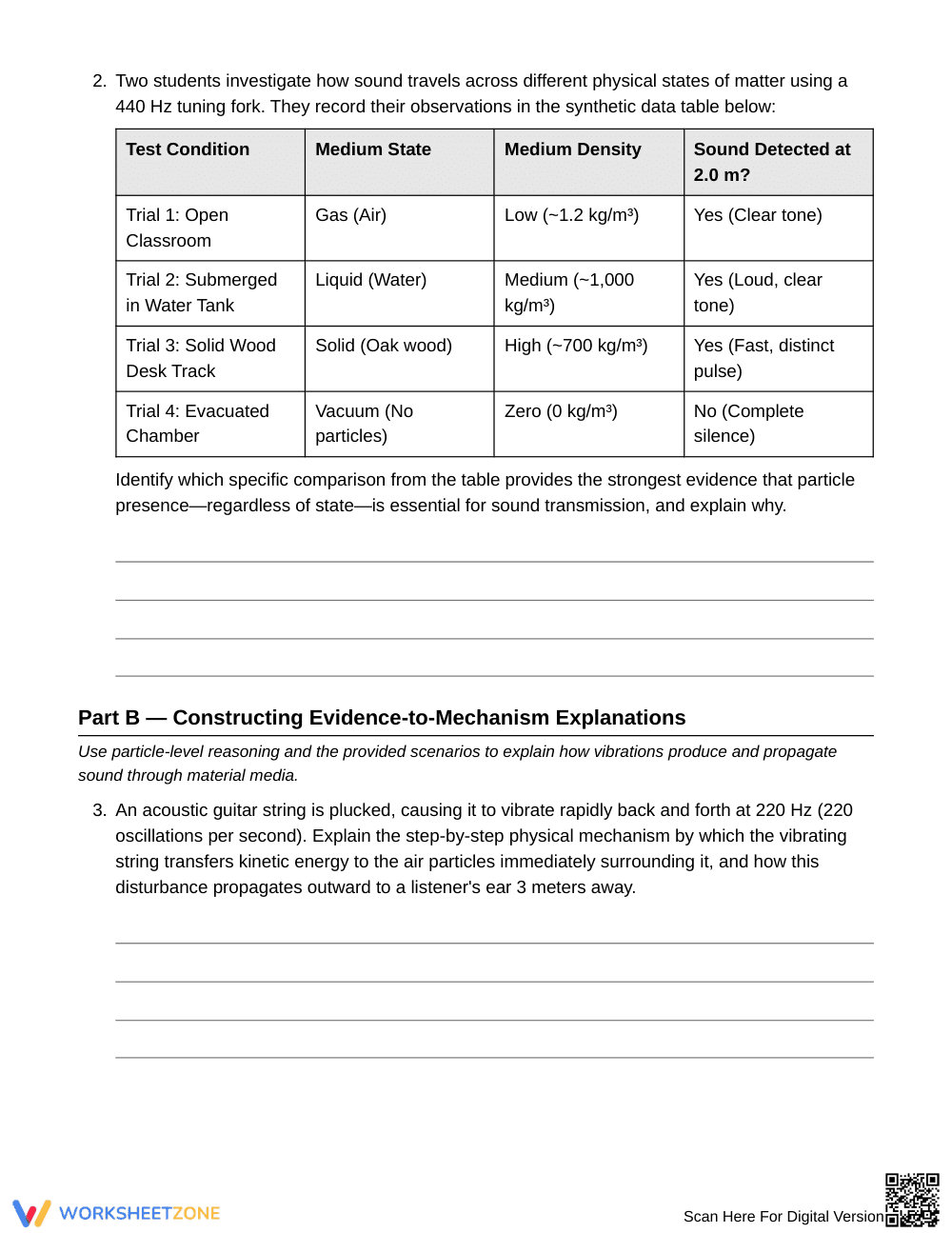
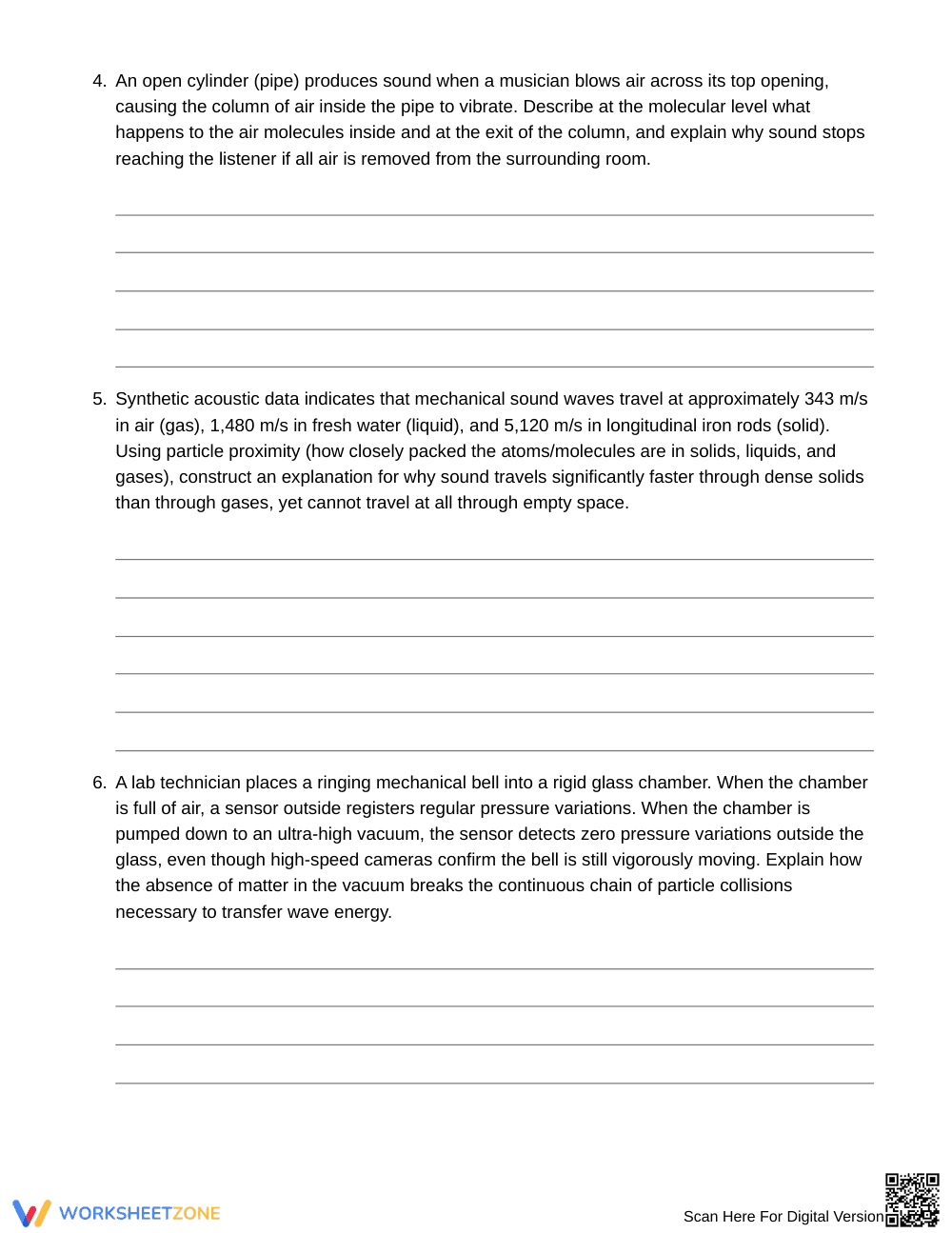


Essential Sound Needs a Medium Worksheet | Grade 6 Science

Paste this activity's link or code into your existing LMS (Google Classroom, Canvas, Teams, Schoology, Moodle, etc.).
Students can open and work on the activity right away, with no student login required.
You'll still be able to track student progress and results from your teacher account.
This Grade 6 science worksheet guides middle school students through the core physical mechanics of mechanical waves, demonstrating why sound energy requires a solid, liquid, or gas medium to propagate. Students analyze empirical data, construct molecular-level explanations, and evaluate competing scientific claims about wave transmission across various states of matter and vacuums.
At a Glance
- Grade: 6 · Subject: Science
- Standard: Explain how mechanical waves require a medium to transfer energy
- Skill Focus: Explaining why sound needs a medium
- Format: 5 pages · 8 problems · Answer key included · PDF
- Best For: Middle school physical science wave units
- Time: 40–50 minutes
What's Inside
The 5-page student resource provides a complete core principles reference box followed by 8 tiered analytical tasks. Students interpret bell jar vacuum experiments, analyze synthetic acoustic speed tables across four physical states of matter, compose particle-collision explanations, and critique common science-fiction misconceptions. A comprehensive 3-page teacher answer key provides full mechanistic explanations and sample student responses.
Skill Progression
- Guided practice (Part A — Tasks 1–2): Students identify empirical evidence from a structured bell-jar investigation and compare acoustic transmission rates across physical states using an evidence table with low scaffold support.
- Supported practice (Part B — Tasks 3–6): Students construct multi-step molecular explanations detailing how vibrating sources transfer kinetic energy through compression and rarefaction chains in solids, liquids, and gases.
- Independent practice (Part C — Tasks 7–8): Students independently evaluate authentic scientific claims, refute popular space-vacuum movie tropes, and apply the conservation of energy to acoustic resonance demonstrations.
This sequence mirrors the gradual-release model, shifting learners from guided data interpretation to independent mechanistic reasoning.
Standards Alignment
This resource aligns with middle school physical science standards addressing wave properties and energy transfer. Students develop models describing that waves are reflected, absorbed, or transmitted through various materials and demonstrate that mechanical sound waves transfer energy via particle interactions rather than matter transport. This curriculum mapping integrates directly into district physical science pacing guides and unit lesson plans.
How to Use It
Deploy this activity immediately following direct instruction on particle theory and mechanical waves. Use Part A as a collaborative mid-lesson check to ensure students recognize why vacuums prevent wave propagation before assigning Part B and Part C for independent practice. During classwork, observe whether students attribute silence in a vacuum to missing energy or missing physical particles. Expected completion time is 40 to 50 minutes.
Who It's For
This activity is designed for Grade 6 general science and introductory physics classrooms. It supports visual and developing scientific writers through clear reference boxes, while offering analytical claim-evaluation challenges for advanced learners. Pair this worksheet with an in-class acoustic bell-jar demonstration or an interactive wave-speed simulation.
According to research by Fisher & Frey (2014) on structured instructional frameworks, providing students with explicit particle-interaction reference points before requiring open-ended scientific justification significantly improves conceptual retention and mechanistic reasoning. This Grade 6 physical science resource operationalizes that evidence-based approach across 8 focused tasks, requiring learners to connect macroscopic sound phenomena with sub-microscopic molecular behavior. Students analyze empirical data tables comparing wave speeds across solids, liquids, gases, and vacuums, establishing clear qualitative evidence that mechanical disturbances depend strictly on atomic collisions. By progressing from guided data interpretation to claim refutation, students master the fundamental physical principle that sound energy cannot travel across a vacuum. The included detailed answer key offers diagnostic benchmarks for identifying persistent student misconceptions regarding wave energy versus physical matter propagation.


