




























Views
Downloads




Essential Rock-Climate Matches Worksheet | Grade 8 Science

Paste this activity's link or code into your existing LMS (Google Classroom, Canvas, Teams, Schoology, Moodle, etc.).
Students can open and work on the activity right away, with no student login required.
You'll still be able to track student progress and results from your teacher account.
This worksheet teaches Grade 8 students to judge whether rock types and ancient climate clues on different continents match well enough to support continental drift. Students weigh tillite, coal, and mountain-belt evidence, calculate drift rates, and defend predictions with reasoning.
At a Glance
- Grade: 8 · Subject: Science
- Standard: Continental drift evidence — Compare rock and climate clues to judge whether continents were once joined
- Skill Focus: Evaluate rock and paleoclimate matches
- Format: 5 pages · 12 problems · Answer key included · PDF
- Best For: Evidence practice after introducing Pangaea
- Time: 35–45 minutes
What's Inside
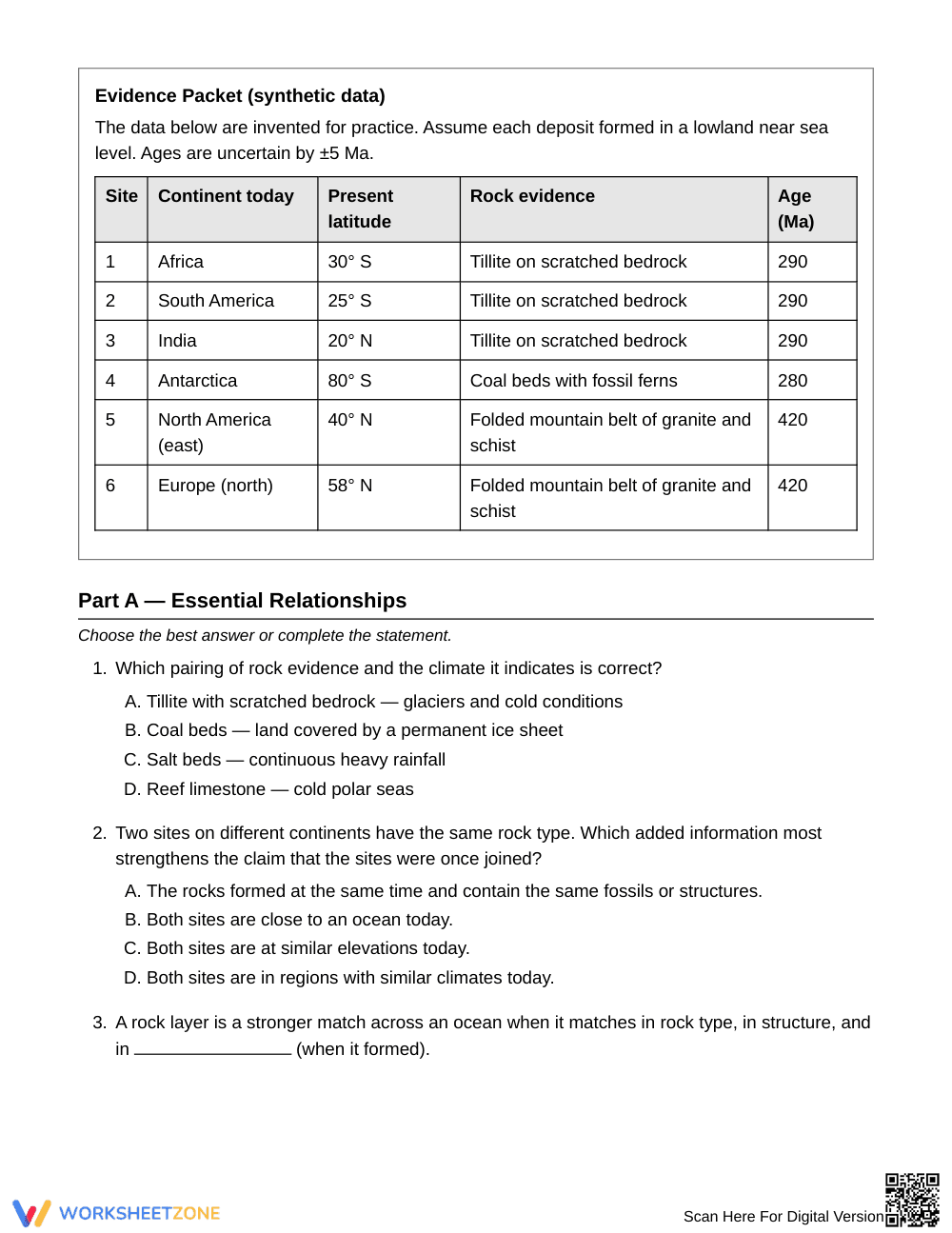
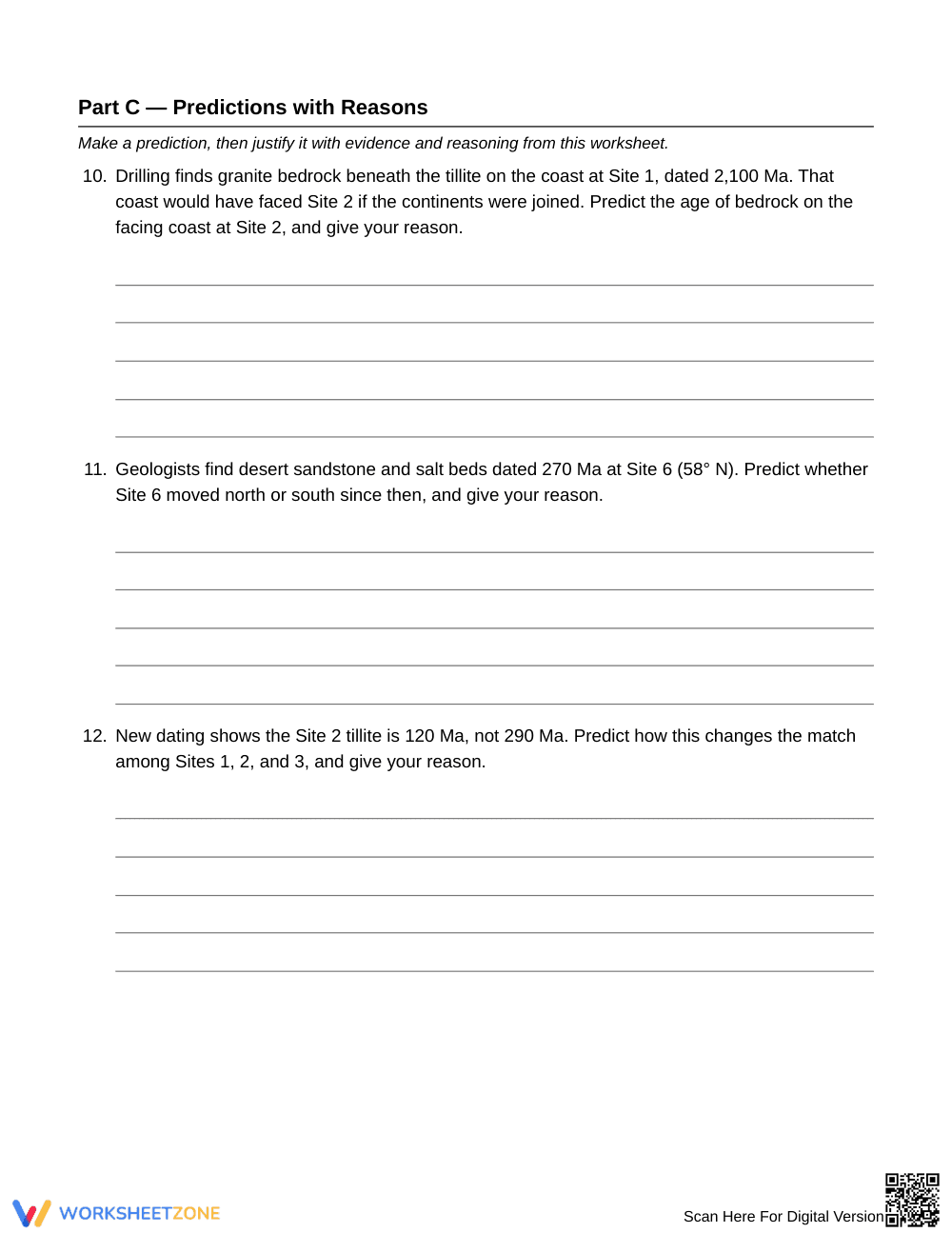
Five pages include a reminder box, a six-site synthetic evidence packet, and three parts: three Part A selected-response and fill-in items, six Part B calculation and explanation problems, and three Part C prediction tasks. A two-page answer key follows with worked calculations and sample reasoning.
Skill Progression
- Guided practice: 3 Part A items check rock-climate pairings and what makes a strong match, with the reminder box as support.
- Supported practice: 6 Part B problems use the evidence packet, given formulas, and unit conversions to explain mechanisms.
- Independent practice: 3 Part C predictions ask students to justify claims with evidence and reasoning alone.
The sequence follows gradual release: I Do, We Do, You Do.
Standards Alignment
No standard code is attached to this resource. It addresses the Grade 8 Earth science idea that patterns in rock formations, fossils, and climate evidence across continents support continental drift. Map it to your state or NGSS-based standards in lesson plans, IEP goals, or district curriculum tools.
How to Use It
After direct instruction on Pangaea, assign Parts A and B as in-class practice, then use Part C as an exit task or homework. As students work, watch whether they cite the Age column, not just rock type, when calling a match strong. Expect 35–45 minutes in total.
Who It's For
Grade 8 science students studying plate tectonics. Students who need support can work Part A and two Part B problems with a partner, while advanced students can write full defenses for Part C. Pair it with a Pangaea fit map or an anchor chart on rock-climate clues.
Evaluating rock and paleoclimate matches is a Grade 8 Earth science skill in which students compare rock type, age, and structure across continents to judge whether landmasses were once joined. This worksheet gives students 12 tasks across 5 pages, using a synthetic six-site evidence packet: tillite at mid and low latitudes, coal in Antarctica, and matching mountain belts across an ocean. Students convert units, calculate drift rates, and predict outcomes from new data. The structure follows the gradual release model described by Fisher & Frey (2014), moving from guided items to supported problems to independent predictions. A two-page answer key supports quick feedback. No standard code is assigned to this resource, so teachers can map it to local science standards on continental drift and plate tectonics. Strong matches require agreement in rock type, age, and structure or fossils, and this worksheet trains students to test each of those conditions before drawing a conclusion.


