




























Views
Downloads




Essential Rebuttal Limits Worksheet | Grade 8 ELA

Paste this activity's link or code into your existing LMS (Google Classroom, Canvas, Teams, Schoology, Moodle, etc.).
Students can open and work on the activity right away, with no student login required.
You'll still be able to track student progress and results from your teacher account.
This Grade 8 argumentative writing worksheet guides students to qualify and justify rebuttal limits when addressing opposing claims. Using a two-source packet on school technology policies, eighth graders evaluate strategic stances, draft nuanced counterarguments, and revise flawed reasoning into academically sound responses with defined boundaries.
At a Glance
- Grade: 8 · Subject: English Language Arts
- Standard:
W.8.1.b— Support claims with logical reasoning and relevant evidence while addressing opposing counterarguments- Skill Focus: Justify a Rebuttal’s Limits
- Format: 5 pages · 8 problems · Detailed answer key included · PDF
- Best For: Middle school argumentative counterargument and rebuttal revision practice
- Time: 45–60 minutes
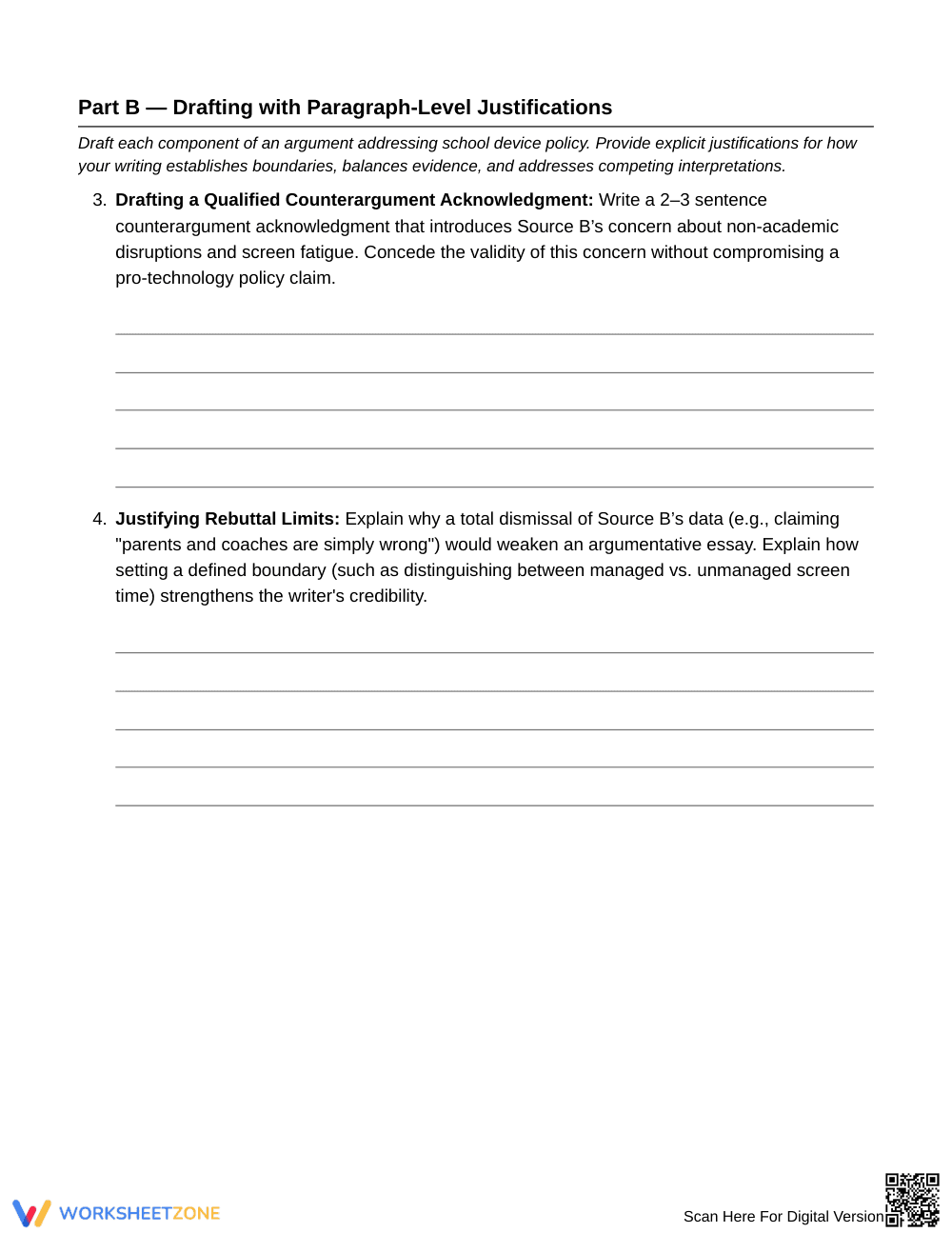
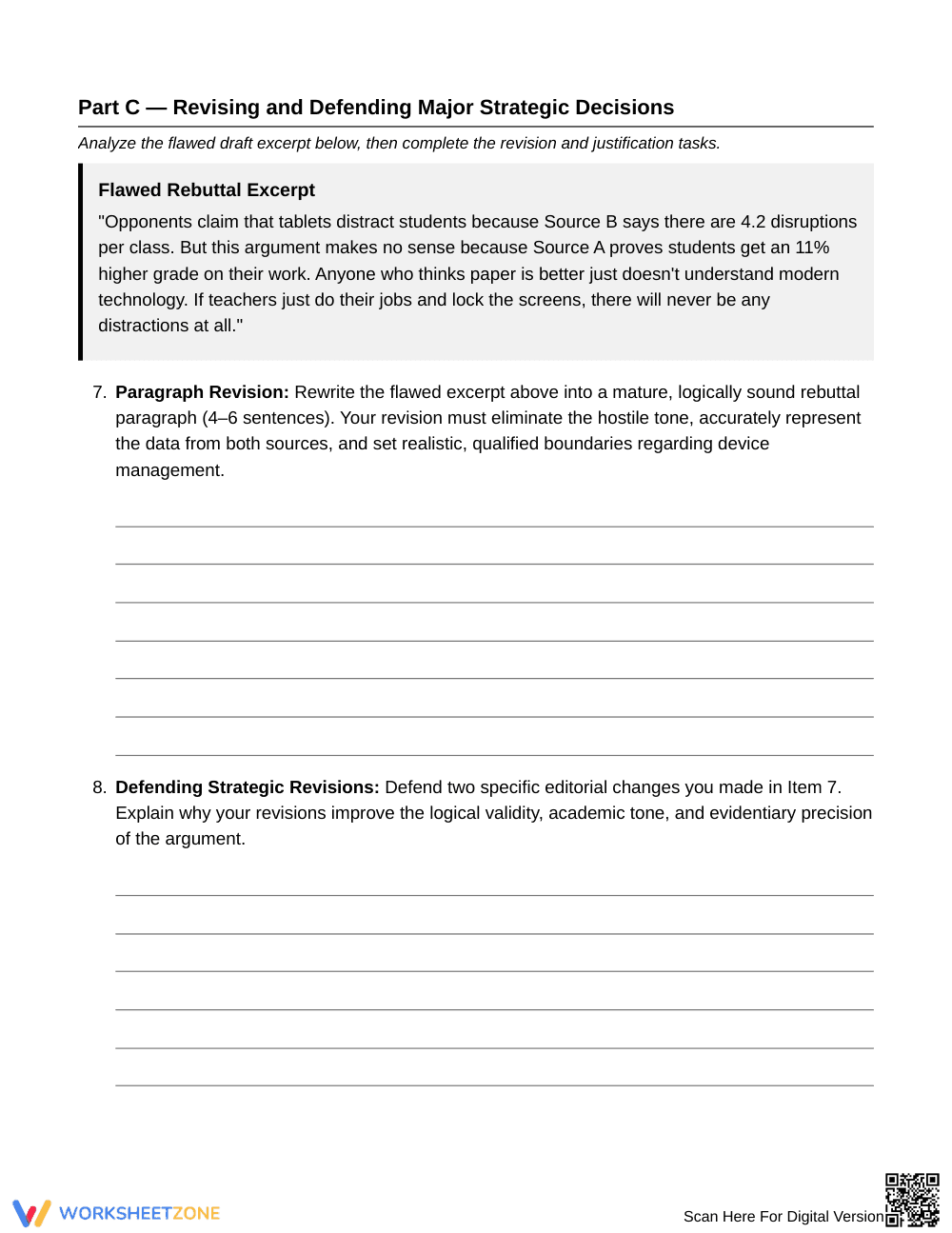
This 5-page worksheet includes 8 tasks and a 4-page answer key. Students explore a two-source packet presenting empirical data on school device policies. Features include a concept anchor box defining rebuttal boundaries, scenario evaluations, paragraph-level drafting prompts, and a revision exercise targeting dismissive argumentation.
Skill Progression
- Guided practice (Tasks 1–2): Students analyze scenarios to select qualified rebuttals over absolute dismissals using evidence-based multiple-choice prompts.
- Supported practice (Tasks 3–6): Learners draft counterargument concessions, synthesize conflicting metrics, and write a structured 250- to 350-word policy argument.
- Independent practice (Tasks 7–8): Students correct hostile tone and logical flaws in a sample rebuttal, rewriting the excerpt and defending their editorial decisions.
This sequence implements gradual release, moving from analytical evaluation to independent compositional defense.
Standards Alignment
Primary standard W.8.1.b requires students to support claims with logical reasoning and relevant evidence while addressing opposing positions. Supporting standard RI.8.8 focuses on evaluating arguments and specific claims for sound reasoning. Both standard codes can be copied directly into lesson plans, IEP goals, or district curriculum mapping tools.
How to Use It
Assign this worksheet during the drafting phase of an argumentative unit or as a targeted revision workshop before essay grading. During Task 5, check whether students acknowledge the screen fatigue metric or dismiss it; use this formative checkpoint to guide boundary setting. Expect 45 to 60 minutes for completion.
Who It's For
This resource serves Grade 8 ELA classrooms, providing scaffolds for struggling writers alongside rigor for advanced students. Built-in boundary definitions assist English learners, while synthesis tasks challenge proficient writers. Pair this printable with a mini-lesson on qualifying transition words like "although" and "primarily."
According to Fisher & Frey (2014), argumentative writing proficiency requires explicit instruction in qualifying rebuttals rather than outright dismissing opposing viewpoints. This instructional worksheet targets standard W.8.1.b by teaching Grade 8 students to justify a rebuttal's limits using authentic empirical texts. When middle school writers learn to establish clear boundaries around their arguments—conceding valid concerns such as screen fatigue while showing how teacher monitoring preserves learning gains—they demonstrate higher-order analytical reasoning. Grounding student composition in conflicting evidence sets and revision tasks bridges the gap between unsupported assertions and mature discourse. Fisher & Frey highlight that gradual-release frameworks help developing writers internalize disciplinary conventions, transforming simplistic rebuttals into balanced, evidence-backed arguments. By learning to define rebuttal limits and defend editorial decisions across these eight sequential tasks, eighth-grade students build essential critical thinking skills required for secondary academic writing and standardized assessments.


