


























Views
Downloads


Essential Quotient Reasonableness Worksheet | Grade 6 Math
Paste this activity's link or code into your existing LMS (Google Classroom, Canvas, Teams, Schoology, Moodle, etc.).
Students can open and work on the activity right away, with no student login required.
You'll still be able to track student progress and results from your teacher account.
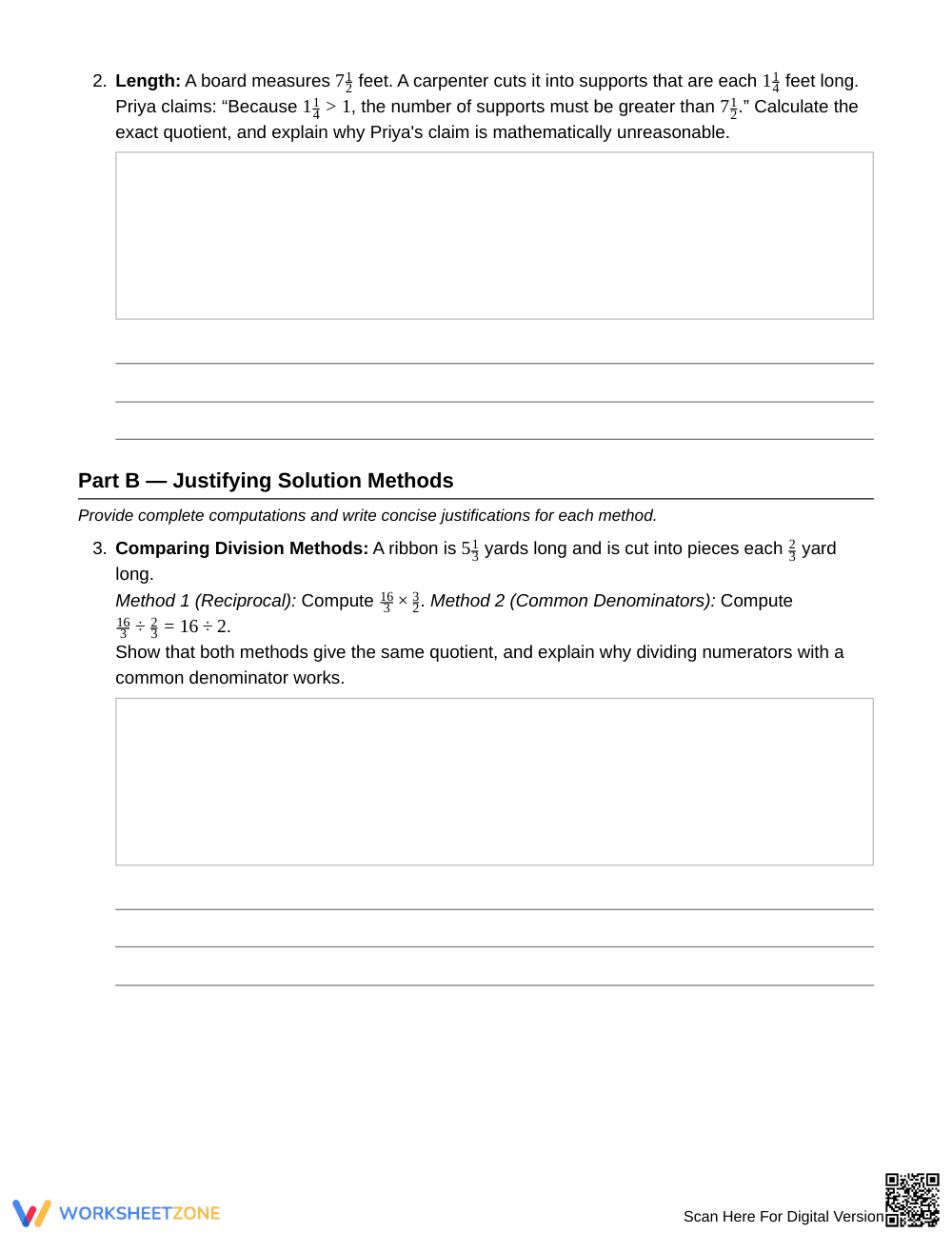
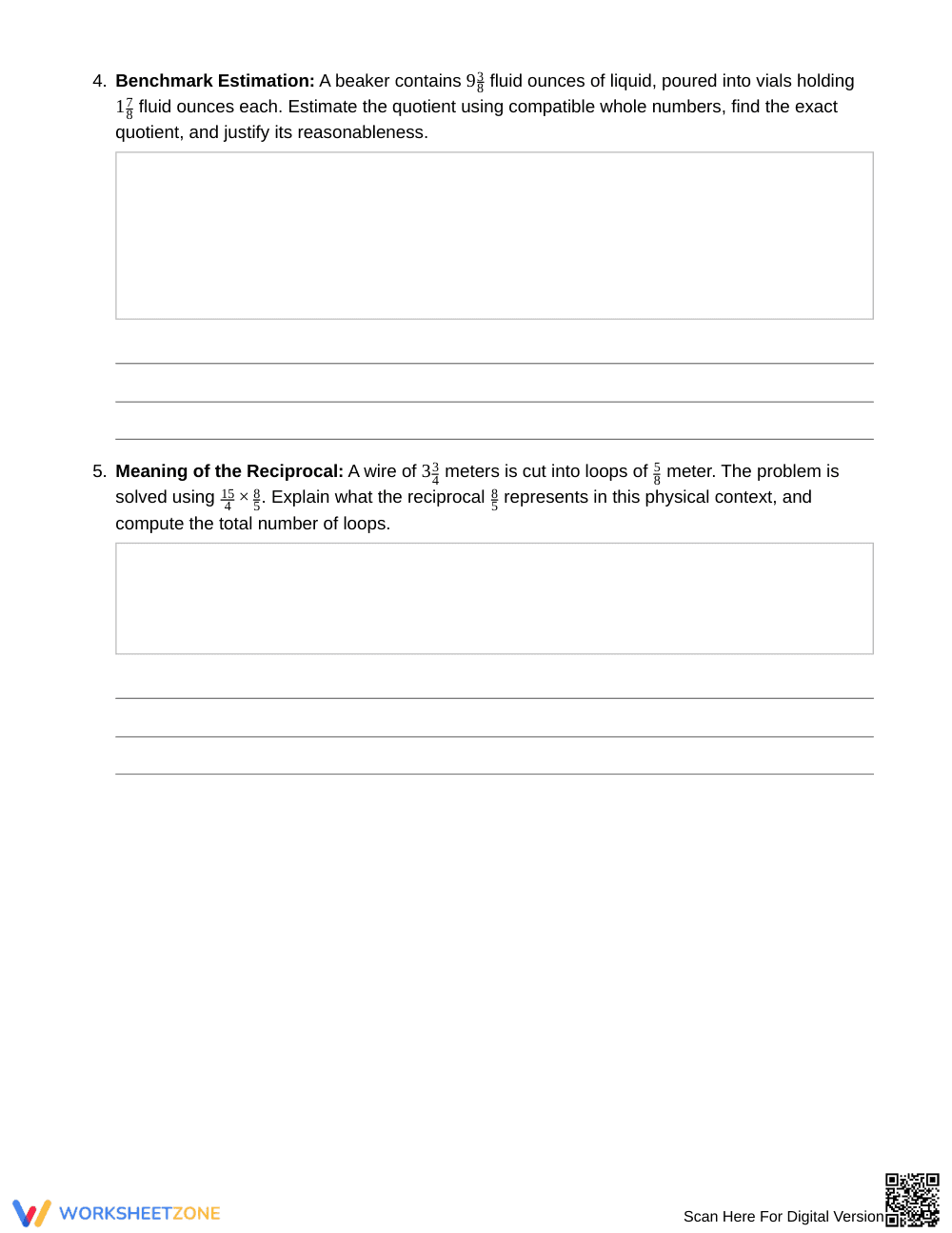
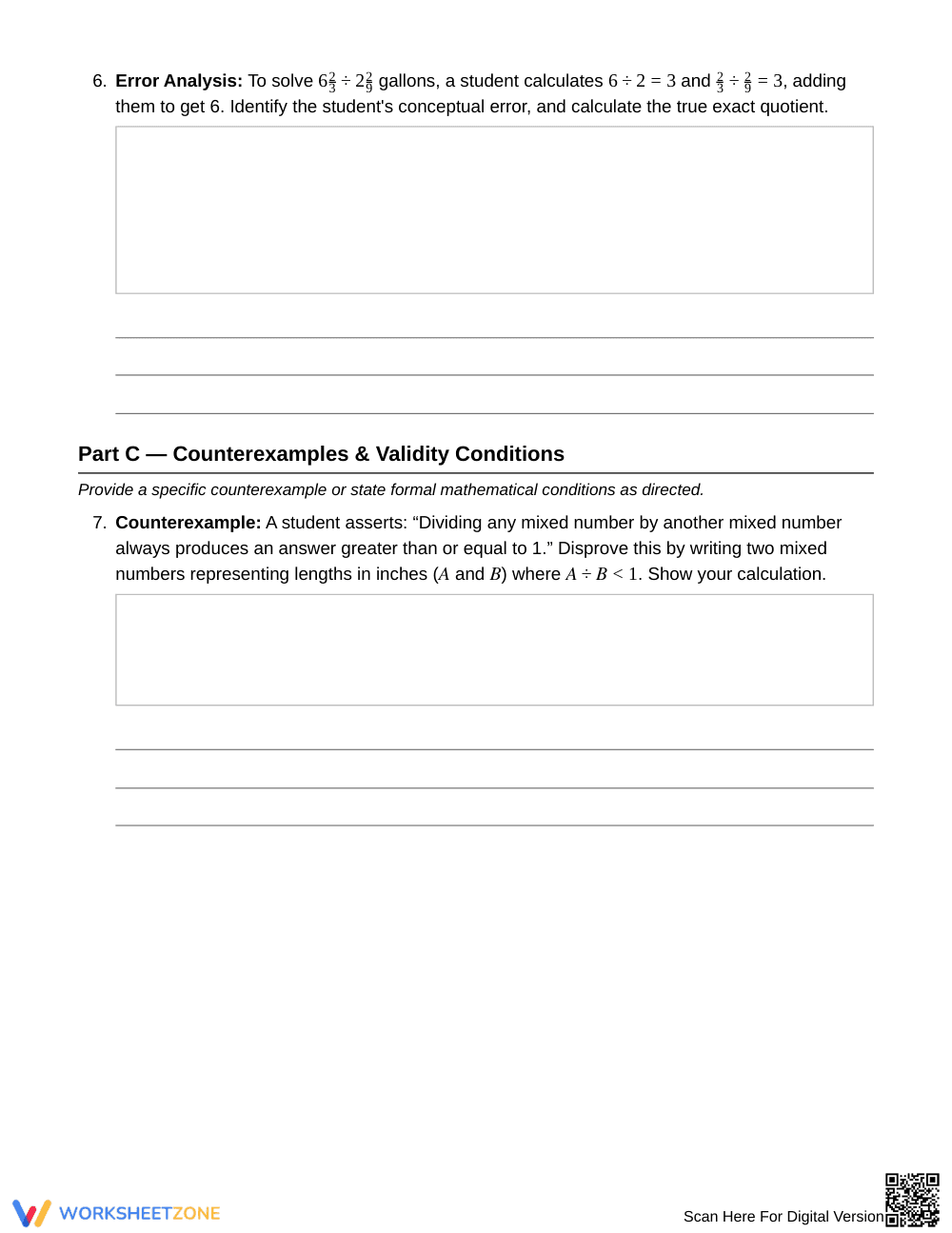
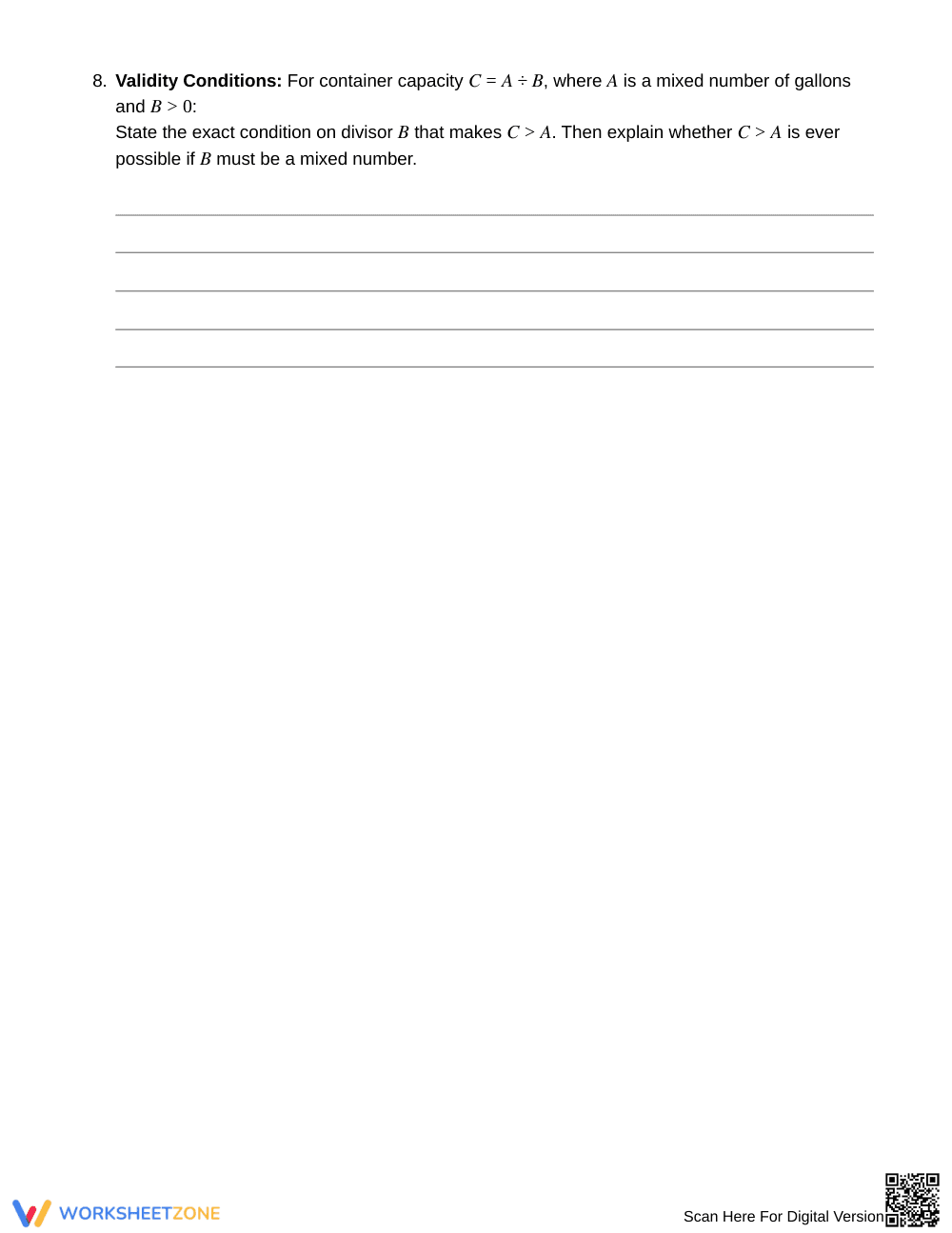
This Grade 6 worksheet develops fraction division skills by having students evaluate claims and justify quotient reasonableness when dividing mixed numbers. Learners move beyond rote calculation by applying divisor-size rules and counterexamples to build lasting conceptual understanding across authentic problem contexts.
At a Glance
- Grade: 6 · Subject: Math
- Standard:
6.NS.A.1— Interpret and compute quotients of fractions to solve contextual word problems- Skill Focus: Justify Quotient Reasonableness
- Format: 5 pages · 8 problems · Answer key · PDF
- Best For: Conceptual fraction division practice
- Time: 40–50 minutes
This 5-page worksheet includes 8 rigorous problems and a complete 3-page answer key featuring step-by-step calculations and written justification models. An introductory reference box clarifies reciprocals and quotient size rules. Activities feature claim verification, method comparisons, benchmark estimation, physical reciprocal interpretation, error analysis, and counterexample construction.
Skill Progression
- Guided practice (Part A, 2 problems): Structured real-world scenarios where students evaluate peer claims about quotients using explicit divisor rules.
- Supported practice (Part B, 4 problems): Multi-step tasks comparing algorithms, estimating with benchmarks, interpreting reciprocals, and diagnosing calculation errors.
- Independent practice (Part C, 2 problems): Unscaffolded challenges requiring students to produce counterexamples and define formal mathematical validity conditions.
This gradual-release sequence guides learners from supported claim testing to independent mathematical justification.
Standards Alignment
The primary focus aligns to `6.NS.A.1`, requiring students to interpret and compute quotients of fractions in contextual scenarios. Supporting standard `6.EE.B.6` reinforces using variables and constraints to justify numeric conditions. Both standard codes can be copied directly into lesson plans, IEP goals, or district curriculum mapping tools.
How to Use It
Use this worksheet after direct instruction on fraction division algorithms. Have students complete Part A in pairs to verbalize reasoning before solving Part B independently, reserving Part C for formative assessment. During circulation, check whether students justify answers using divisor-magnitude relationships rather than relying solely on procedural steps. Completion requires 40 to 50 minutes.
Who It's For
Designed for Grade 6 general math classrooms, this resource also supports Grade 7 intervention and advanced Grade 5 enrichment. Support emerging learners with visual fraction strips, and challenge advanced students to write formal proofs for Part C. Pair this worksheet with an introductory fraction division lesson or reciprocal anchor chart.
According to EdReports 2024, high-quality middle school mathematics instruction must balance procedural fluency with conceptual understanding and authentic application rather than teaching fraction algorithms in isolation. Standard 6.NS.A.1 specifically requires that sixth-grade students interpret fraction quotients conceptually, using sound mathematical reasoning to explain why dividing by a fraction produces a specific quotient relative to the dividend. This 5-page worksheet reinforces this instructional priority across 8 focused tasks that require learners to justify quotient reasonableness, analyze common procedural mistakes, and formulate valid counterexamples. By challenging students to examine reciprocal relationships and evaluate mathematical claims against formal divisor-magnitude principles, the tasks promote rigorous mathematical communication and critical thinking skills. Research demonstrates that integrating structured written justification prompts into fraction division tasks significantly strengthens student retention and prepares middle school learners for proportional reasoning in higher-level mathematics.


