


























Views
Downloads




Essential Professional Tone Worksheet | Grade 12 English IV
Paste this activity's link or code into your existing LMS (Google Classroom, Canvas, Teams, Schoology, Moodle, etc.).
Students can open and work on the activity right away, with no student login required.
You'll still be able to track student progress and results from your teacher account.
This comprehensive workplace writing resource trains high school seniors to refine demanding imperatives, eliminate passive-aggressive phrasing, and replace ambiguous timelines with actionable precision. Through authentic workplace scenarios, twelfth graders build professional self-regulation, ensuring their written requests preserve working relationships, respect organizational hierarchy, and communicate clear accountability across academic and career settings.
At a Glance
- Grade: 12 · Subject: English IV
- Standard:
W.11-12.5— Develop and strengthen writing by planning, revising, editing, and rewriting for specific audiences- Skill Focus: Repair Ambiguous or Demanding Language
- Format: 6 pages · 10 problems · Answer key included · PDF
- Best For: Professional correspondence and executive writing practice
- Time: 45–60 minutes
What's Inside
Spread across 6 rigorous pages, this packet includes an executive reference guide outlining principles of diplomatic phrasing, 10 authentic workplace tasks, and a detailed 5-page answer key with exemplar rewrites. Students encounter diagnostic critique prompts, isolated line-level revisions, and complete multi-paragraph scenario briefs featuring realistic logistical stakes.
Skill Progression
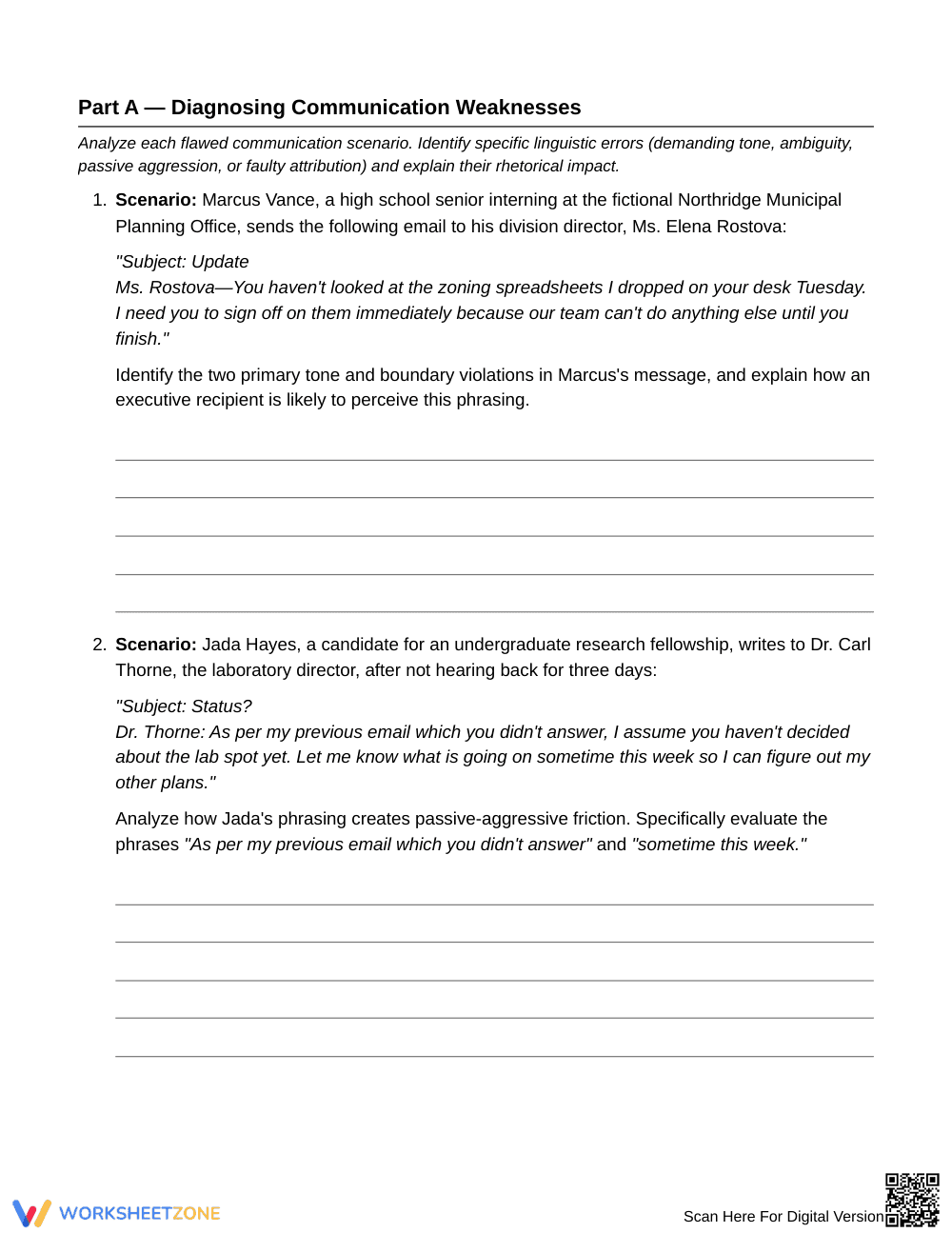
- Guided practice (Tasks 1–3): Students analyze flawed drafts from interns and student leaders, diagnosing specific rhetorical missteps including hostile imperatives, vague timelines, and passive aggression.
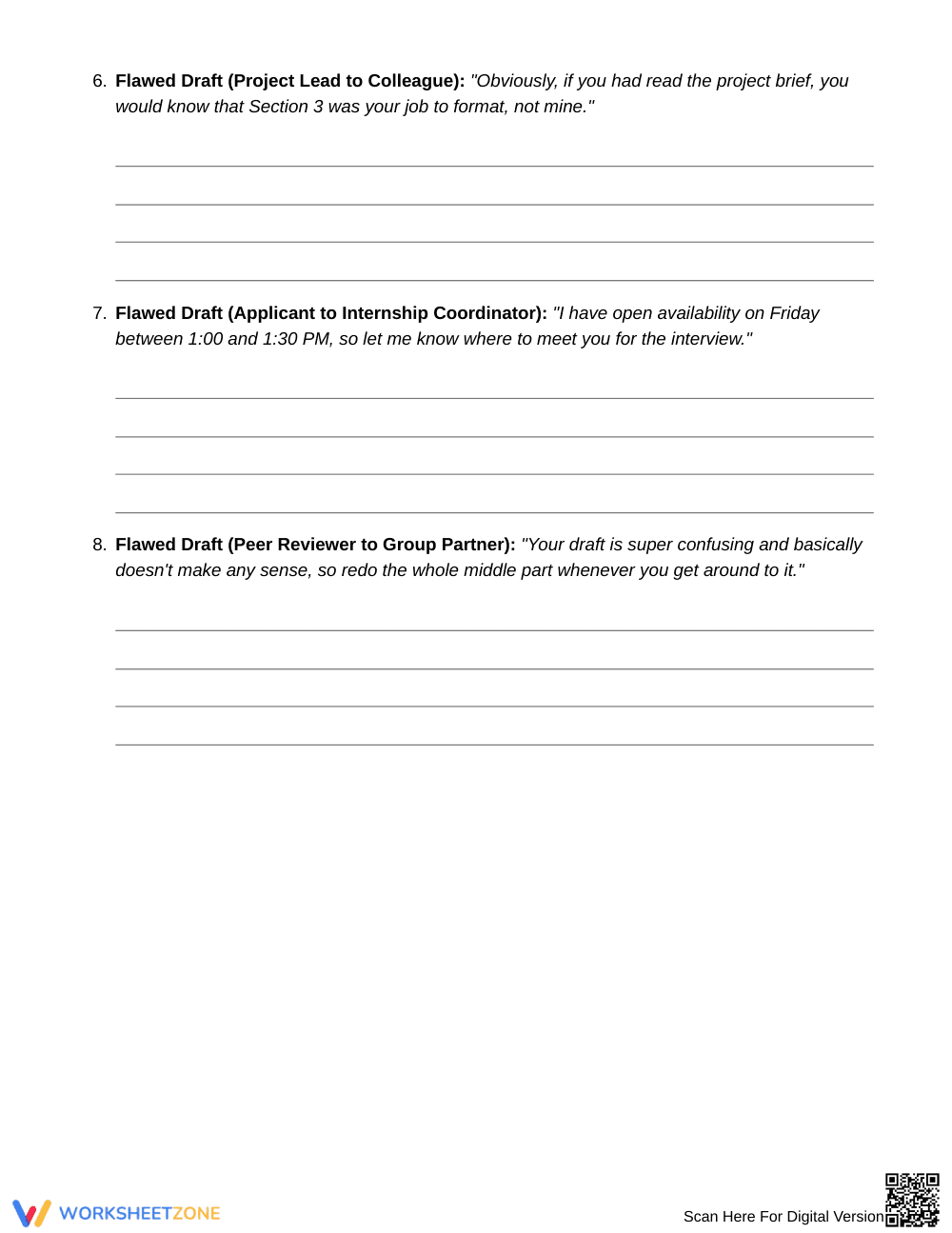
- Supported practice (Tasks 4–8): Learners rewrite 5 isolated, high-stakes sentences to eliminate entitlement and ambiguity while preserving core operational objectives.
- Independent practice (Tasks 9–10): Working from rich administrative briefs, students synthesize complex scheduling and financial constraints into fully articulated, professional email solutions.
This sequence mirrors the gradual release of responsibility model, guiding students from diagnostic evaluation to autonomous executive composition.
Standards Alignment
Primary Standard: W.11-12.5 — Develop and strengthen writing as needed by planning, revising, editing, rewriting, or trying a new approach, focusing on addressing what is most significant for a specific purpose and audience. Supporting standard L.11-12.3 reinforces adapting language choices to satisfy the expectations of professional and academic contexts. Both standard codes can be copied directly into lesson plans, IEP goals, or district curriculum mapping tools.
How to Use It
Deploy this activity during post-instruction guided application within a business communication or senior rhetoric unit. Before independent drafting, conduct a five-minute warm-up displaying Task 1 on a projector, prompting students to point out how imperative commands inadvertently undermine sender credibility. For formative assessment, inspect Task 5 during desk walkthroughs; check whether students supply concrete timeframes rather than defaulting to ambiguous descriptors like "soon." Plan for an instructional window of 45 to 60 minutes.
Who It's For
Designed for Grade 12 English IV, CTE business communication, and college-preparatory electives, this worksheet offers crucial workforce readiness training. To support developing writers, supply sentence stems that reframe demands into collaborative inquiries. Pair this worksheet directly with mentor professional correspondence or an executive etiquette anchor chart.
Mastering audience-aware revision requires explicit instruction in evaluating rhetorical impact and tone. Aligned to standard W.11-12.5, this instructional resource equips Grade 12 students to identify demanding imperatives, diagnose passive-aggressive friction, and repair ambiguous language across authentic workplace contexts. As documented by Fisher & Frey (2014), systematic gradual-release structures that bridge analytical critique and guided revision substantially accelerate writing proficiency and rhetorical decision-making in secondary learners. By working through 10 carefully sequenced problems—spanning diagnostic critique, sentence-level repairs, and multi-paragraph draft overhauls—students internalize how subtle linguistic adjustments influence executive perception. This 6-page printable sequence delivers targeted, evidence-based revision practice that reinforces workplace readiness, interpersonal diplomacy, and advanced written communication across postsecondary academic and career pathways.


