


























Views
Downloads


Essential Pitch and Loudness Worksheet | Grade 6 Science
Paste this activity's link or code into your existing LMS (Google Classroom, Canvas, Teams, Schoology, Moodle, etc.).
Students can open and work on the activity right away, with no student login required.
You'll still be able to track student progress and results from your teacher account.
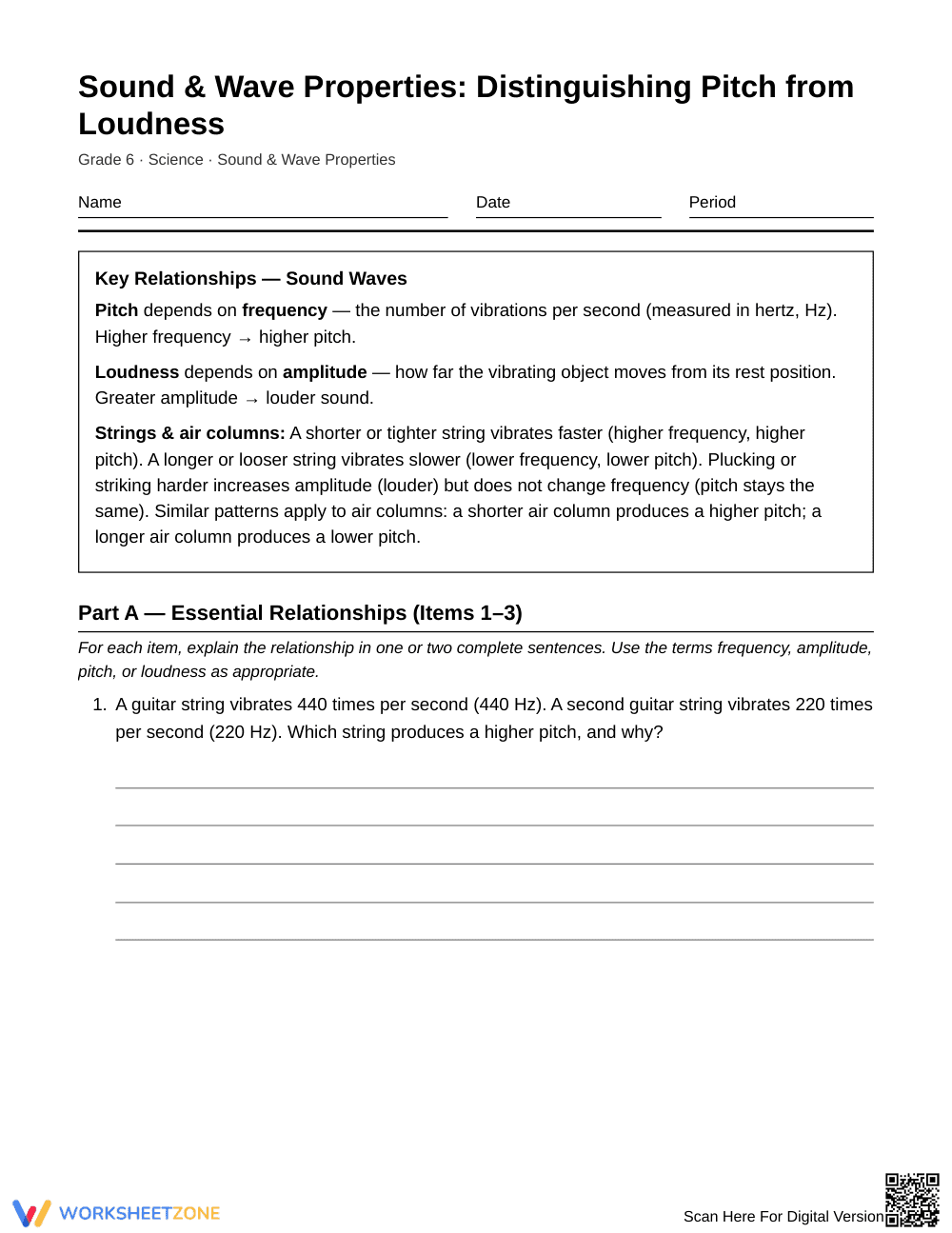
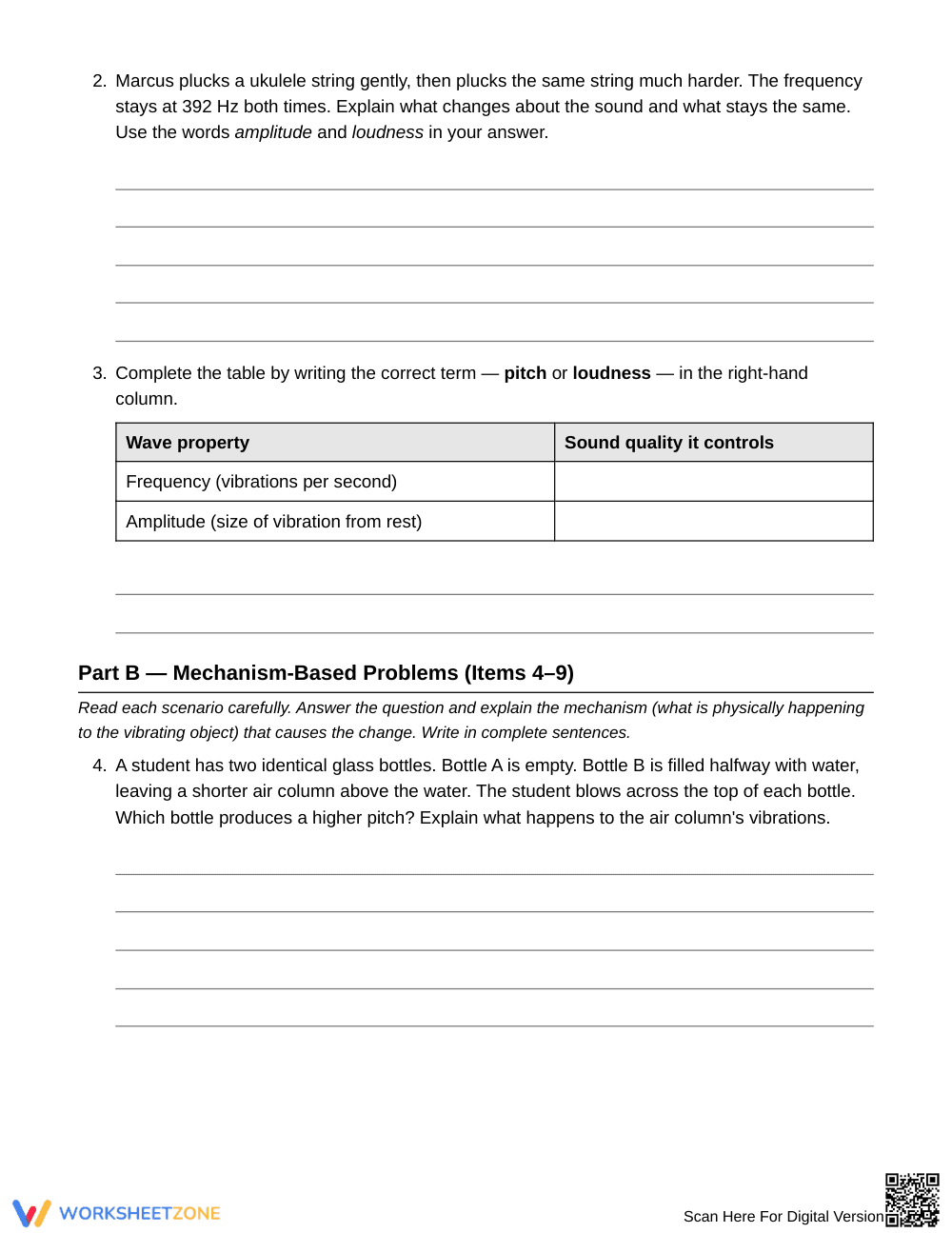
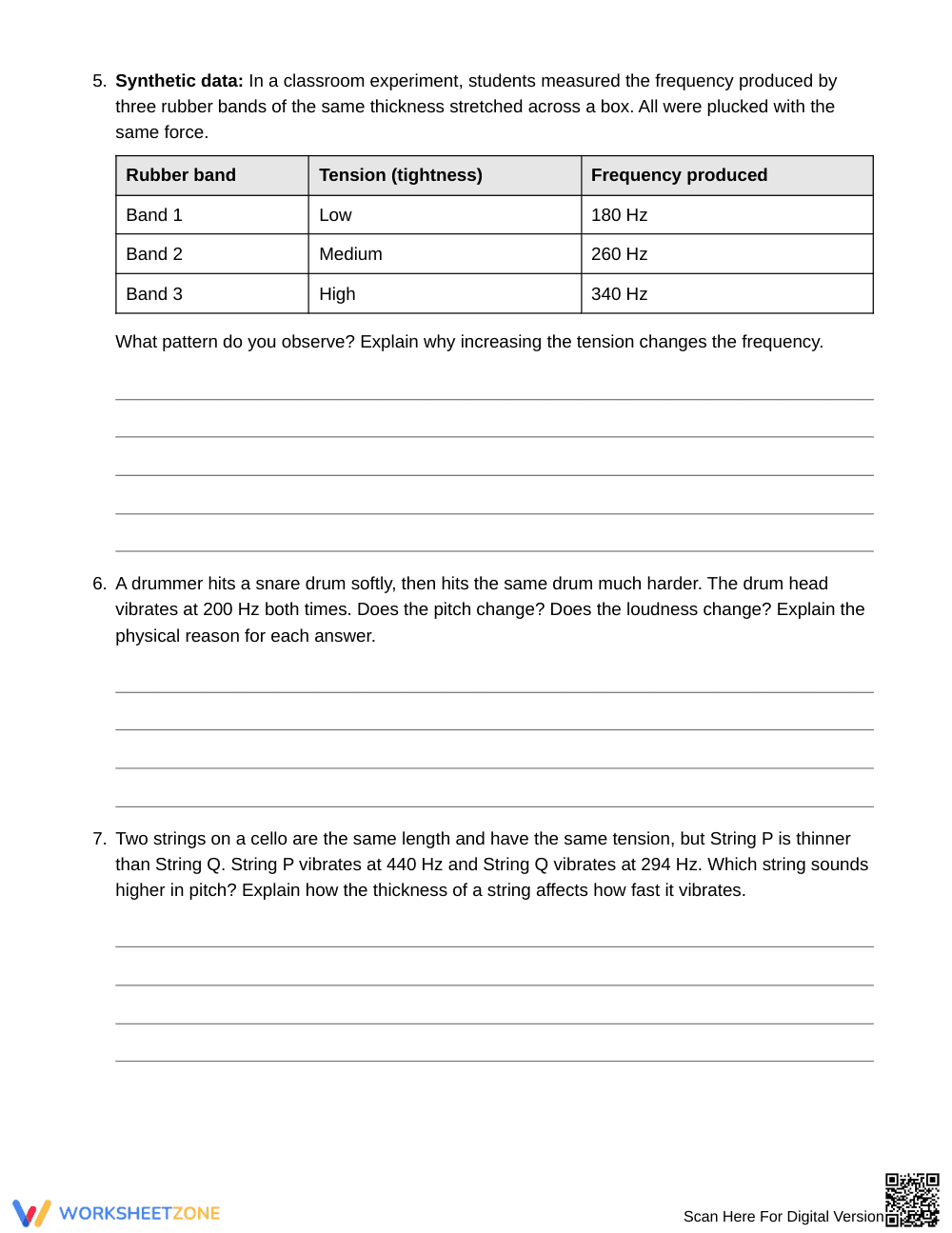
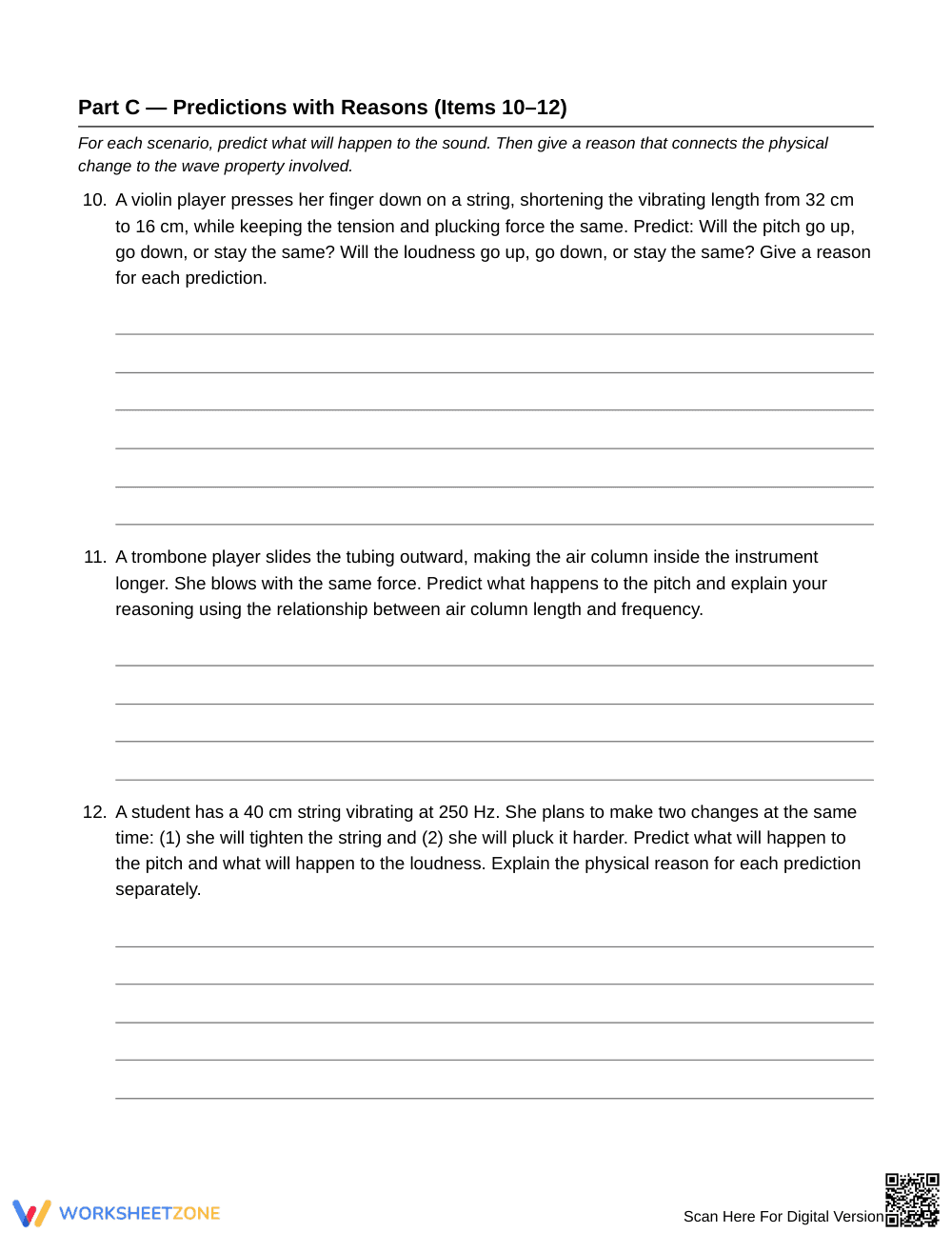
This Grade 6 science worksheet equips students to distinguish pitch from loudness by connecting them to wave frequency and amplitude. Through 12 targeted problems across 5 pages, learners analyze acoustic scenarios, interpret synthetic data tables, and justify physical predictions to master fundamental sound wave mechanics.
At a Glance
- Grade: 6 · Subject: Science
- Standard: Sound Waves — Connect wave frequency to pitch and amplitude to loudness
- Skill Focus: Distinguish Pitch from Loudness
- Format: 5 pages · 12 problems · Answer key included · PDF
- Best For: Middle school physical science wave units
- Time: 30–45 minutes
This 5-page resource provides 12 scaffolded tasks and a detailed 3-page answer key. It opens with a "Key Relationships" reference box detailing how frequency governs pitch and amplitude governs loudness. Students complete conceptual explanations, interpret dual-variable data tables, and write predictions for vibrating strings and air columns.
Skill Progression
- Guided Practice (Items 1–3): Students establish core concepts by identifying frequency values, relating amplitude to loudness, and completing a reference chart.
- Supported Practice (Items 4–9): Students analyze scenarios and experimental data to explain how string tension, air column length, and striking force alter sound.
- Independent Practice (Items 10–12): Students apply wave principles to multi-variable changes on instruments, predicting pitch and loudness outcomes.
This sequence follows a gradual-release model, moving learners from guided definitions to independent scientific explanations.
Standards Alignment
This worksheet aligns with middle school physical science standards addressing wave properties and energy transfer. Students model how sound wave frequency and amplitude dictate auditory properties. Both standard codes can be copied directly into lesson plans, IEP goals, or district curriculum mapping tools.
How to Use It
Deploy this worksheet after direct instruction on wave properties or following a hands-on tuning fork investigation. For mid-lesson practice, assign Part A in pairs before students independently analyze Part B's data tables. During work time, check Item 9 to ensure students understand that plucking force changes amplitude rather than frequency. Completion takes 30 to 45 minutes.
Who It's For
Designed for Grade 6 science classrooms, this activity supports general education students, physical science units, and targeted intervention. Scaffolded reference boxes and data tables assist English language learners. It pairs naturally with an interactive sound simulation lab.
According to Fisher & Frey (2014), structured gradual-release frameworks significantly strengthen conceptual retention in middle school science by bridging direct instruction and independent problem-solving. This Grade 6 physical science worksheet operationalizes that instructional model through 12 sequenced tasks focused on the core skill of distinguishing pitch from loudness. By isolating frequency as the determinant of pitch and amplitude as the determinant of loudness, the resource targets a frequent misconception among young learners who mistakenly conflate sound volume with frequency. Students evaluate vibrating strings, air columns, and synthetic classroom experimental data across 5 structured pages. The progression moves from foundational definitions to mechanism-based explanations and dual-variable predictions. Complete with an exhaustive 3-page answer key, this resource delivers measurable evidence of student mastery during introductory wave units, supporting rigorous formative assessment and targeted scientific discourse in diverse science classrooms.


