




























Views
Downloads




Essential Permeability Models Worksheet | Grade 7 Science

Paste this activity's link or code into your existing LMS (Google Classroom, Canvas, Teams, Schoology, Moodle, etc.).
Students can open and work on the activity right away, with no student login required.
You'll still be able to track student progress and results from your teacher account.
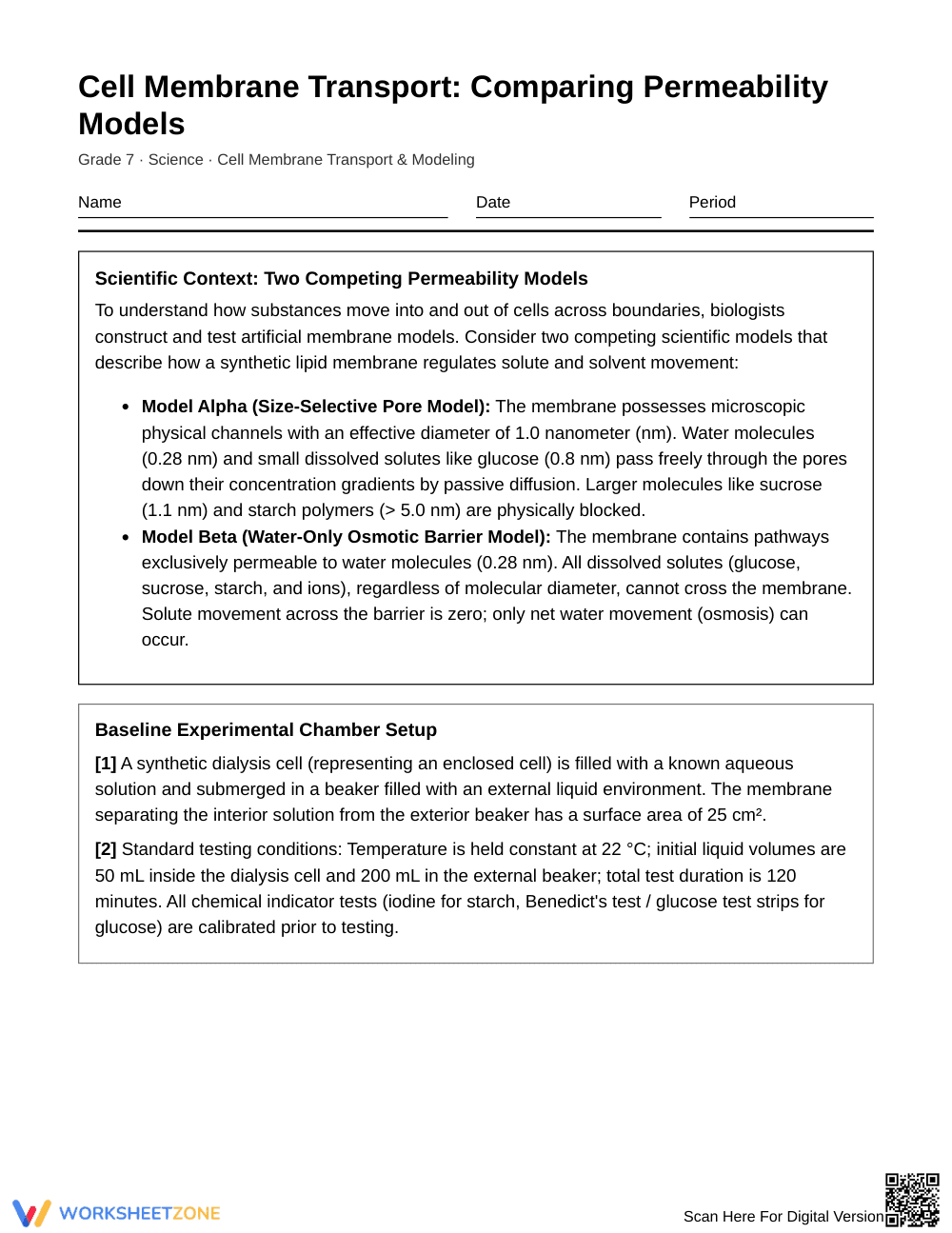
This Grade 7 science worksheet guides students in comparing scientific permeability models of cell membrane transport. Learners analyze size-selective diffusion and osmotic barriers, evaluate controlled experiments, and examine empirical evidence to explain how semipermeable membranes regulate molecular movement.
At a Glance
- Grade: 7 · Subject: Science · Course: Life Science
- Standard: Cell Systems — Develop and use models to describe cellular membrane transport and selective permeability
- Skill Focus: Compare Permeability Models
- Format: 5 pages · 10 problems · Comprehensive answer key included · Printable PDF
- Best For: Membrane transport unit practice and data analysis
- Time: 40–50 minutes of instructional time
What's Inside
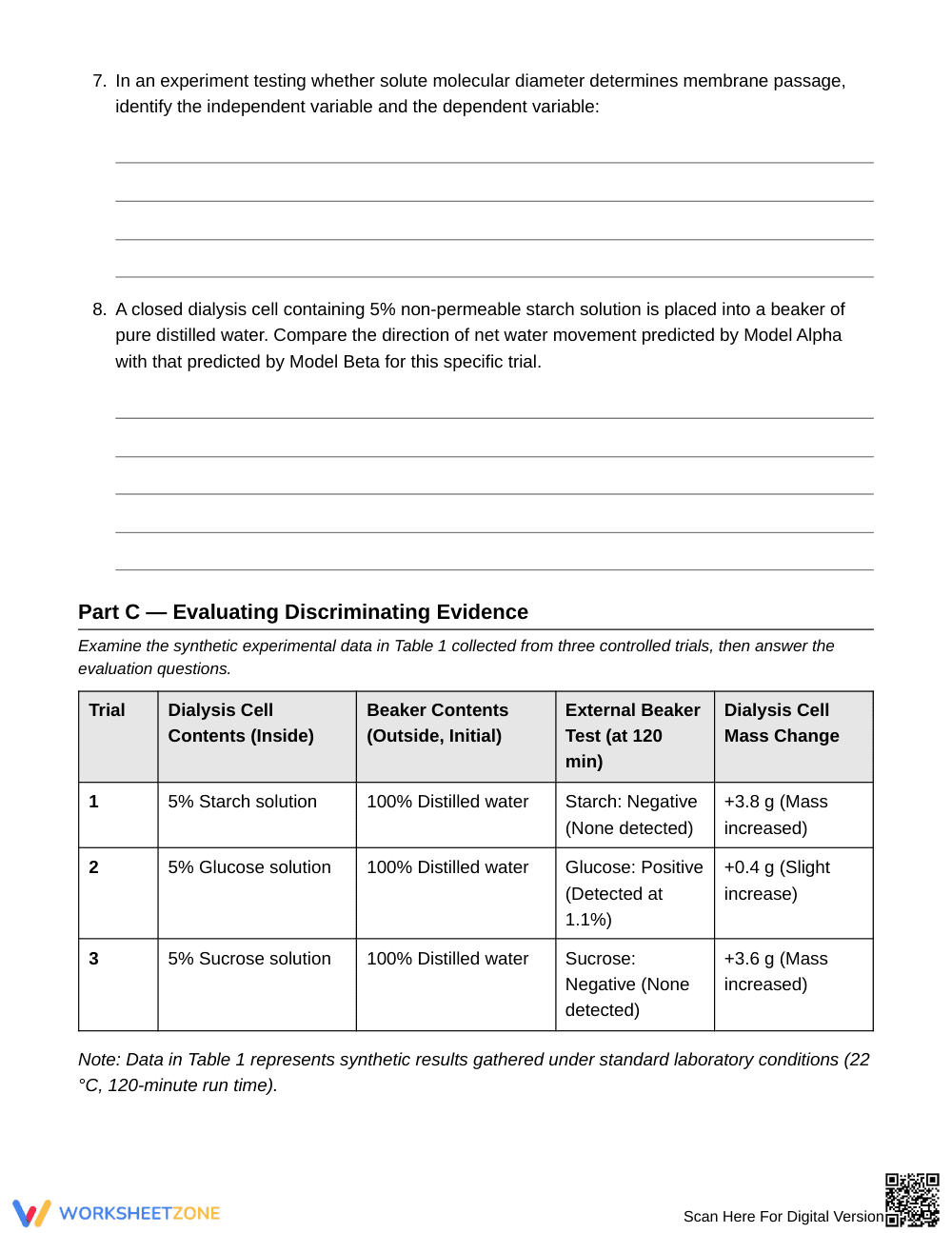
This 5-page worksheet provides 10 structured analytical tasks evaluating two competing models: Model Alpha (size-selective 1.0 nm pore) and Model Beta (water-only barrier). Students examine baseline experimental parameters, analyze variable controls, and interpret synthetic data across 3 trials in a data table. A complete 3-page teacher answer key provides model predictions, variable classifications, and evidence-based sample explanations.
Skill Progression
- Guided Practice (Part A, 2 tasks): Students apply Model Alpha and Model Beta definitions to predict diffusion and mass changes.
- Supported Practice (Part B, 6 tasks): Learners identify experimental variables, design a negative control, and compare model mechanisms across solute conditions.
- Independent Practice (Part C, 2 tasks): Working from experimental trial data, students evaluate evidence to determine supported models and refute misconceptions.
This progression follows gradual-release principles, advancing students from theoretical predictions to independent empirical evaluation.
Standards Alignment
This resource aligns with middle school life science standards for cell systems: develop and use a model to describe cell function and membrane transport. Students examine how selective permeability regulates molecular movement. Both standard codes can be copied directly into lesson plans, IEP goals, or district curriculum mapping tools.
How to Use It
Assign this worksheet after direct instruction on passive transport and osmosis. Have student pairs debate Part A predictions before reviewing empirical results in Part C. During classwork, check Part B responses to ensure learners correctly identify the negative control setup. Completion requires approximately 40 to 50 minutes.
Who It's For
Designed for Grade 7 life science students, this resource strengthens scientific modeling and data analysis. Built-in molecular size references support developing learners, while Part C provides rigorous evidence evaluation for advanced students. Pair this activity with a dialysis tubing lab or cell transport simulation.
Scientific modeling activities in middle school life science demand that learners coordinate theoretical explanations with empirical observations. In this Grade 7 worksheet, students compare permeability models by evaluating two competing hypotheses regarding cell membrane transport: a size-selective pore framework versus a water-only osmotic barrier. Grounded in the gradual-release instructional architecture articulated by Fisher & Frey (2014), the 10-task sequence moves systematically from scaffolded theoretical predictions to independent evaluation of multi-trial laboratory data. By requiring students to analyze molecular diameters, isolate controlled variables, and cite specific trial evidence to refute student misconceptions, the resource cultivates rigorous scientific reasoning. Educators can utilize the synthetic data table and accompanying 3-page answer key to evaluate student mastery of selective permeability, passive diffusion, and osmotic mass changes without requiring physical laboratory reagents, making it an efficient tool for developing robust evidentiary discourse in secondary science classrooms.


