


























Views
Downloads




Essential Part-to-Whole Ratios Worksheet | Grade 6 Math
Paste this activity's link or code into your existing LMS (Google Classroom, Canvas, Teams, Schoology, Moodle, etc.).
Students can open and work on the activity right away, with no student login required.
You'll still be able to track student progress and results from your teacher account.
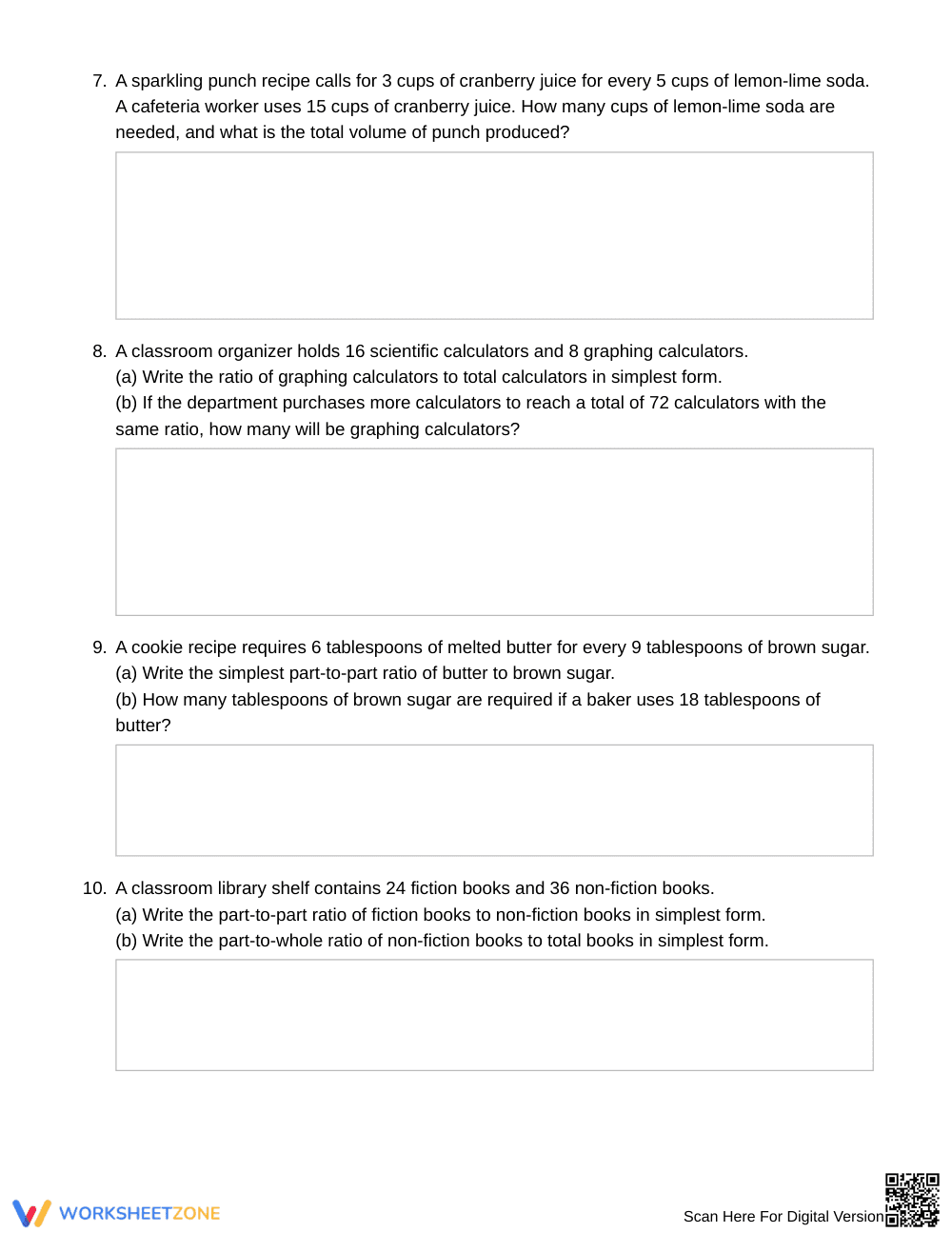
This Grade 6 math worksheet strengthens ratio reasoning by guiding learners through sixteen rigorous problems focused on part-to-part and part-to-whole relationships. Students identify ratio types, calculate equivalent proportions, evaluate realistic application scenarios, and write detailed justifications to solidify foundational proportional thinking before encountering complex unit rates and percentages.
At a Glance
- Grade: 6 · Subject: Math
- Standard:
6.RP.A.1— Understand ratio concepts and use ratio language to describe relationships between quantities- Skill Focus: Part-to-Part and Part-to-Whole Ratios
- Format: 5 pages · 16 problems · Answer key included · PDF
- Best For: Small group instruction and independent skill practice
- Time: 40–50 minutes
What's Inside: The resource opens with a foundational concept review defining notation, part-to-part comparisons, and whole-collection relationships. Students complete four multiple-choice distinction problems, eight multi-step computational word problems requiring simplest form reductions and scaling, and four written explanation tasks, backed by a comprehensive four-page step-by-step answer key.
Skill Progression
- Guided practice (Tasks 1–4): Multiple-choice questions scaffold basic identification, requiring students to categorize given scenarios as part-to-part or part-to-whole models using concrete contexts like trail mix and classroom supplies.
- Supported practice (Tasks 5–12): Multi-part computational items prompt learners to write simplified ratios, scale quantities up to 72 units, and verify equivalence across two separate mixture batches.
- Independent practice (Tasks 13–16): Open-response transfer prompts challenge students to diagnose error analysis items, justify invariance during scaling, and articulate why whole quantities alone cannot determine specific internal parts.
This structure follows an intentional I Do, We Do, You Do gradual-release architecture that systematically transfers cognitive ownership to the student.
Standards Alignment
This activity aligns directly to `6.RP.A.1`: Understand the concept of a ratio and use ratio language to describe a ratio relationship between two quantities. It also reinforces foundational work under `6.RP.A.3` by preparing students to generate equivalent ratio tables and solve real-world proportion problems. Both standard codes can be copied directly into lesson plans, IEP goals, or district curriculum mapping tools.
How to Use It
Deploy this worksheet during the core practice phase immediately after direct instruction on ratio notation. During seatwork, conduct a quick formative check on Task 13 to ensure students recognize that a part cannot serve as the denominator in a part-to-whole fraction. Expected student completion time is 40 to 50 minutes.
Who It's For
Designed for Grade 6 general education math classrooms, this resource supports tier-2 intervention groups and middle school resource rooms targeting proportional reasoning gaps. Pair this printable with visual tape diagrams or double number line anchor charts to support visual learners.
According to Fisher & Frey (2014), purposeful gradual-release designs maximize retention by transitioning students from structured recognition tasks to independent written justification. When tackling standard 6.RP.A.1, middle school learners frequently conflate subgroup comparisons with total-set quantities. This 5-page worksheet directly targets this misconception across 16 focused problems that systematically separate part-to-part distinctions from part-to-whole relationships. By incorporating precise mathematical vocabulary, structured word problems, and written error analysis prompts, the activity ensures students build robust conceptual frameworks rather than relying on rote algorithmic memory. Teachers can leverage the included four-page answer key to evaluate student explanations, pinpoint persistent computational errors, and verify conceptual mastery during tier-1 core instruction or targeted intervention blocks.


