




























Views
Downloads



Essential Outdoor Wellness Word Search | Grades 4–5 Science

Paste this activity's link or code into your existing LMS (Google Classroom, Canvas, Teams, Schoology, Moodle, etc.).
Students can open and work on the activity right away, with no student login required.
You'll still be able to track student progress and results from your teacher account.
This outdoor recreation and well-being word search engages students in Grades 4–5 with healthy living concepts. By reading descriptive clues and locating key wellness vocabulary, learners connect physical movement, safety, and mindfulness to daily health habits. The activity reinforces foundational science concepts through purposeful, clue-based vocabulary practice.
At a Glance
- Grade: Grades 4–5 · Subject: Elementary Science (Healthy Habits Unit)
- Standard: Not standards-assessed — targeted vocabulary enrichment supporting physical and mental wellness
- Skill Focus: Outdoor recreation, healthy living, and personal well-being
- Format: 3 pages · 14 words · Full answer key included · Printable PDF
- Best For: Science vocabulary review, healthy living warm-ups, and independent fast finishers
- Time: 15–25 minutes
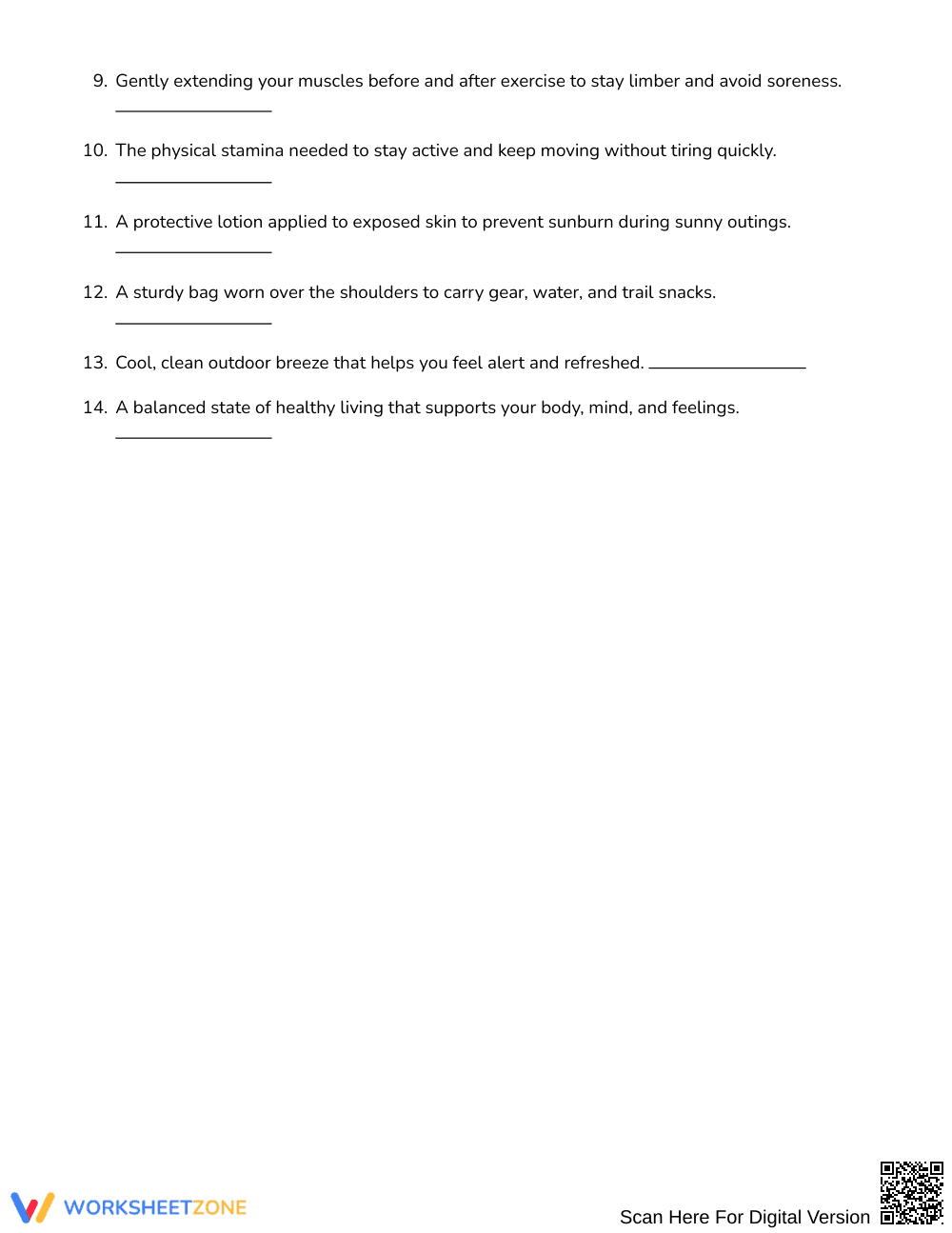
What's Inside: This 3-page printable science resource features a clue-detective word search puzzle paired with complete solution keys. Students read 14 contextual clues covering outdoor recreation terms, including hydration, mindfulness, and endurance, before finding each term. The resource contains a full 3-page answer key showing exact letter coordinates and word paths to make checking student work effortless.
Puzzle Mechanics
Students solve the activity through a structured clue-solving process:
- Clue Identification: Learners read 14 descriptive definitions that define key healthy habits concepts such as stretching, backpacking, and trail navigation.
- Word Search Grid: Hidden vocabulary terms are placed within a 16 x 16 letter grid alongside a shuffled word bank.
- Word Placement Directions: Target terms run in four distinct directions across the grid: northeast (NE), east (E), southeast (SE), and south (S).
Standards Alignment
This resource serves as supplemental vocabulary enrichment and is not aligned to a specific state or national standard. It is designed to reinforce essential health literacy, recreation terminology, and active lifestyle concepts across general elementary science and wellness curricula.
How to Use It
This word search fits naturally as an introductory hook before direct instruction on physical health, prompting students to activate background knowledge about outdoor activities. Alternatively, assign it after direct instruction during independent practice or as an engaging station activity. During work time, observe whether students deduce terms directly from the clues before referencing the word bank, noting which health concepts require clarification. Most learners complete the puzzle in 15 to 25 minutes.
Who It's For
This activity is designed for Grades 4–5 students studying health and wellness in science class. For students needing support, encourage highlighting keywords in each clue before scanning the grid. Advanced learners can write original sentences connecting two or more discovered terms. Pair this activity with an informational reading passage on sun safety or an anchor chart detailing the components of physical fitness.
Vocabulary acquisition in elementary science relies on contextual exposure and active retrieval, enabling students in Grades 4–5 to master specialized health concepts related to outdoor recreation and well-being. According to Fisher & Frey (2014), structured word exploration that links conceptual definitions directly to orthographic search routines deepens semantic processing and strengthens long-term lexical retention. By analyzing 14 descriptive clues—spanning hydration, endurance, and mindfulness—before locating hidden terms across a 16 by 16 grid, learners move beyond rote memorization into active schema building. This dual-demand structure reinforces cross-disciplinary wellness knowledge while developing pattern recognition and visual scanning strategies. Although designed as non-standardized vocabulary enrichment, clue-based word activities provide teachers with immediate diagnostic insight into student comprehension of wellness terminology. Systematic integration of contextual health vocabulary prepares intermediate elementary learners for advanced scientific literacy and personal health decision-making.


