




























Views
Downloads



Essential Osmosis Transport Worksheet | Grade 7 Science

Paste this activity's link or code into your existing LMS (Google Classroom, Canvas, Teams, Schoology, Moodle, etc.).
Students can open and work on the activity right away, with no student login required.
You'll still be able to track student progress and results from your teacher account.
This Grade 7 science worksheet helps students explain and predict osmosis across selectively permeable membranes. Across 12 structured problems, learners analyze solute gradients, evaluate cell volume changes in varied tonicities, and apply transport mechanisms to biological models with clear scientific reasoning.
At a Glance
- Grade: 7 · Subject: Science
- Standard: Explain how water moves across selectively permeable membranes based on solute concentration gradients
- Skill Focus: Explain Osmosis Across a Selective Barrier
- Format: 5 pages · 12 problems · Answer key included · PDF
- Best For: Mid-unit practice and formative assessment
- Time: 40–50 minutes
The 5-page printable resource features a concise reference box defining selective permeability and tonicity. Students complete 12 multi-part items ranging from conceptual checks and U-tube models to synthetic cell data tables and plant cell comparisons. A full 2-page answer key provides complete model explanations.
Skill Progression
- Guided practice (Part A, 3 items): Builds foundational understanding of free water concentration, solute ratios, and gradient steepness.
- Supported practice (Part B, 6 items): Analyzes dialysis tubing, U-tube apparatuses, synthetic cell mass tables, and differential membrane permeability.
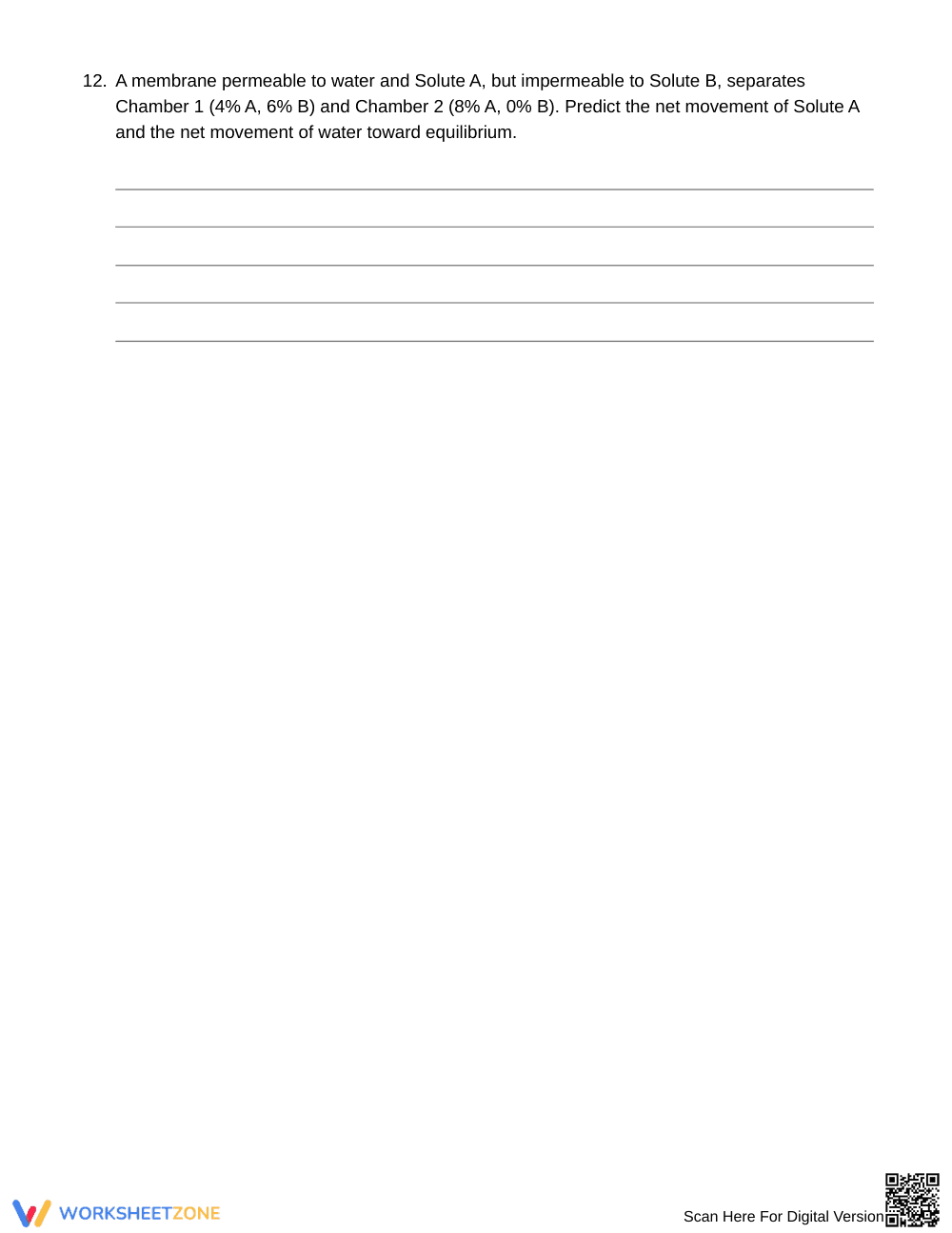
- Independent practice (Part C, 3 items): Applies transport principles to clinical IV solutions, plant tissue turgor pressure, and multi-solute chambers.
This sequence follows a gradual release framework, moving learners from core definitions to autonomous scientific predictions.
Standards Alignment
This worksheet aligns with middle school life science standards on cellular transport and homeostasis. Students demonstrate how passive transport moves matter into and out of cells across semipermeable boundaries. Standard alignments can be copied directly into lesson plans, IEP goals, or district curriculum mapping tools.
How to Use It
Use this worksheet after direct instruction on cell membranes for structured practice. During the activity, check student responses on Part B's plant versus animal cell item to formatively evaluate comprehension of cell wall resistance to turgor pressure. Expected completion time is 40 to 50 minutes.
Who It's For
This resource supports Grade 7 life science students learning cellular physiology. The structured layout aids on-grade learners while providing data scaffolding for students needing visual reinforcement. It pairs naturally with a dialysis tubing wet lab or interactive transport anchor chart.
According to Fisher & Frey (2014), structured instructional materials that scaffold mechanistic scientific reasoning significantly strengthen student conceptual retention in middle school life science. This Grade 7 science worksheet directly targets student ability to explain osmosis across a selectively permeable barrier by systematically decomposing concentration gradients, membrane permeability, and net water transport across 12 analytical tasks. By bridging qualitative vocabulary with quantitative mass-change data and clinical scenarios, the resource helps middle school learners connect cellular transport principles to visible physiological changes in animal and plant cells. Research in secondary science pedagogy demonstrates that deliberate progression from single-variable models to complex multi-solute predictions prevents common misconceptions regarding solvent movement. Educators can use this 5-page curriculum-aligned resource with confidence to support cellular biology mastery and ensure robust evidence of student comprehension during membrane transport units.


