


























Views
Downloads



Essential Opposing Motifs Worksheet | Grade 10 English II
Paste this activity's link or code into your existing LMS (Google Classroom, Canvas, Teams, Schoology, Moodle, etc.).
Students can open and work on the activity right away, with no student login required.
You'll still be able to track student progress and results from your teacher account.
This Grade 10 English II worksheet trains high school readers to evaluate opposing motif interpretations and situational irony across paired narrative perspectives. Students examine how contrasting viewpoints transform a single recurring symbol, empowering them to construct evidence-based thematic arguments from complex literary texts.
At a Glance
- Grade: 10 · Subject: English II
- Standard:
RL.9-10.2— Analyze theme development and recurring motifs across texts- Skill Focus: Compare Opposing Motif Interpretations
- Format: 6 pages · 10 problems · Answer key included · PDF
- Best For: Paired-text literary analysis
- Time: 45–60 minutes
What's Inside
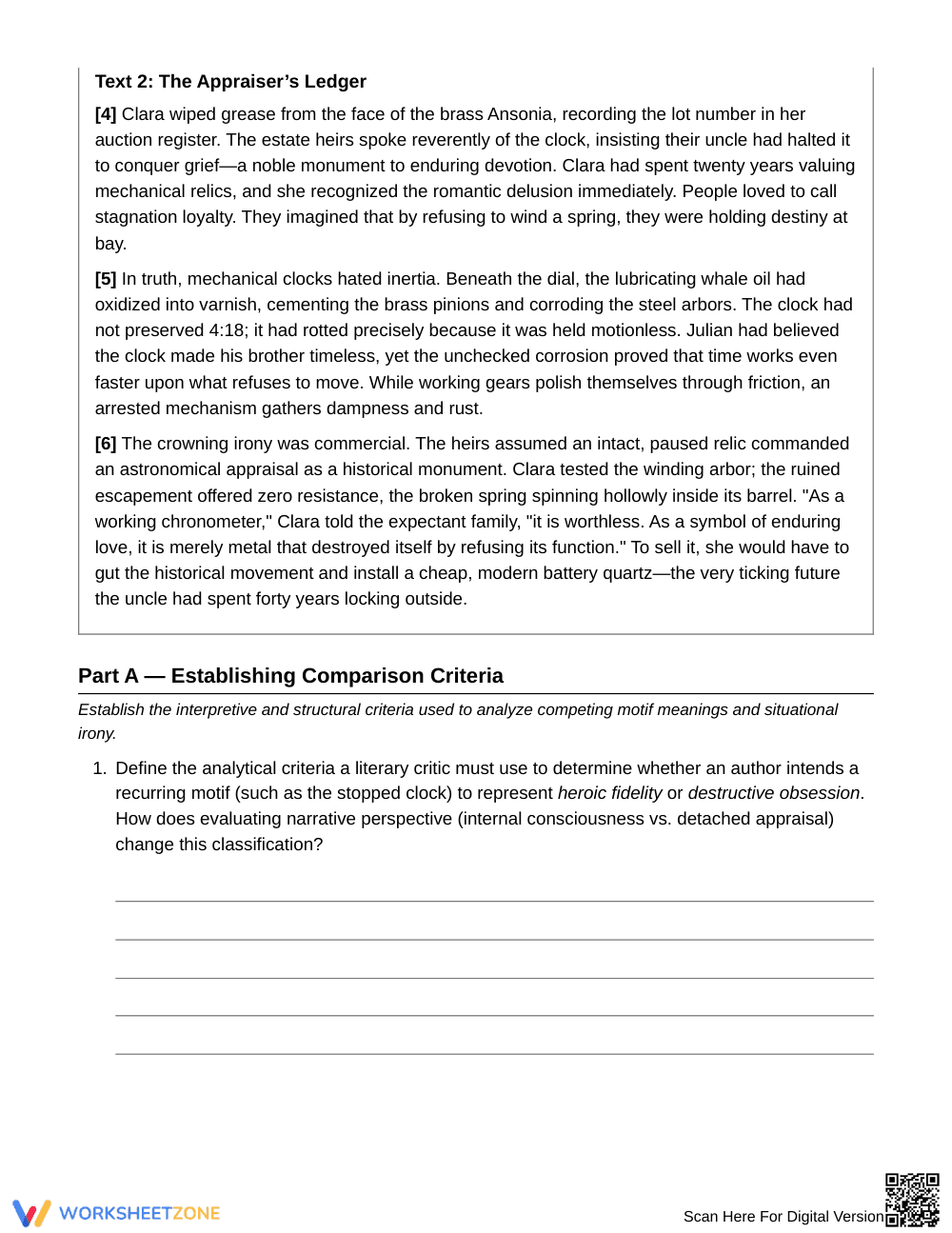
This 6-page printable resource features two original paired literary texts exploring a stopped antique clock, accompanied by 10 rigorous multi-part analytical questions. It includes a foundational concept reminder framing motifs and situational irony, followed by a complete 4-page answer key containing exemplar evidence and analytical criteria.
Skill Progression
- Guided Practice (Part A — Tasks 1–2): Students establish criteria to evaluate whether a motif represents fidelity or destructive obsession.
- Supported Practice (Part B — Tasks 3–8): Students complete 6 text-dependent prompts contrasting subjective emotional projection against objective appraisal and physical decay.
- Independent Practice (Part C — Tasks 9–10): Learners independently synthesize both passages to articulate comprehensive central themes.
This sequence follows a gradual-release model, moving from analytical criteria definition to autonomous paired-text synthesis.
Standards Alignment
This activity aligns with primary standard `RL.9-10.2`: "Determine a theme or central idea of a text and analyze in detail its development over the course of the text." It also supports `RL.9-10.1` through rigorous text-based evidence requirements. Both standard codes can be copied directly into lesson plans, IEP goals, or district curriculum mapping tools.
How to Use It
Implement this worksheet after direct instruction on literary irony and narrative perspective. Assign Part A and Part B during paired reading, using Part C as an exit ticket. Formatively monitor whether students recognize how mechanical decay refutes Julian's belief in temporal preservation. The full 10-task set takes approximately 45 to 60 minutes to complete.
Who It's For
This lesson serves Grade 10 English Language Arts students mastering comparative literary analysis, including honors cohorts. For students needing support, provide highlighters to track parallel figurative language across both excerpts. Pair this worksheet directly with an anchor chart on situational irony and motif tracking.
Comparative motif analysis directly targets the interpretive demands outlined in `RL.9-10.2`, requiring students to evaluate how authors deploy recurring symbols across varied narrative viewpoints to develop multi-layered themes. According to research by Fisher & Frey (2014) on close reading and text-dependent questioning, structured analysis of paired literary passages fosters metacognitive awareness and deepens text comprehension by requiring learners to reconcile contradictory narrative claims using verifiable textual evidence. When high school readers evaluate how differing character perspectives alter the symbolic trajectory of a central object, they transition from passive plot recall to sophisticated thematic synthesis. This rigorous 10-task worksheet equips Grade 10 students with the analytical criteria and comparative frameworks necessary to identify situational irony, assess competing motif functions, and articulate defensible thematic conclusions across rigorous high school literature curricula.


