




























Views
Downloads




Essential Net Particle Movement Worksheet | Grade 7 Science

Paste this activity's link or code into your existing LMS (Google Classroom, Canvas, Teams, Schoology, Moodle, etc.).
Students can open and work on the activity right away, with no student login required.
You'll still be able to track student progress and results from your teacher account.
Mastering membrane transport requires students to evaluate concentration gradients alongside selective permeability. This 5-page worksheet provides 10 scaffolded tasks that guide Grade 7 science students to predict net particle movement, analyze dynamic equilibrium, and differentiate between solute diffusion and osmosis in realistic biological models.
At a Glance
- Grade: 7 · Subject: Science
- Standard: Middle School Life Science — Predict net solute and solvent movement across selectively permeable cell boundaries
- Skill Focus: Predict Net Particle Movement
- Format: 5 pages · 10 problems · Answer key included · PDF
- Best For: Mid-unit diffusion and osmosis practice
- Time: 40–50 minutes
What's Inside
This resource features a core principle reference box, two worked practice models, and three distinct problem sets totaling 10 items. Students analyze tabular concentration data, calculate pressure-driven gas exchange, evaluate dialysis bag systems, and critique scientific claims. A complete 2-page answer key provides step-by-step explanations and student response criteria.
Skill Progression
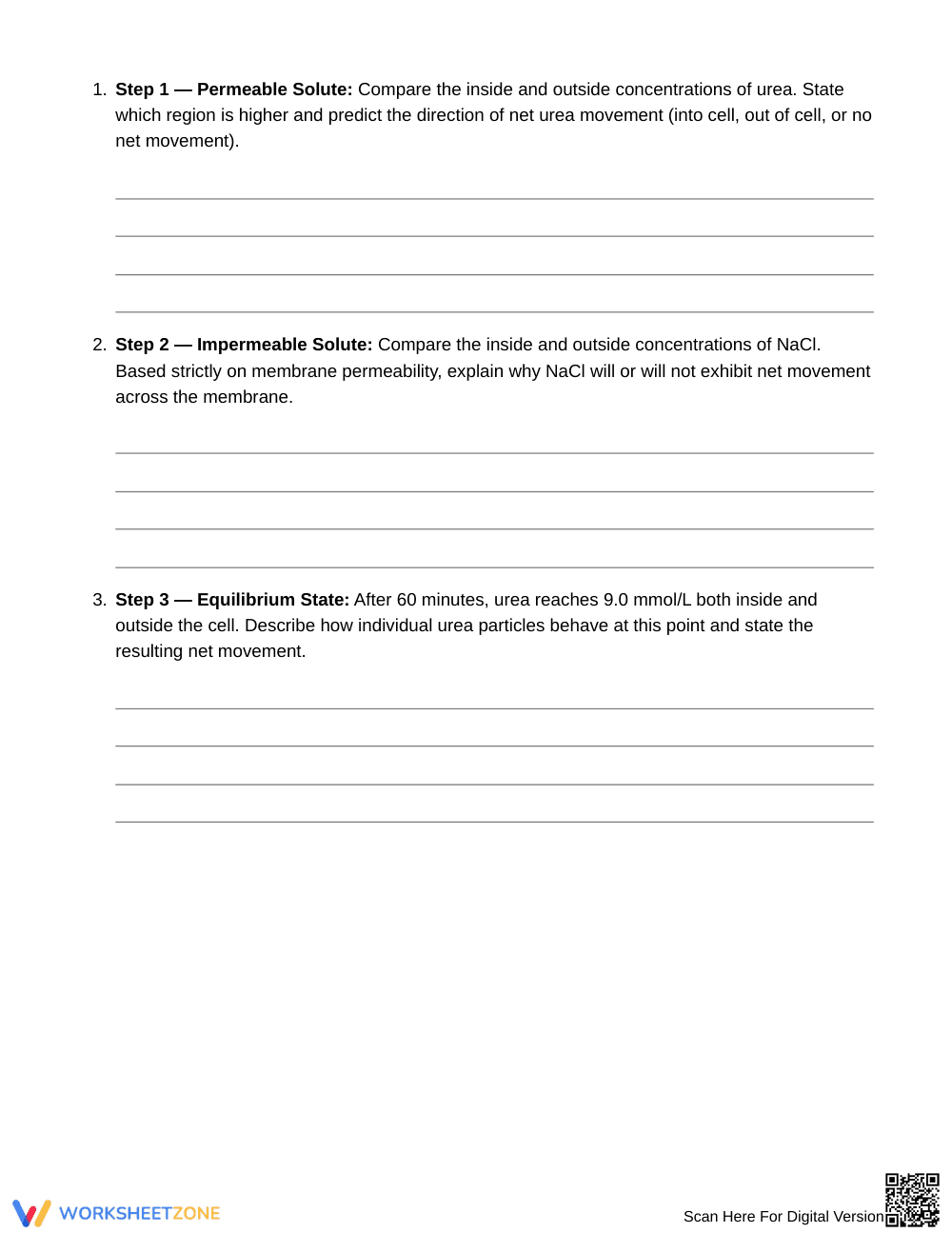
- Guided practice (Part A, Items 1–3): Students use step-by-step prompts and tabular data to evaluate concentration gradients, check membrane permeability, and determine dynamic equilibrium states.
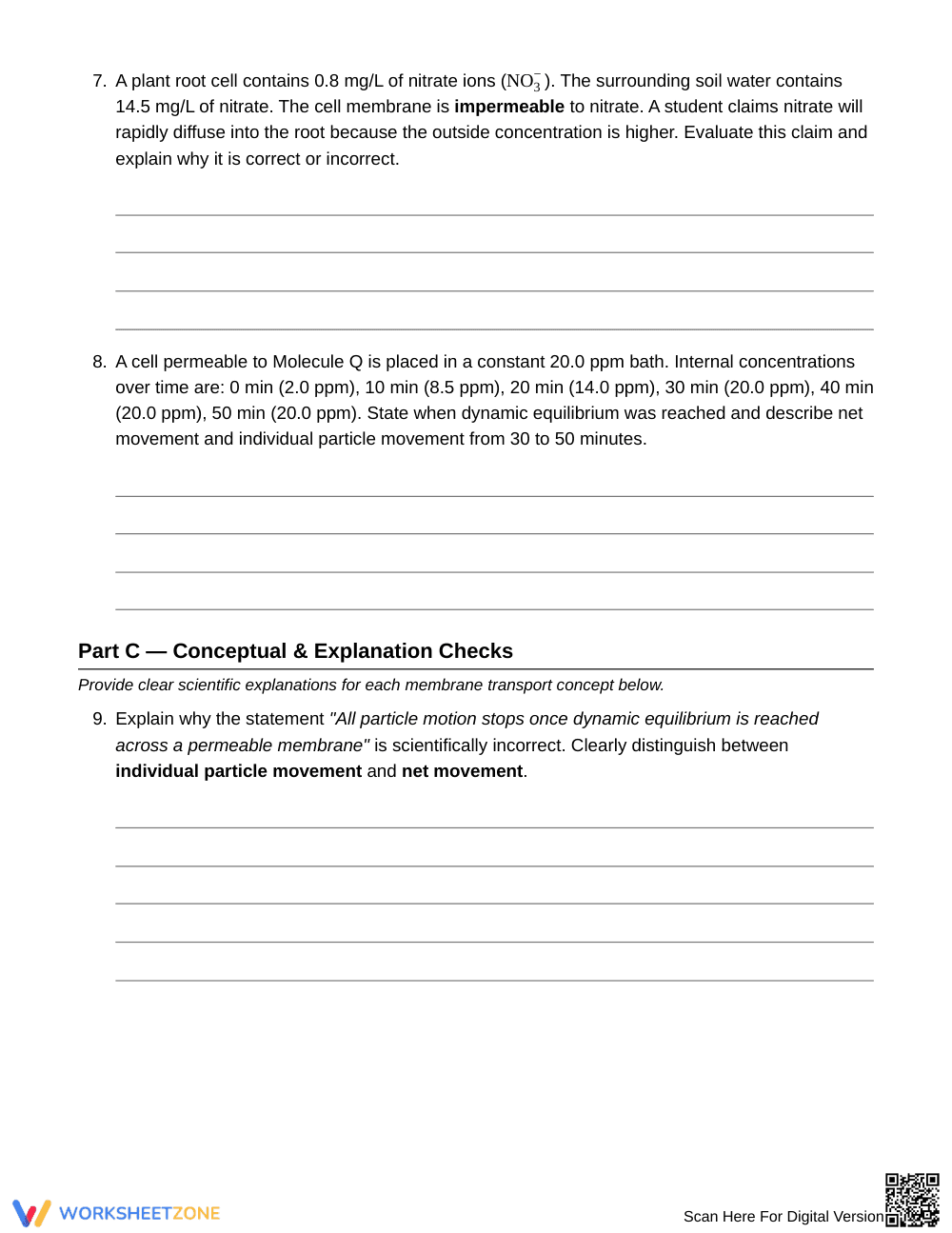
- Supported practice (Part B, Items 4–8): Learners apply transport principles across five realistic laboratory and physiological scenarios, including dialysis tubing, synthetic lung models, and plant root systems.
- Independent practice (Part C, Items 9–10): Students write extended conceptual explanations that contrast dynamic equilibrium with cessation of movement and analyze how cells balance concentration disparities.
This structured progression reflects the gradual release of responsibility model, shifting students smoothly from structured analytical steps to open conceptual mastery.
Standards Alignment
This resource aligns with middle school life science standards requiring students to develop and use models to describe the function of a cell as a whole and the role of cell membranes in selective transport. The targeted learning objectives can be copied directly into lesson plans, IEP goals, or district curriculum mapping tools.
How to Use It
Deploy this worksheet directly after introducing diffusion, osmosis, and selectively permeable membranes. During class, monitor student work on Part A to verify they check permeability before predicting movement direction; students frequently assume solutes diffuse regardless of membrane barriers. Completion typically takes 40 to 50 minutes during independent seatwork, partner stations, or small-group remediation.
Who It's For
Designed for Grade 7 general science or introductory life science classrooms, this resource supports diverse learners through structured data tables, bolded permeability labels, and worked models. Pair this activity with an interactive iodine-and-dialysis-tubing lab demonstration to connect molecular concepts to observable physical evidence.
Understanding cellular transport requires learners to coordinate multiple variables simultaneously, including relative concentration, membrane permeability, and dynamic equilibrium. According to Fisher & Frey (2014), academic achievement increases when complex analytical tasks are structured around purposeful gradual release frameworks that bridge modeled demonstrations to autonomous conceptual application. This 10-task worksheet enacts that empirical recommendation by guiding Grade 7 science students through explicit data analysis in initial problems before presenting multi-solute laboratory systems and open-ended explanatory prompts. By isolating the critical distinction between individual particle movement and net equilibrium, the activity prevents widespread scientific misconceptions regarding molecular kinetic behavior. Science educators can utilize this resource to evaluate student capacity to predict net particle movement across selectively permeable biological boundaries, providing dependable formative data that documents individual progression toward comprehensive mastery of cellular structure, membrane function, and homeostatic regulation.


