




























Views
Downloads



Essential Narrative Pacing Worksheet | Grade 6 ELA

Paste this activity's link or code into your existing LMS (Google Classroom, Canvas, Teams, Schoology, Moodle, etc.).
Students can open and work on the activity right away, with no student login required.
You'll still be able to track student progress and results from your teacher account.
Mastering narrative pacing empowers middle school writers to control dramatic tension. This five-page narrative writing worksheet guides Grade 6 students through diagnosing rushed drafts, expanding climactic scenes with sensory micro-actions, and compressing routine events across eight analytical and applied tasks.
At a Glance
- Grade: 6 · Subject: ELA
- Standard:
W.6.3.b— Use narrative techniques like pacing and description to develop experiences- Skill Focus: Narrative Pacing and Scene Expansion
- Format: 5 pages · 8 problems · Answer key included · PDF
- Best For: Narrative revision and pacing craft
- Time: 40–50 minutes
What's Inside
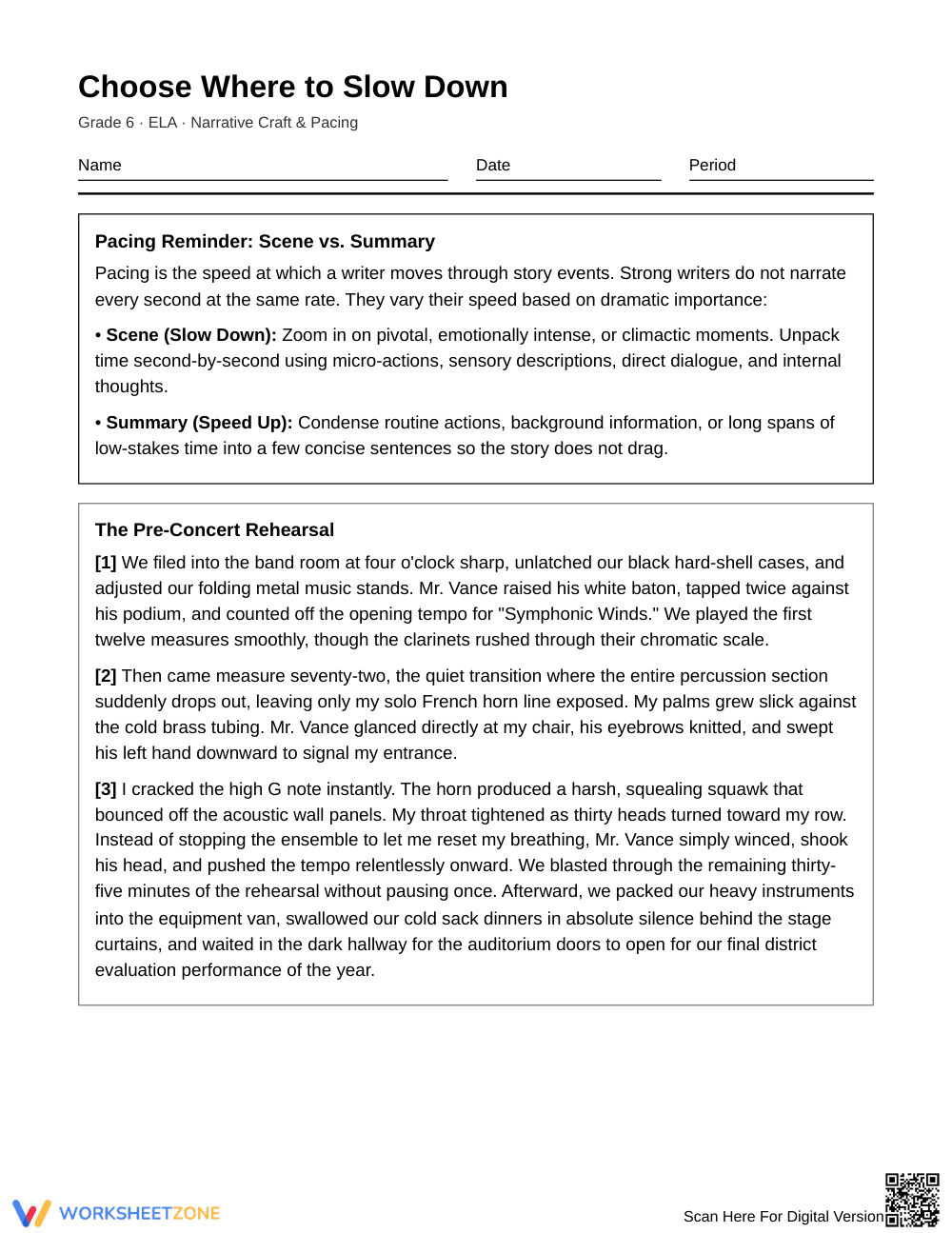
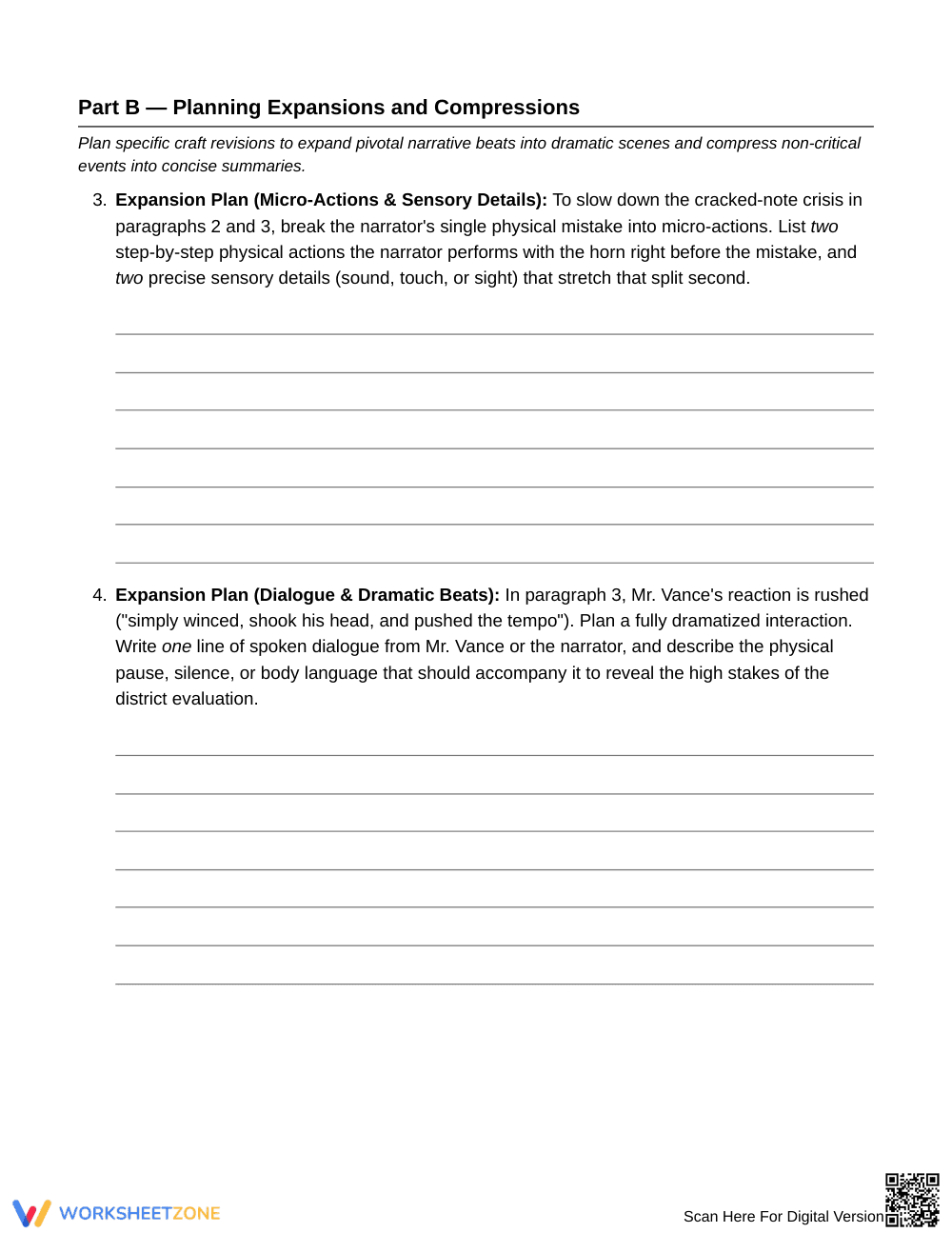
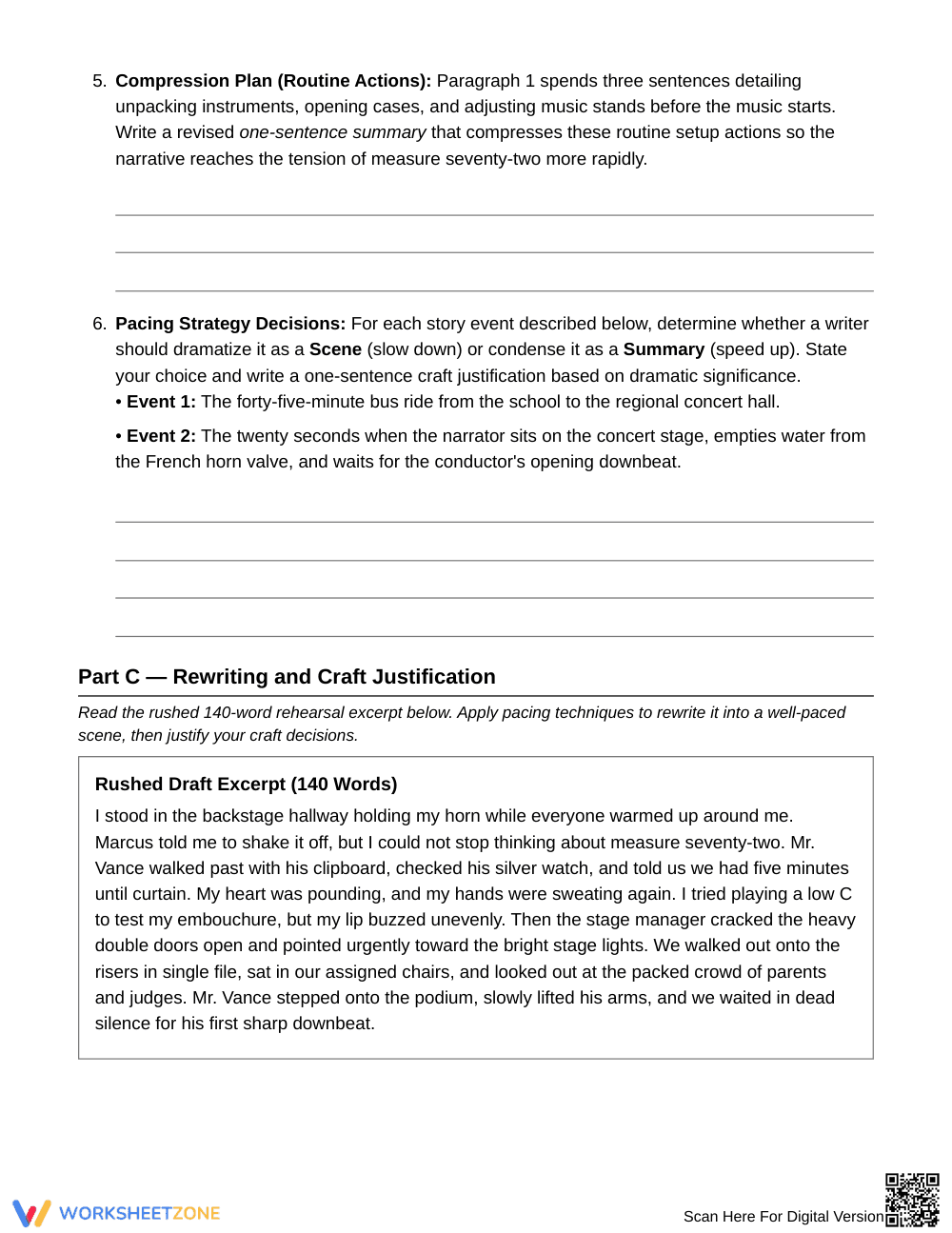
This resource includes a pacing rule box contrasting scene and summary, an authentic mentor narrative titled "The Pre-Concert Rehearsal," and eight practice tasks. Students analyze pacing flaws, plan sensory expansions and dialogue, make scene-or-summary determinations, and rewrite a 140-word draft with a craft justification. A five-page answer key provides model responses.
Skill Progression
- Guided practice (Tasks 1–2): Students examine a mentor text to identify rushed pacing and explain why glossing over climactic moments weakens tension.
- Supported practice (Tasks 3–6): Students plan micro-actions, sensory details, and dialogue while categorizing story events as scenes or summaries.
- Independent practice (Tasks 7–8): Students rewrite a 140-word draft into an expanded scene and justify their craft decisions in writing.
This sequence follows the gradual release of responsibility model, guiding students from diagnostic analysis to independent narrative revision.
Standards Alignment
This worksheet aligns to `W.6.3.b`: "Use narrative techniques, such as dialogue, pacing, and description, to develop experiences, events, and/or characters." It also supports `W.6.5` through targeted planning and revising. Both standard codes can be copied directly into lesson plans, IEP goals, or district curriculum mapping tools.
How to Use It
Use this worksheet during the revision phase of a narrative unit after direct instruction on pacing, or assign Parts A and B as a collaborative partner workshop. While students work on the final rewrite, observe whether they stretch pivotal seconds using internal thoughts and micro-actions rather than dialogue alone. Expected completion time is 40 to 50 minutes.
Who It's For
This worksheet is designed for Grade 6 ELA students developing narrative craft. Provide sentence frames for students needing extra support on craft justifications, while advanced writers can expand multiple beats. It pairs naturally with mentor texts demonstrating effective narrative pacing.
Explicit instruction in narrative pacing enables developing writers to manipulate story time effectively, transforming flat summaries into immersive dramatic scenes. According to Fisher & Frey (2014), structured instructional scaffolds that transition students from analytical evaluation of mentor texts to supported planning and independent revision significantly enhance writing achievement. Aligned with Common Core standard W.6.3.b, this Grade 6 worksheet develops students' ability to intentionally slow down pivotal narrative moments through precise micro-actions, sensory imagery, and internal monologue while compressing routine transitions. By isolating the craft distinction between scene and summary across eight focused tasks, students build metacognitive control over narrative structure. Research confirms that engaging students in purposeful revision and craft justification fosters deeper transfer of descriptive writing techniques into authentic student compositions, strengthening both narrative competence and overall literacy development across diverse classroom learning contexts.


