


























Views
Downloads




Essential Motif & Irony Worksheet | Grade 10 English II
Paste this activity's link or code into your existing LMS (Google Classroom, Canvas, Teams, Schoology, Moodle, etc.).
Students can open and work on the activity right away, with no student login required.
You'll still be able to track student progress and results from your teacher account.
This literary analysis worksheet guides tenth-grade students through evaluating how recurring motifs drive situational irony and thematic development. Working with a two-part narrative, learners trace how a character's obsession with a broken clock creates an ironic reversal, transforming close reading into rigorous evidence-based writing and objective summarization.
At a Glance
- Grade: 10 · Subject: English II
- Standard:
RL.9-10.2— Determine a theme and analyze its development over the course of a text- Skill Focus: Connect Motif and Ironic Outcome
- Format: 6 pages · 12 problems · Answer key included · PDF
- Best For: Close reading and thematic synthesis practice
- Time: 45–60 minutes
What's Inside
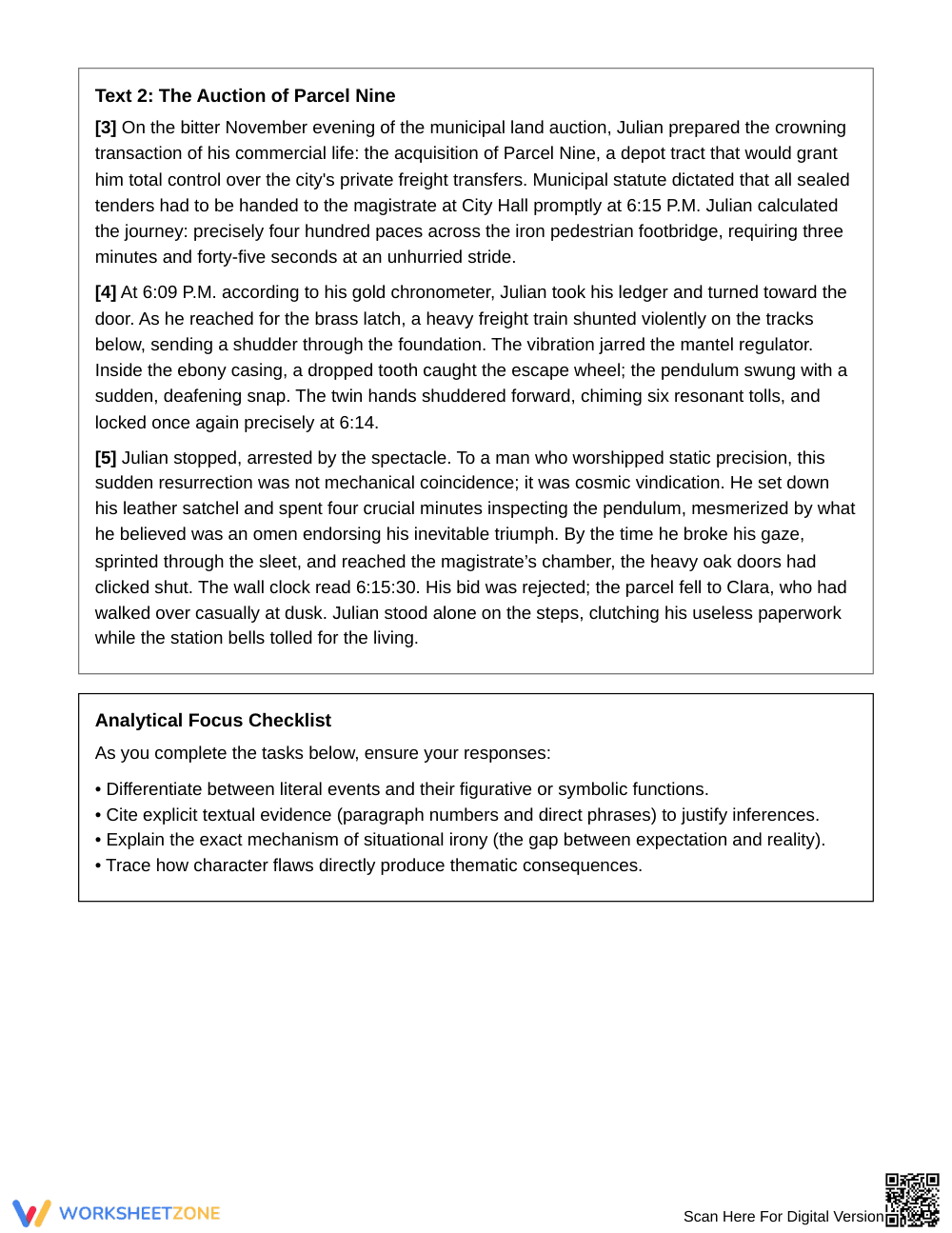
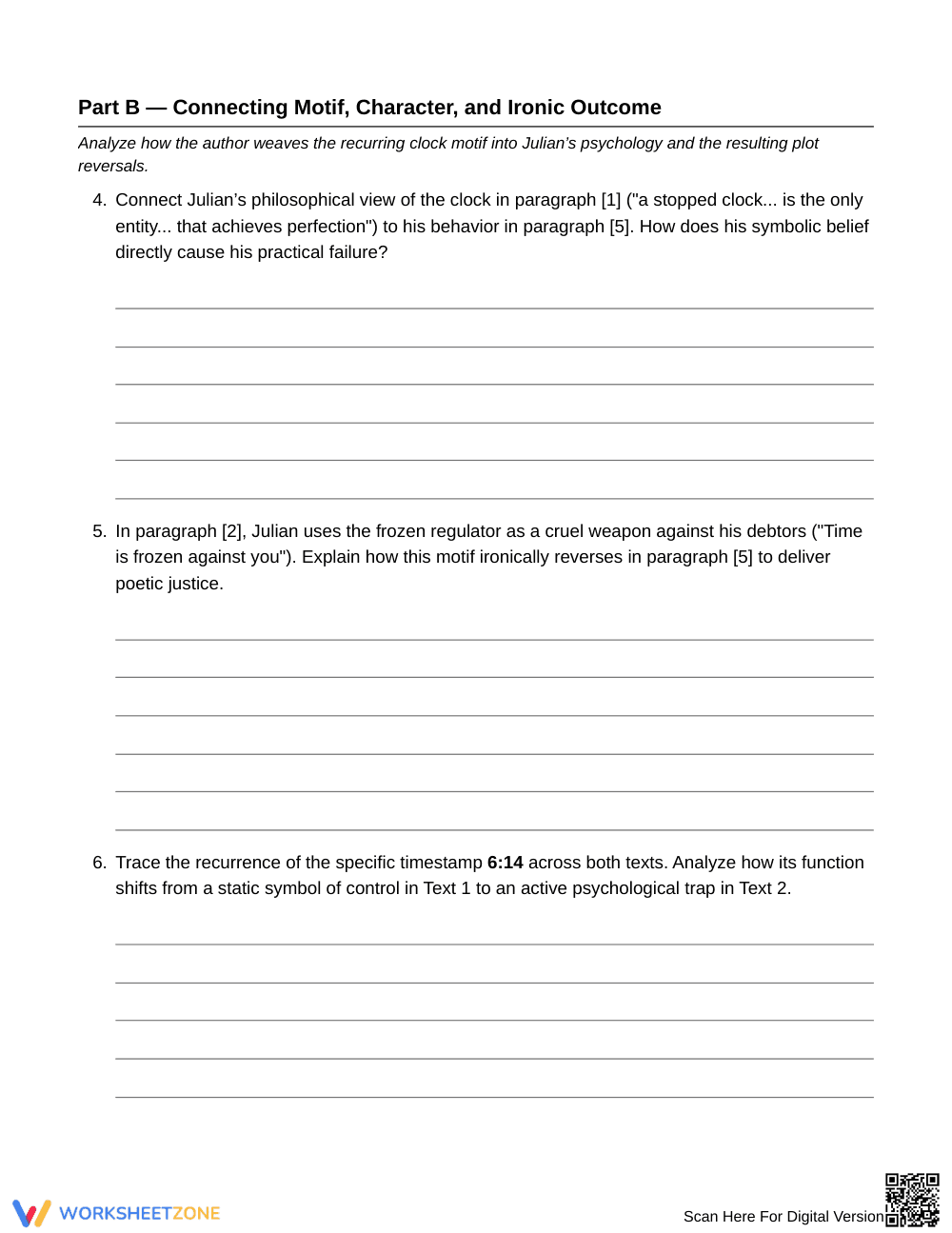
The resource features a paired short story, "The Custodian of Seconds" and "The Auction of Parcel Nine," followed by 12 analytical tasks organized across three distinct sections. It includes core concept definitions, an analytical focus checklist, structured text-dependent questions, and a 4-page answer key with exemplar responses and textual citations.
Skill Progression
- Guided Practice (Part A, Tasks 1–3): Students identify concrete motifs, define symbolic associations, and establish structural setups that foreshadow situational irony with text evidence.
- Supported Practice (Part B, Tasks 4–9): Students analyze character psychology, trace shifting symbolic timestamps and sound motifs, and evaluate dual interpretations of mechanical events.
- Independent Practice (Part C, Tasks 10–12): Students synthesize whole-text effects by formulating a theme statement, writing an objective analytical summary, and justifying the symbolic resolution.
This sequence reinforces gradual release, guiding students from structural recognition to independent thematic synthesis.
Standards Alignment
Primary Standard: `RL.9-10.2` — Determine a theme or central idea of a text and analyze in detail its development over the course of the text; provide an objective summary of the text. Supporting standard RL.9-10.1 is reinforced as students cite strong textual evidence to substantiate interpretive claims.
How to Use It
Deploy this resource during or following a unit on figurative language, symbolism, and irony. In whole-class settings, read the text aloud and complete Part A collaboratively, then assign Parts B and C for paired or independent work. For formative assessment, examine student responses to Task 6 to verify mastery.
Who It's For
Designed for Grade 10 English II students mastering secondary literary analysis, this resource includes embedded scaffolding for developing writers and dual-interpretation tasks for honors learners. Pair this worksheet with instruction on tragic hubris, situational irony, or classic short stories.
According to Fisher & Frey (2014), structured close-reading routines that integrate text-dependent questions with intentional instructional scaffolding significantly accelerate adolescent comprehension of complex literary elements. This Grade 10 worksheet targets standard RL.9-10.2 by systematically linking recurring motifs to ironic plot reversals and overarching thematic statements. Through 12 sequenced analytical tasks, students evaluate how recurring details shape meaning across a complete two-part narrative text. Rather than treating literary devices as isolated definitions, the worksheet requires secondary learners to trace the direct cause-and-effect relationship between character assumptions, symbolic motifs, and dramatic narrative outcomes. Complete with an objective summary prompt and an extensive 4-page answer key, this resource provides high school English educators with verified instructional materials that directly support rigorous reading comprehension, text-based discussion, and analytical writing benchmarks across diverse classroom learning environments.


