


























Views
Downloads



Essential Mixed Number Division Worksheet | Grade 6 Math
Paste this activity's link or code into your existing LMS (Google Classroom, Canvas, Teams, Schoology, Moodle, etc.).
Students can open and work on the activity right away, with no student login required.
You'll still be able to track student progress and results from your teacher account.
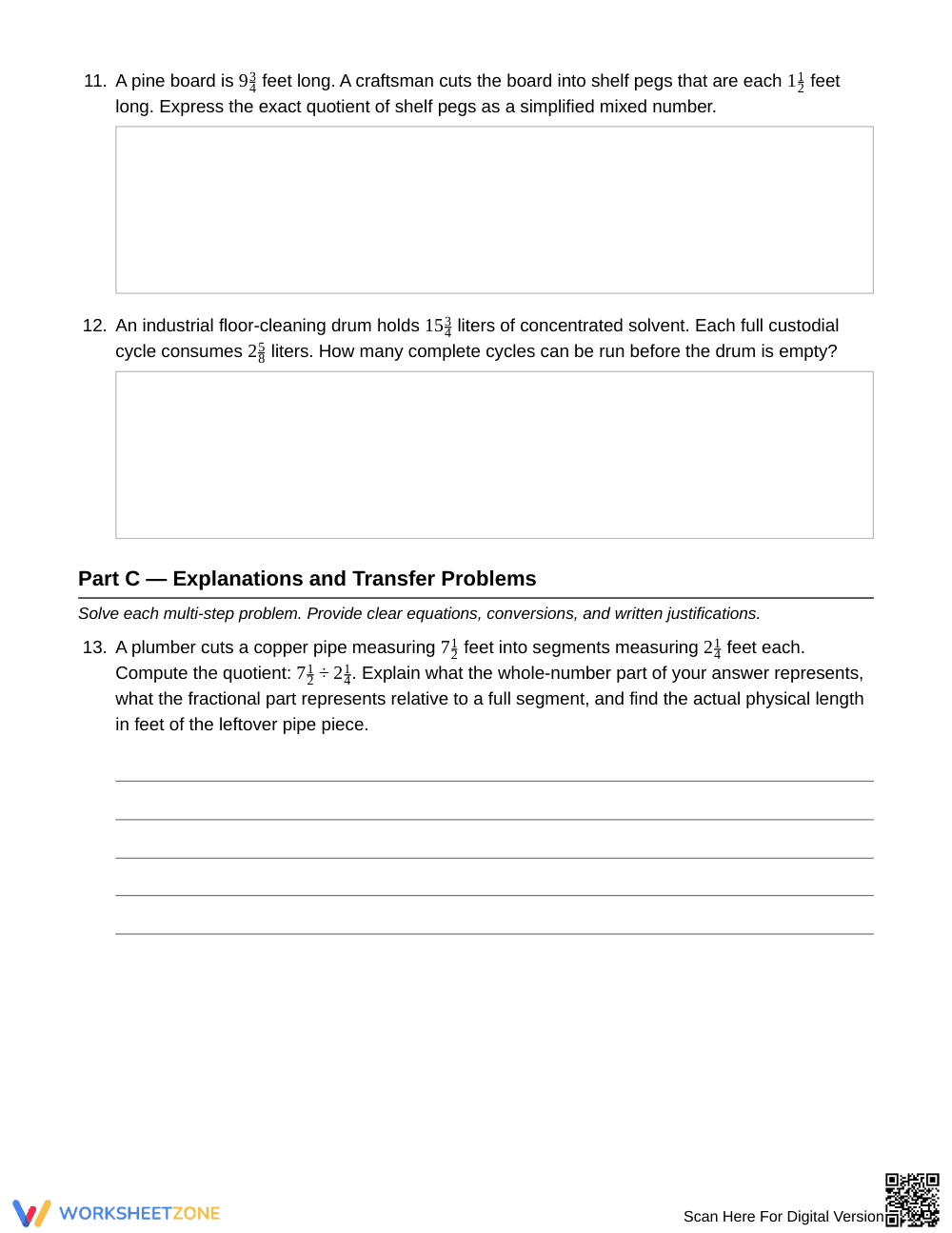
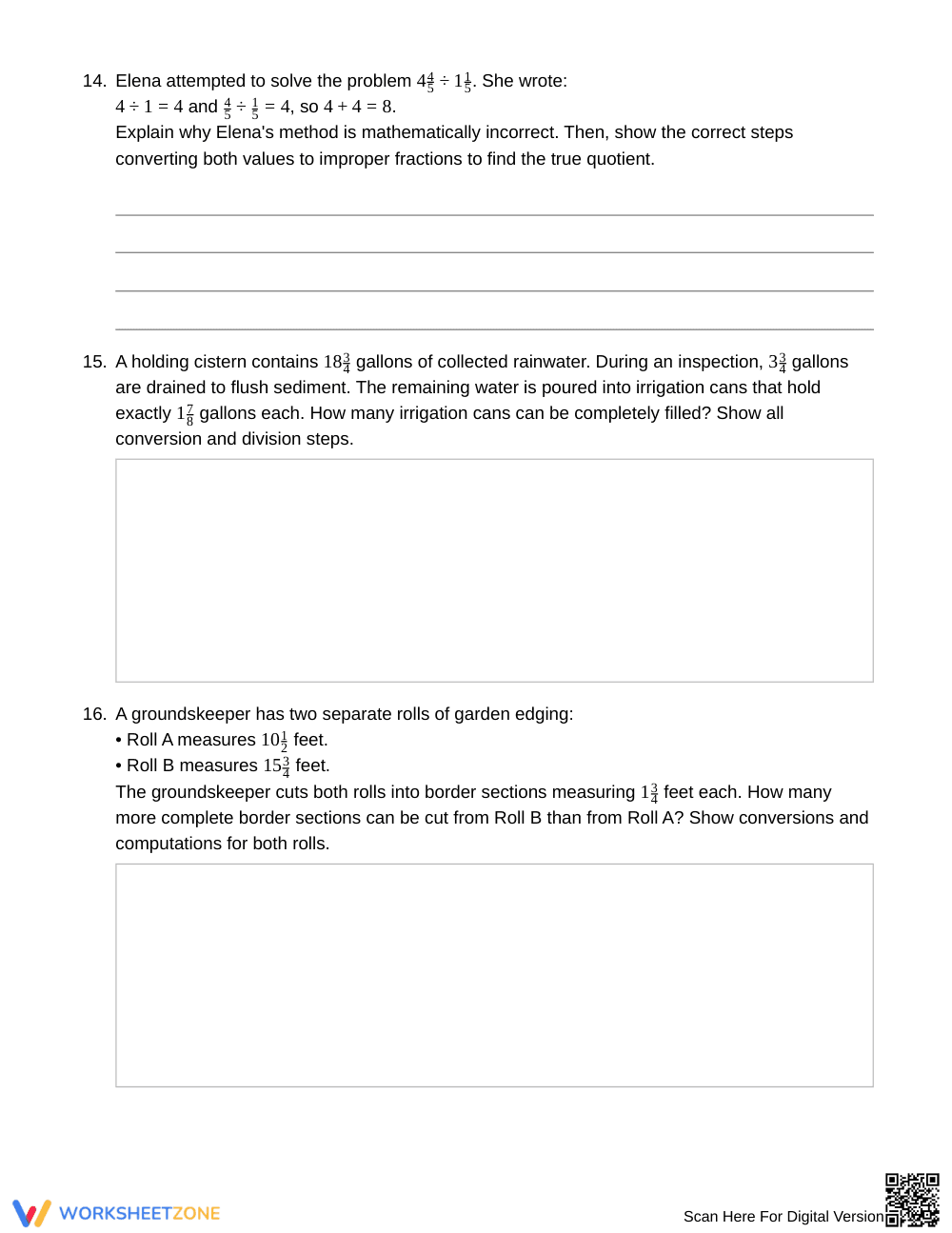
Mastering mixed number division requires students to convert mixed values into improper fractions before multiplying by the reciprocal. This 5-page Grade 6 worksheet provides 16 problems that build conceptual understanding, procedural fluency, and real-world problem-solving across length and capacity contexts. Students interpret quotients, analyze non-distributive division errors, and evaluate fractional remainders.
At a Glance
- Grade: 6 · Subject: Math
- Standard:
6.NS.A.1— Compute quotients of fractions to solve real-world word problems.- Skill Focus: Mixed Numbers as Improper Fractions
- Format: 5 pages · 16 problems · Answer key included · PDF
- Best For: Skill mastery and error analysis
- Time: 40–55 minutes
What's Inside
This resource includes a Core Strategy reference anchor, four conceptual multiple-choice items, eight single-step word problems, and four multi-step transfer tasks. Learners encounter realistic scenarios involving carpentry, recipe scaling, liquid measurement, and athletic pacing. The 3-page answer key provides complete fraction conversions, reciprocal setups, and written explanatory models.
Skill Progression
- Guided practice (Part A — 4 items): Multiple-choice questions target structural understanding, such as why division does not distribute across mixed-number parts and identifying divisor reciprocals.
- Supported practice (Part B — 8 items): Word problems prompt students to convert mixed numbers to improper fractions before calculating quotients in length and volume contexts.
- Independent practice (Part C — 4 items): Multi-step tasks require calculating fractional remainders, analyzing student errors, and executing two-step operations.
This sequence reinforces the gradual-release model, moving from conceptual verification to independent mathematical justification.
Standards Alignment
This worksheet aligns directly with 6.NS.A.1: Interpret and compute quotients of fractions, and solve word problems involving division of fractions by fractions. Supporting standard 5.NF.B.7 reinforces division of unit fractions by whole numbers. Both standard codes can be copied directly into lesson plans, IEP goals, or district curriculum mapping tools.
How to Use It
Use this worksheet following direct instruction on converting mixed numbers to improper fractions and finding reciprocals. During independent work, check whether students attempt to divide whole numbers separately or forget to invert the divisor. Expected completion time is 40 to 55 minutes.
Who It's For
This resource serves Grade 6 general math classrooms, tier-2 intervention groups reviewing fraction operations, and advanced Grade 5 students. Pair this printable with a visual fraction bar anchor chart to reinforce reciprocal relationships.
According to research by Fisher & Frey (2014) on the gradual release of responsibility, structured progression from conceptual identification to independent problem solving significantly strengthens mathematical reasoning and procedural retention. Standard 6.NS.A.1 requires Grade 6 students to interpret and calculate quotients of fractions, including converting mixed numbers into improper fractions and applying reciprocals within authentic real-world contexts. Many middle school learners exhibit persistent misconceptions when dividing mixed numbers, frequently attempting to divide whole numbers and fractions independently. By embedding targeted conceptual checks, structured word problems in measurement and capacity, and rigorous error analysis, this worksheet systematically addresses cognitive hurdles. Students construct meaningful mental representations of fraction division, distinguish between quotient remainders and fractional leftovers, and build lasting fluency. The clear progression ensures that learners transition successfully from initial procedural conversion to advanced mathematical justification and multi-step problem execution.


