


























Views
Downloads



Essential Missing Cell Function Worksheet | Grade 6 Science
Paste this activity's link or code into your existing LMS (Google Classroom, Canvas, Teams, Schoology, Moodle, etc.).
Students can open and work on the activity right away, with no student login required.
You'll still be able to track student progress and results from your teacher account.
This Grade 6 science worksheet builds biological reasoning by challenging students to predict what happens when specific cell structures fail or go missing. Through 12 scenario-based prompts, learners analyze how damaged organelles disrupt homeostasis, halt energy production, and cause cellular death in plant and animal systems.
At a Glance
- Grade: 6 · Subject: Science
- Standard: Model how cell parts function together to sustain life
- Skill Focus: Predict Effects of a Missing Function
- Format: 5 pages · 12 problems · Answer key included · PDF
- Best For: Post-lesson practice and formative assessment
- Time: 40–50 minutes
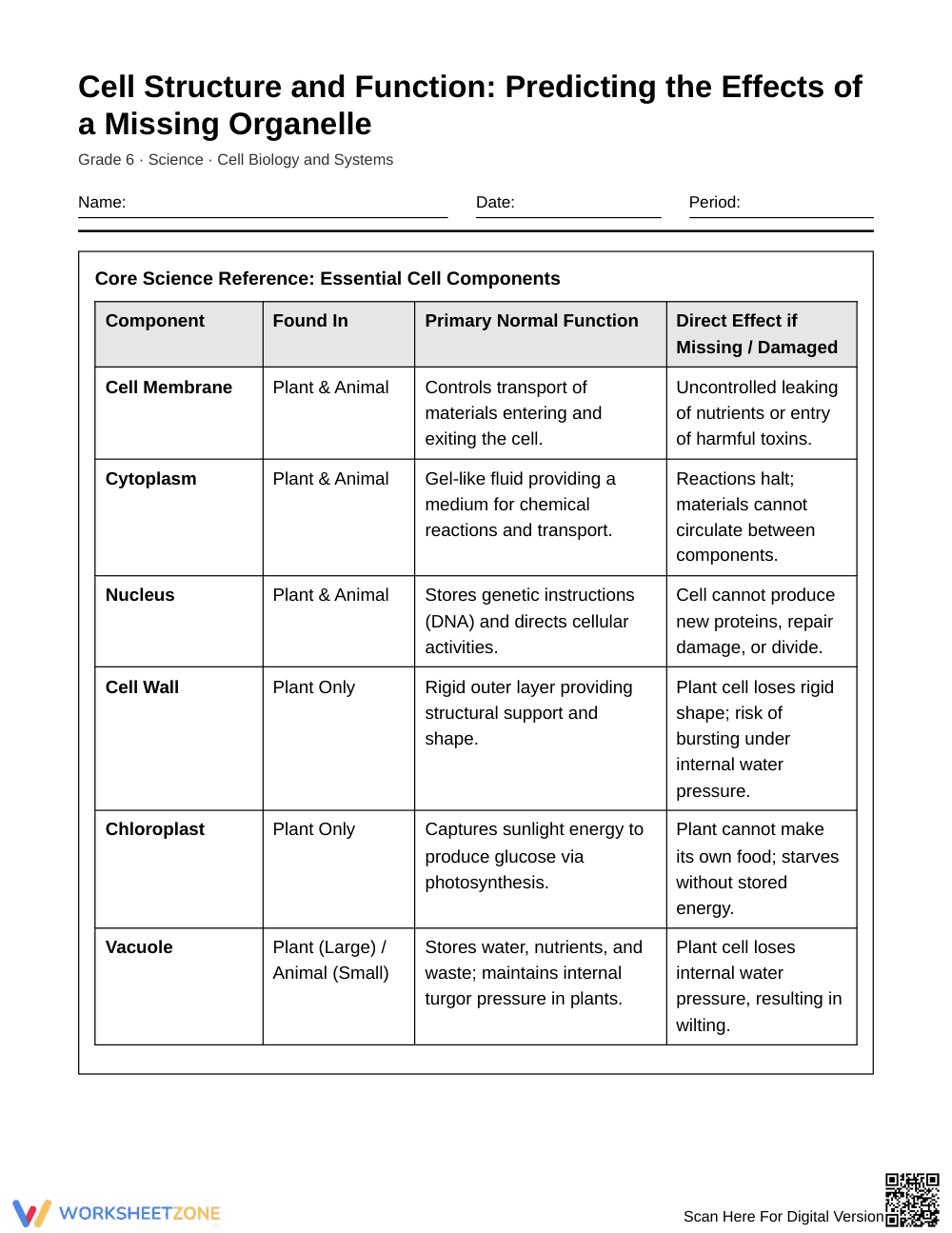
The 5-page packet opens with a Core Science Reference table detailing normal functions and malfunction effects for six key organelles: cell membrane, cytoplasm, nucleus, cell wall, chloroplast, and vacuole. Students solve 12 multi-part items across three progressive sections, supported by a 3-page teacher answer key with complete scientific explanations.
Skill Progression
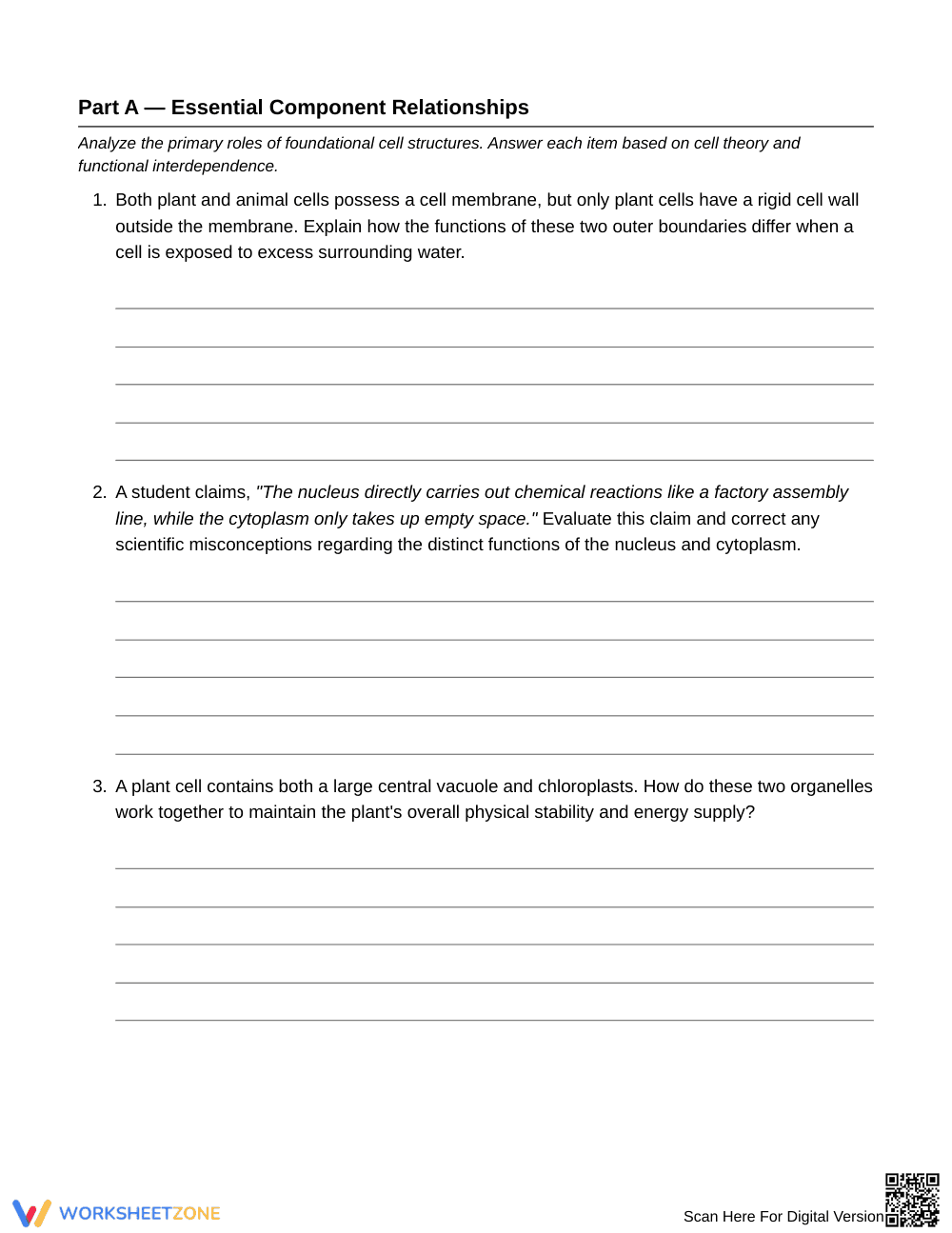
- Guided Practice (Part A · 3 items): Prompts evaluating structural relationships, correcting misconceptions, and explaining organelle interdependence using the reference table.
- Supported Practice (Part B · 6 items): Lab scenarios requiring students to diagnose failures caused by dissolved membranes, destroyed nuclei, dehydrated cytoplasm, and absent cell walls.
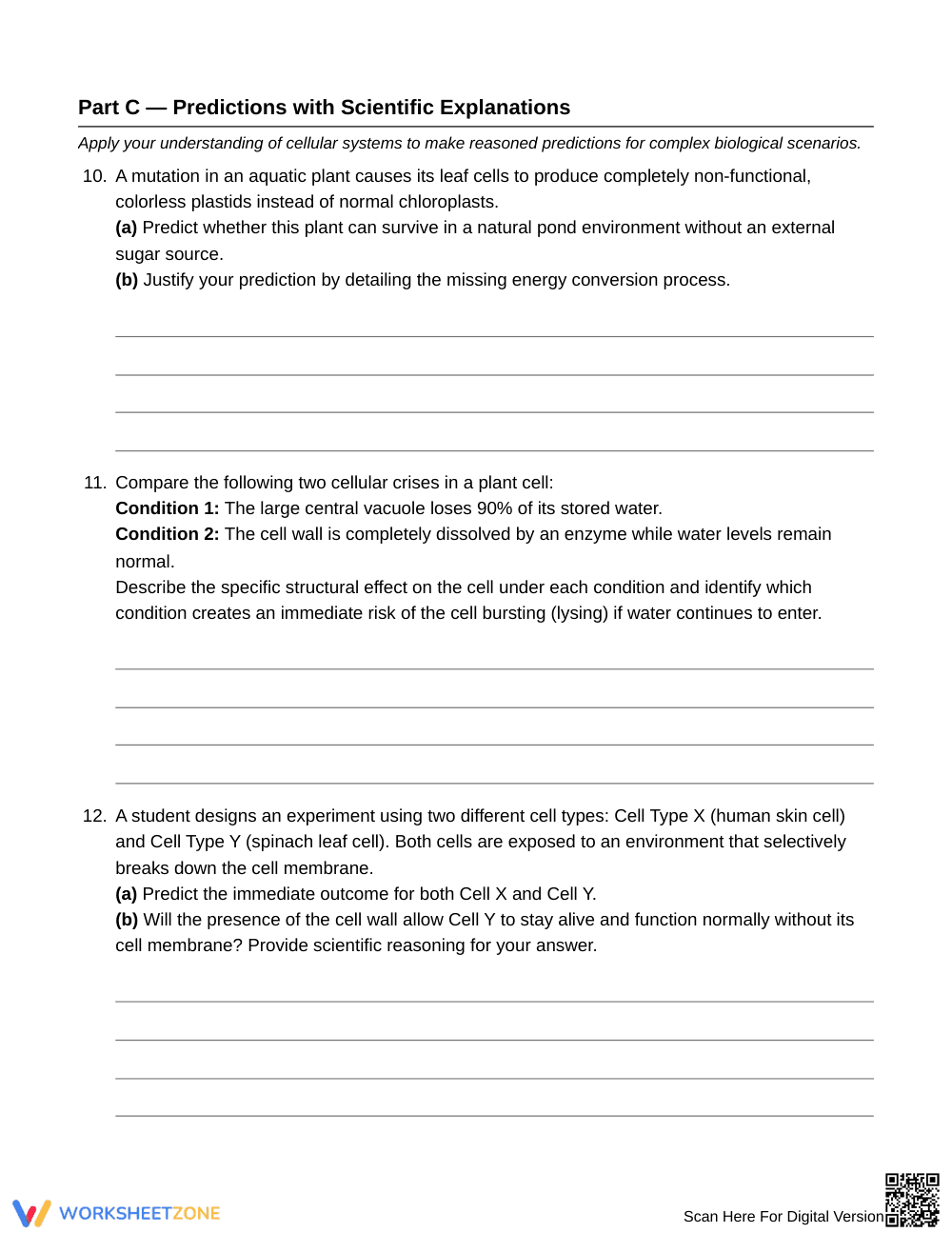
- Independent Practice (Part C · 3 items): Predictive prompts where students justify outcomes for mutant chloroplasts, vacuole volume loss, and selective membrane destruction.
This sequence follows a gradual-release model, shifting learners from guided reference interpretation to independent cause-and-effect scientific reasoning.
Standards Alignment
This resource aligns with middle school life science standards requiring students to model cell function and understand how internal components sustain living systems. The prompts prioritize functional reasoning over rote memorization. Both standard codes can be copied directly into lesson plans, IEP goals, or district curriculum mapping tools.
How to Use It
Assign this worksheet after direct instruction on cell anatomy. Use Part A for paired discussion, then assign Parts B and C for independent analysis. During class, monitor whether students recognize that cell walls cannot regulate transport without a functioning membrane. Expected completion time is 40 to 50 minutes.
Who It's For
Ideal for Grade 6 general science and life science students. The reference chart supports English language learners and students needing structured aids, while Part C provides rigorous extension. Pair this packet with a compound microscope lab or an organelle anchor chart.
Educational research by Fisher & Frey (2014) demonstrates that structured cause-and-effect reasoning tasks establish significantly deeper conceptual mastery than isolated vocabulary recall in middle school science classrooms. This Grade 6 life science resource operationalizes that empirical research by targeting the core analytical skill of predicting the biological effects of missing organelle functions. Rather than simply identifying organelle diagrams, students solve 12 scenario-based problems requiring them to evaluate synthetic laboratory data, explain mechanism breakdowns, and formulate evidence-based conclusions. By investigating how damage to cell membranes, nuclei, chloroplasts, and vacuoles disrupts cellular homeostasis, learners develop sophisticated systems-thinking abilities aligned with middle school life science standards. The deliberate instructional progression from foundational reference analysis to open-ended predictive explanations guarantees that middle school students build durable biological comprehension, rigorous scientific communication skills, and measurable analytical proficiency across cellular biology units.


