




























Views
Downloads



Essential Membrane Permeability Worksheet | Grade 7 Science

Paste this activity's link or code into your existing LMS (Google Classroom, Canvas, Teams, Schoology, Moodle, etc.).
Students can open and work on the activity right away, with no student login required.
You'll still be able to track student progress and results from your teacher account.
Help middle school life science students dismantle the common misconception that water unconditionally follows salt. This 5-page worksheet provides 12 rigorous problems guiding seventh graders to analyze solute permeability versus solvent movement across cell membranes, establishing accurate understanding of passive transport and osmosis.
At a Glance
- Grade: 7 · Subject: Science
- Standard: Cell Biology — Model cell membrane function and selective permeability
- Skill Focus: Correcting Passive Transport Misconceptions
- Format: 5 pages · 12 problems · Answer key included · PDF
- Best For: Membrane transport error analysis practice
- Time: 40–50 minutes
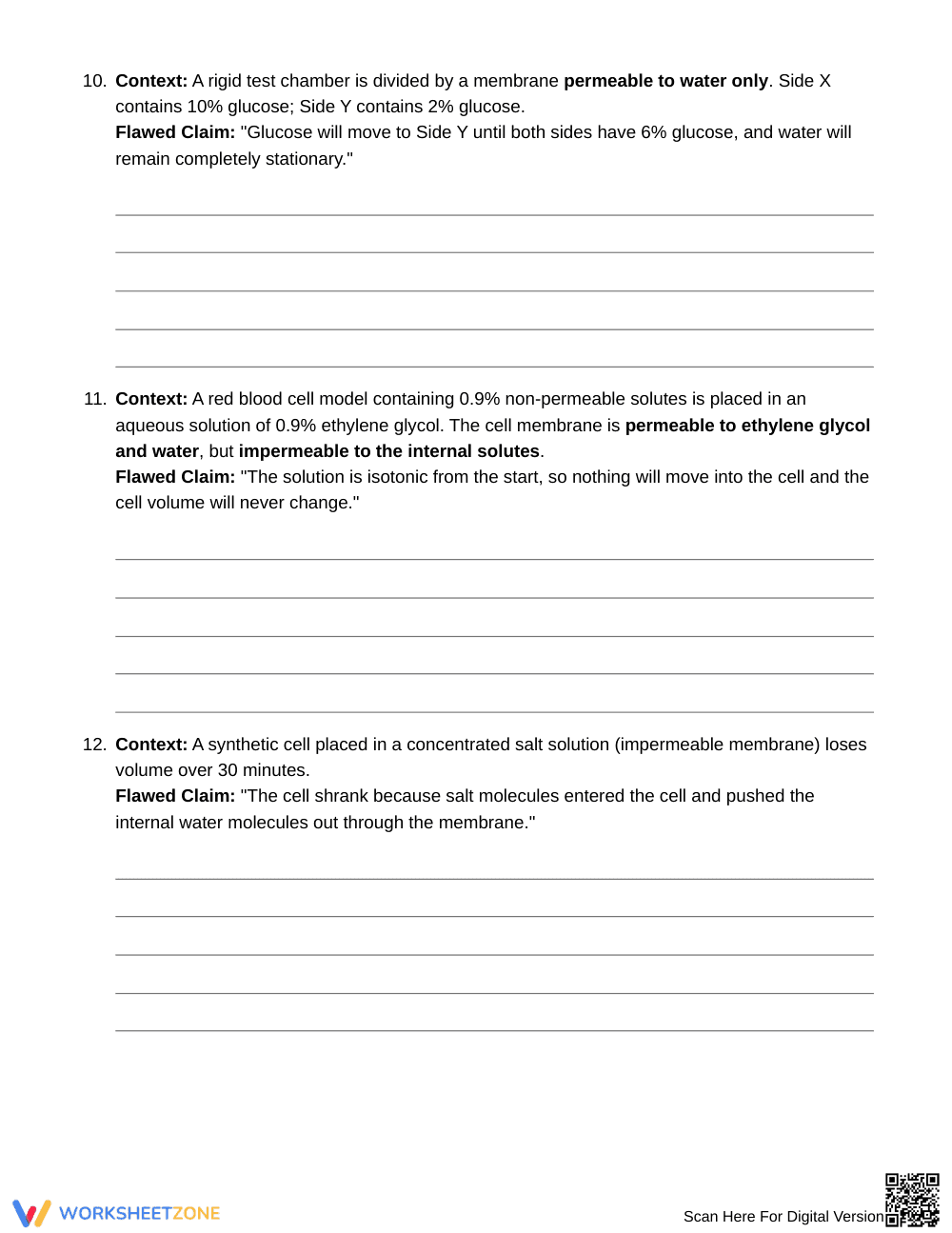
This resource features a core principle summary, a modeled error analysis worked example, and two structured practice sections across 5 pages. Part A delivers 4 foundational prediction scenarios using dialysis tubing and U-tubes. Part B provides 8 error-correction items where students diagnose flawed peer claims and write scientific explanations. A 3-page answer key is included.
Skill Progression
- Guided Practice (Part A, Problems 1–4): Students analyze concentration gradients and pore sizes across laboratory models with prompts evaluating solute permeability.
- Supported Practice (Worked Example & Part B, Problems 5–8): A complete worked example models error diagnosis before students correct flawed claims.
- Independent Practice (Part B, Problems 9–12): Students independently evaluate multi-solute claims and dynamic equilibrium to write accurate explanations.
This sequence utilizes a gradual-release instructional model (I Do, We Do, You Do) to move students from guided prediction to independent error correction.
Standards Alignment
This activity aligns with middle school life science standards on cellular systems, where students describe how cell membranes regulate material transport into and out of cells. The tasks specifically assess whether students differentiate between permeable solute diffusion and solvent osmosis. Both standard concepts can be copied directly into lesson plans, IEP goals, or district curriculum mapping tools.
How to Use It
Use this worksheet after direct instruction on diffusion and osmosis or as post-lab remediation. During class, circulate during Part A to verify that students check solute permeability before applying osmotic rules. Expect completion within 40 to 50 minutes.
Who It's For
Designed for Grade 7 life science students, this resource supports general education, honors classes, and targeted intervention. Scaffolded prompts assist emerging bilingual students and learners with IEPs. Pair this worksheet with a dialysis tubing lab or a membrane transport anchor chart.
According to research on science concept attainment by Fisher & Frey (2014), structured error analysis combined with explicit modeled examples substantially improves conceptual understanding and directly resolves persistent biological misconceptions. When middle school life science students evaluate flawed claims regarding membrane permeability and osmosis, they actively contrast oversimplified rules—such as assuming water always follows solute—with the physical laws governing passive transport. By working through 12 rigorous analytical problems across synthetic laboratory models, seventh-grade learners develop accurate mental models of concentration gradients, selective membrane pore sizes, and dynamic equilibrium. Combining explicit diagnostic worked examples with scaffolded independent practice empowers students to construct evidence-based scientific explanations, reinforcing academic literacy and ensuring thorough mastery of cell biology principles across diverse classroom learning environments. This targeted practice establishes foundational scientific reasoning essential for advanced secondary biology coursework.


