


























Views
Downloads



Essential Measurement Division Worksheet | Grade 6 Math
Paste this activity's link or code into your existing LMS (Google Classroom, Canvas, Teams, Schoology, Moodle, etc.).
Students can open and work on the activity right away, with no student login required.
You'll still be able to track student progress and results from your teacher account.
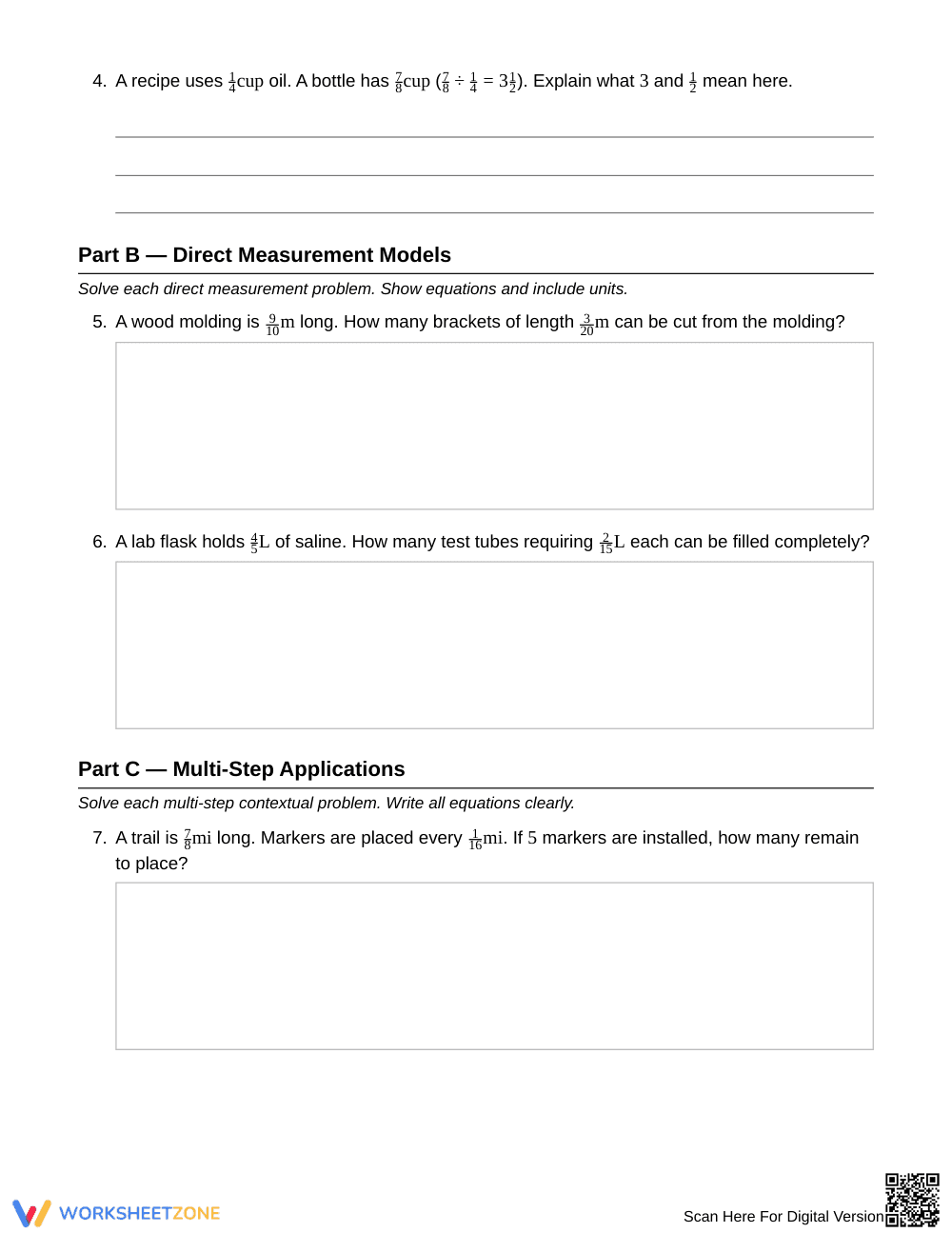
This 4-page fraction division worksheet equips Grade 6 students to interpret quotients in measurement contexts where division reveals how many groups fit into a total. Learners transition from conceptual reasoning to multi-step word problems, mastering quotient meanings and fraction remainders across 14 rigorous practice problems.
At a Glance
- Grade: 6 · Subject: Math
- Standard:
6.NS.A.1— Interpret and compute quotients of fractions to solve measurement word problems- Skill Focus: Measurement fraction division
- Format: 4 pages · 14 problems · Answer key included · PDF
- Best For: Guided practice and skill mastery
- Time: 35–45 minutes
What's Inside
The resource begins with a core measurement division rule and a worked ribbon example using common denominators. Across four structured sections, students solve 14 problems spanning conceptual explanations, denominator tables, multi-step application problems, and constraint-based packaging tasks. A complete 2-page answer key provides step-by-step arithmetic and contextual remainder explanations.
Skill Progression
- Guided practice (Part A, 4 problems): Students examine foundational measurement interpretations, complete common-denominator tables, and explain whole and fractional quotients with strong conceptual scaffolding.
- Supported practice (Part B, 2 problems): Learners solve direct measurement equations involving lengths and liquid volumes, setting up equations and labeling units.
- Independent practice (Parts C & D, 8 problems): Students solve multi-step application problems and constraint scenarios requiring fractional remainder interpretation without prompts.
This gradual-release sequence moves students systematically from guided conceptual reasoning to autonomous problem-solving.
Standards Alignment
This worksheet aligns directly with 6.NS.A.1: Interpret and compute quotients of fractions, and solve word problems involving division of fractions by fractions. It also supports 5.NF.B.7 by building on unit fraction division models. Both standard codes can be copied directly into lesson plans, IEP goals, or district curriculum mapping tools.
How to Use It
Assign Part A during direct instruction as a paired check for understanding after introducing measurement models. Use Parts B through D for independent practice or formative assessment during a 35- to 45-minute period. As a formative tip, verify whether students interpret remainders as fractions of the divisor rather than of the original quantity.
Who It's For
This activity is designed for Grade 6 math classes, Tier 2 intervention groups, and advanced Grade 5 students. Provide visual tape diagrams for multilingual learners tackling word problems. Pair this resource with a direct instruction lesson on bar models or an anchor chart emphasizing the core measurement question: "How many fit?"
Mastering fraction division in measurement contexts is essential for middle school algebraic readiness, enabling students to interpret division as determining how many given quantities fit into a total amount. Under standard 6.NS.A.1, Grade 6 learners must compute fraction quotients and interpret real-world division contexts rather than relying solely on procedural invert-and-multiply algorithms without comprehension. According to Fisher & Frey (2014), purposeful gradual-release structures—moving intentionally from explicit conceptual modeling to guided collaborative analysis and ultimately unassisted problem-solving—substantially increase student retention and accuracy in multi-step mathematics tasks. This 14-task worksheet aligns with those empirical findings by establishing a common-denominator framework before requiring students to resolve multi-step measurement scenarios and evaluate real-world packaging constraints. By explicitly connecting quotients to tangible quantities, the materials ensure students develop deep conceptual mastery alongside procedural fluency, establishing a durable cognitive foundation for rational number operations in Grade 7 and beyond.


