




























Views
Downloads



Essential Light Boundaries Worksheet | Grade 6 Science

Paste this activity's link or code into your existing LMS (Google Classroom, Canvas, Teams, Schoology, Moodle, etc.).
Students can open and work on the activity right away, with no student login required.
You'll still be able to track student progress and results from your teacher account.
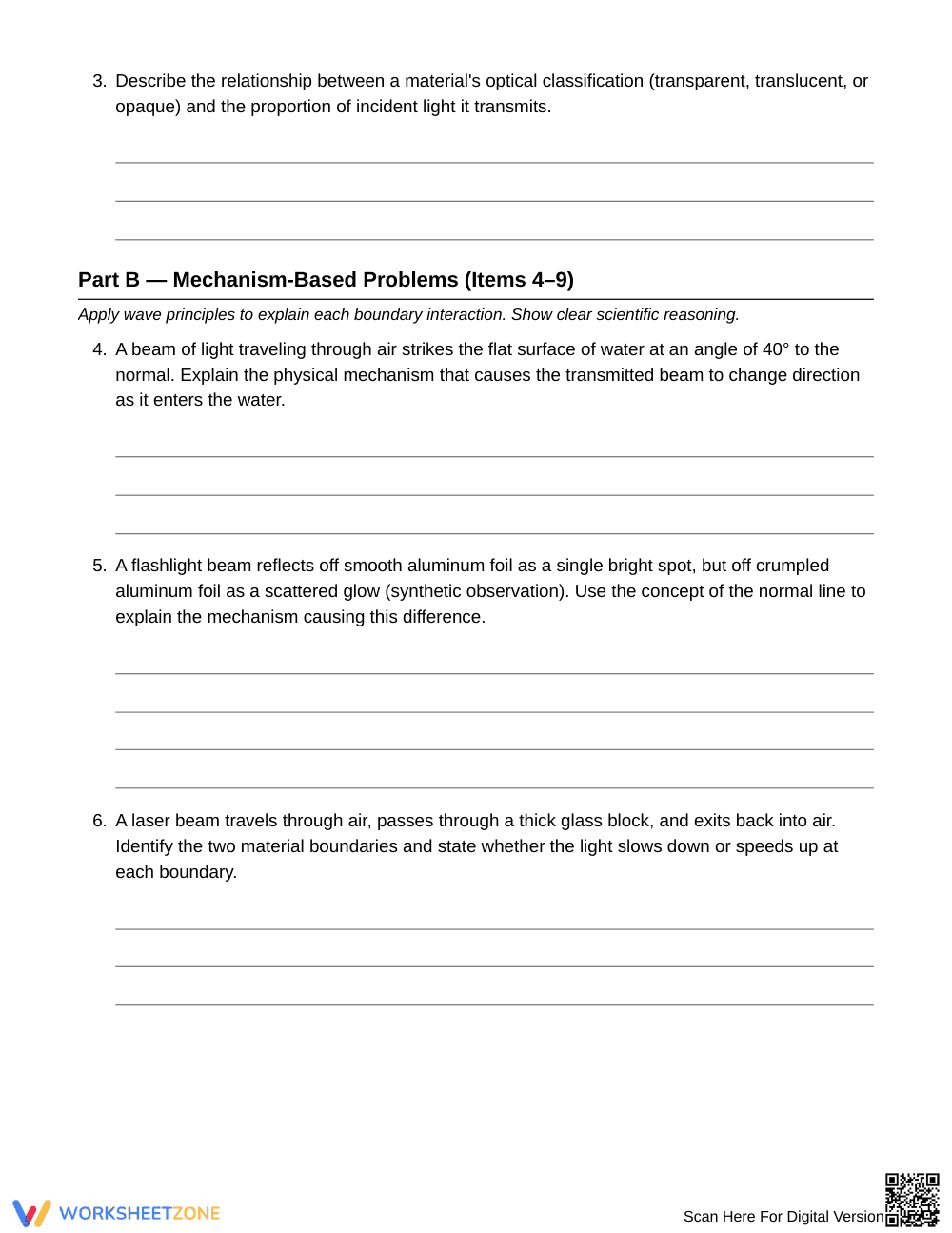
Help middle school physical science students master light wave interactions with this comprehensive material boundaries practice set. Students analyze reflection, absorption, and refraction mechanisms across 12 structured tasks to predict how light behaves when moving between media. This resource builds conceptual mastery from foundational principles to complex real-world predictions.
At a Glance
- Grade: 6 · Subject: Science
- Standard: Predict and describe light wave reflection, absorption, and transmission across boundaries
- Skill Focus: Predict Changes at Material Boundaries
- Format: 4 pages · 12 problems · Answer key included · PDF
- Best For: Light wave physics practice
- Time: 30–45 minutes
This 4-page science resource features a reference section defining reflection, absorption, and refraction, followed by 12 scaffolded problems and a complete 2-page answer key. Students examine wave behavior through short-response explanations, multiple-choice reasoning, and real-world multi-factor scenarios involving mirrors, colored paper, submerged objects, and thermal absorption.
Skill Progression
- Guided Practice (Items 1–3): Students articulate core relationships between material properties—such as surface texture, optical transparency, and surface color—and light transmission, reflection, and absorption using defined principles.
- Supported Practice (Items 4–9): Learners apply wave mechanisms to explain refraction angles, diffuse versus specular reflection, normal line interactions, and color perception across six detailed scenarios.
- Independent Practice (Items 10–12): Students independently predict thermal and visual outcomes across novel contexts, including submerged flashlights and painted metallic surfaces, justifying their predictions with wave speed and absorption data.
This sequence implements a gradual release model that transitions students from reviewing fundamental concepts to independently evaluating complex wave phenomena.
Standards Alignment
This activity aligns with middle school physical science expectations for wave behavior. Students develop and use models to describe that waves are reflected, absorbed, or transmitted through various materials. By connecting light speed changes at boundaries to directional refraction, students master qualitative wave mechanics. These skills support standard curriculum objectives and can be integrated into lesson plans, IEP goals, or district curriculum mapping tools.
How to Use It
Use this worksheet after direct instruction on wave properties as mid-unit guided practice, or assign Parts B and C as an independent check for understanding. During class, monitor student explanations on Items 4 and 9 to ensure they correctly identify wave speed change as the underlying physical mechanism of refraction. Most sixth-grade students complete the 12 items in 30 to 45 minutes.
Who It's For
This resource supports Grade 6 physical science students learning optics and wave mechanics. The embedded reference box provides essential scaffolding for English language learners and developing readers, while the multi-step prediction prompts in Part C offer rigorous extension for advanced learners. Pair this worksheet with a hands-on refraction lab or a light wave ray diagram lesson.
According to research on guided cognitive apprenticeship by Fisher & Frey (2014), structured instructional scaffolds that systematically advance from foundational relational concepts to mechanism-based reasoning foster deep conceptual understanding in middle school physical science. This Grade 6 light and wave behavior resource operationalizes that evidence-based progression across 12 targeted problems. Students first articulate fundamental optical interactions—including specular reflection, thermal absorption, and transmission—before applying wave mechanisms to explain directional bending at material boundaries. By challenging learners to predict thermal outcomes from light absorption and ray paths based on changing wave speeds, the activity strengthens scientific modeling competencies. Consequently, teachers gain meaningful diagnostic insight into student wave reasoning. The complete 4-page printable format, paired with an instructional key principles reference guide and a full 2-page answer key, provides educators with a rigorous tool for assessing student mastery of wave interactions across diverse media.


