


























Views
Downloads




Essential Layered Irony Worksheet | Grade 10 English II
Paste this activity's link or code into your existing LMS (Google Classroom, Canvas, Teams, Schoology, Moodle, etc.).
Students can open and work on the activity right away, with no student login required.
You'll still be able to track student progress and results from your teacher account.
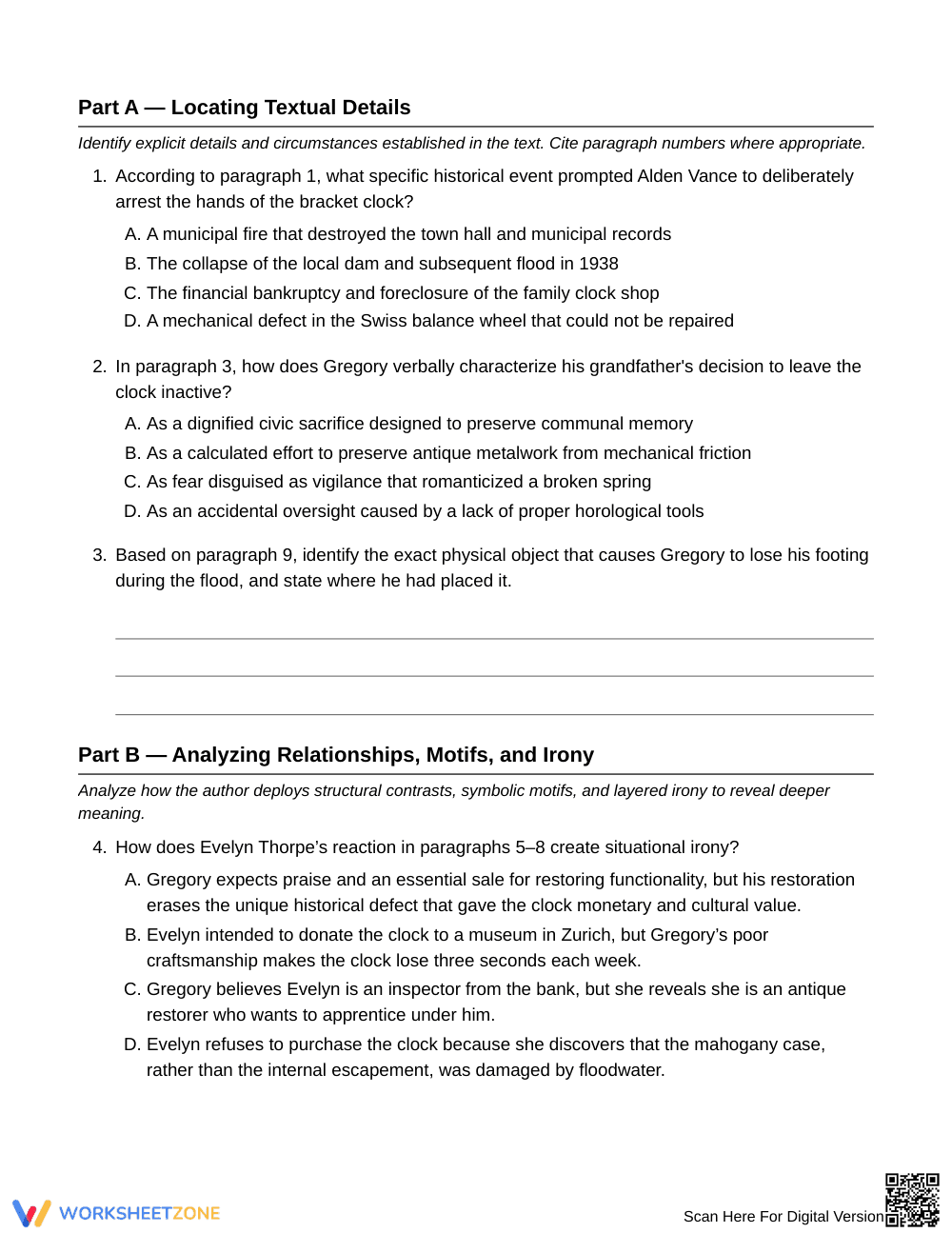
This comprehensive Grade 10 English II worksheet trains high school students to analyze situational irony, dramatic irony, and symbolic motifs within complex literary prose. Working through the original narrative "The Escapement of Highbarrow," learners examine how structural contrasts and recurring symbols develop sophisticated central themes and refine objective text summaries.
At a Glance
- Grade: 10 · Subject: English II
- Standard:
RL.9-10.2— Determine a theme and analyze its development over the course of a text- Skill Focus: Interpret Layered Irony
- Format: 6 pages · 12 problems · Answer key included · PDF
- Best For: Close reading and literary analysis
- Time: 45–60 minutes
What's Inside
The resource features a rigorous, multi-paragraph narrative accompanied by a reference reminder box defining situational irony, dramatic irony, and motifs. Across 6 pages, students complete 12 rigorous tasks comprising text-dependent multiple-choice questions, short-answer analytical items, and extended synthesis prompts. A thorough 4-page answer key provides complete model responses and textual citations for straightforward evaluation.
Skill Progression
- Guided practice (Part A — Tasks 1–3): Students identify explicit textual details, key historical plot events, and character dialogue with moderate scaffolding to establish core comprehension.
- Supported practice (Part B — Tasks 4–9): Learners analyze how dramatic tension, situational plot twists, and recurring water motifs interact to critique character motivations and philosophical perspectives.
- Independent practice (Part C — Tasks 10–12): Students independently formulate theme statements, evaluate competing thematic interpretations using direct evidence, and write an objective summary tracing the central motif.
This structured sequence reflects the gradual release of responsibility model, guiding students systematically from surface-level textual recall to rigorous thematic evaluation.
Standards Alignment
This worksheet directly aligns with RL.9-10.2: Determine a theme or central idea of a text and analyze in detail its development over the course of the text, including how it emerges and is shaped and refined by specific details; provide an objective summary of the text. Both standard codes can be copied directly into lesson plans, IEP goals, or district curriculum mapping tools.
How to Use It
Deploy this activity after direct instruction on literary devices during a dedicated unit on symbolism and irony. Use it as an anchor task during a 50-minute block or assign it as an independent close-reading assessment. As a formative assessment checkpoint, review student responses to Part B, Task 6 to ensure learners distinguish between dramatic and situational irony before they write their final thematic defense in Part C.
Who It's For
Designed for tenth-grade literature classrooms, this resource supports general education, honors, and advanced secondary readers. Provide graphic organizers or sentence starters to support developing writers during the multi-paragraph analysis in Part C. It pairs naturally with anchor charts on literary devices or short fiction by O. Henry, Guy de Maupassant, and Shirley Jackson.
Rigorous close-reading practice enables secondary students to master the structural and thematic demands of high school standards. According to Fisher & Frey (2014), systematic text-dependent questioning coupled with a gradual release framework significantly enhances reading comprehension and analytical writing performance. By examining how an author layers situational irony and dramatic irony across a single text, students learn to connect micro-level narrative details to macro-level thematic insights. This 6-page printable worksheet provides 12 aligned tasks directly addressing standard RL.9-10.2, helping students build the academic discipline required to construct defensible literary arguments and objective summaries.


