


























Views
Downloads

Essential Labeled-DNA Evidence Worksheet | Grade 10 Biology
Paste this activity's link or code into your existing LMS (Google Classroom, Canvas, Teams, Schoology, Moodle, etc.).
Students can open and work on the activity right away, with no student login required.
You'll still be able to track student progress and results from your teacher account.
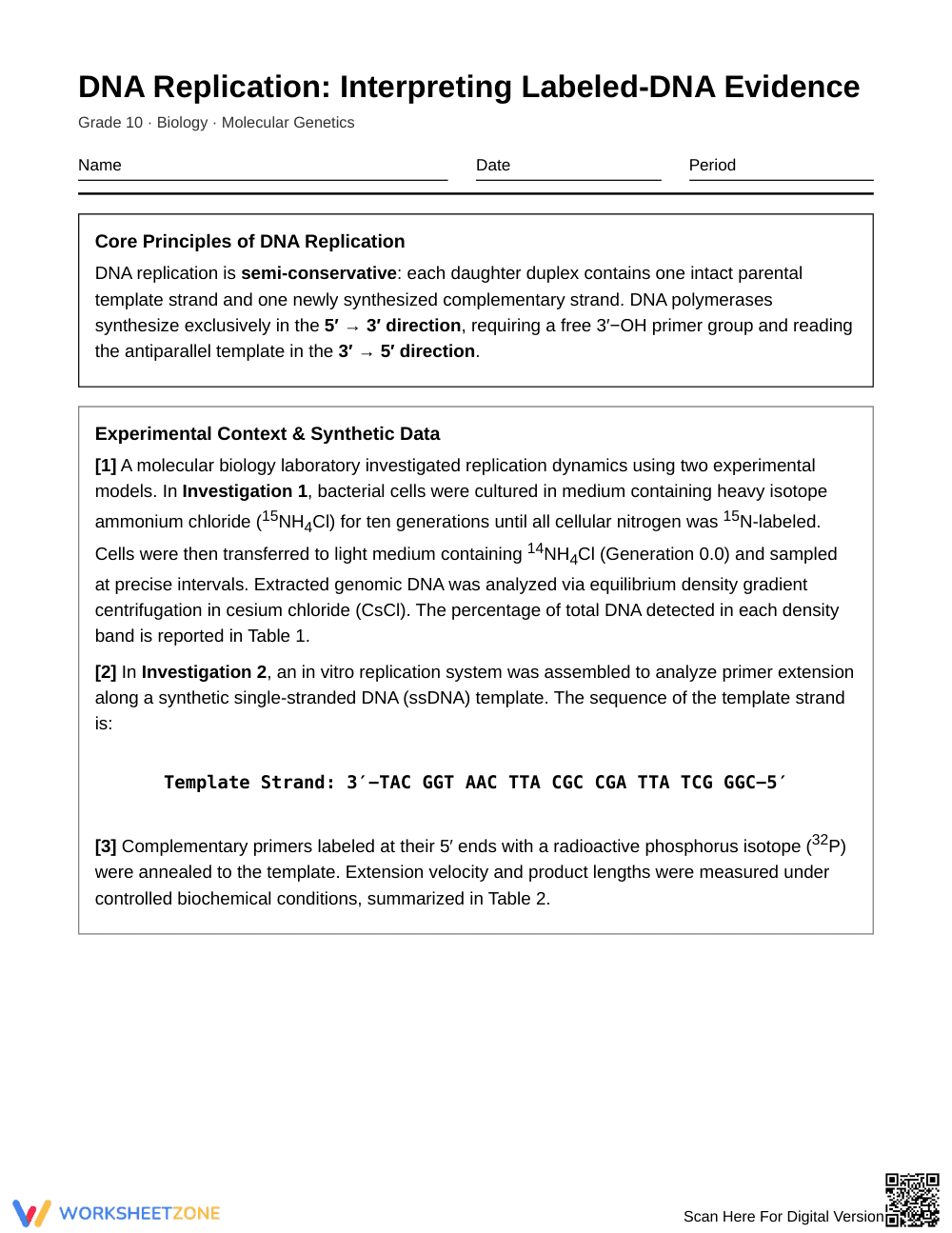
This comprehensive biology worksheet trains high school students to analyze experimental evidence from isotopic labeling and in vitro replication assays. Students evaluate quantitative density gradient data and primer extension conditions to confirm semi-conservative replication mechanisms, deduce antiparallel strand synthesis, and calculate multi-generation isotopic distributions. The resource equips learners to translate raw biochemical data into rigorous scientific explanations.
At a Glance
- Grade: 10 · Subject: Biology
- Standard: Molecular Genetics — Analyze isotopic evidence to evaluate models of semi-conservative DNA replication
- Skill Focus: Interpret Labeled-DNA Evidence
- Format: 5 pages · 10 problems · Answer key included · PDF
- Best For: Advanced genetics review or post-lab assessment
- Time: 45–55 minutes
What's Inside
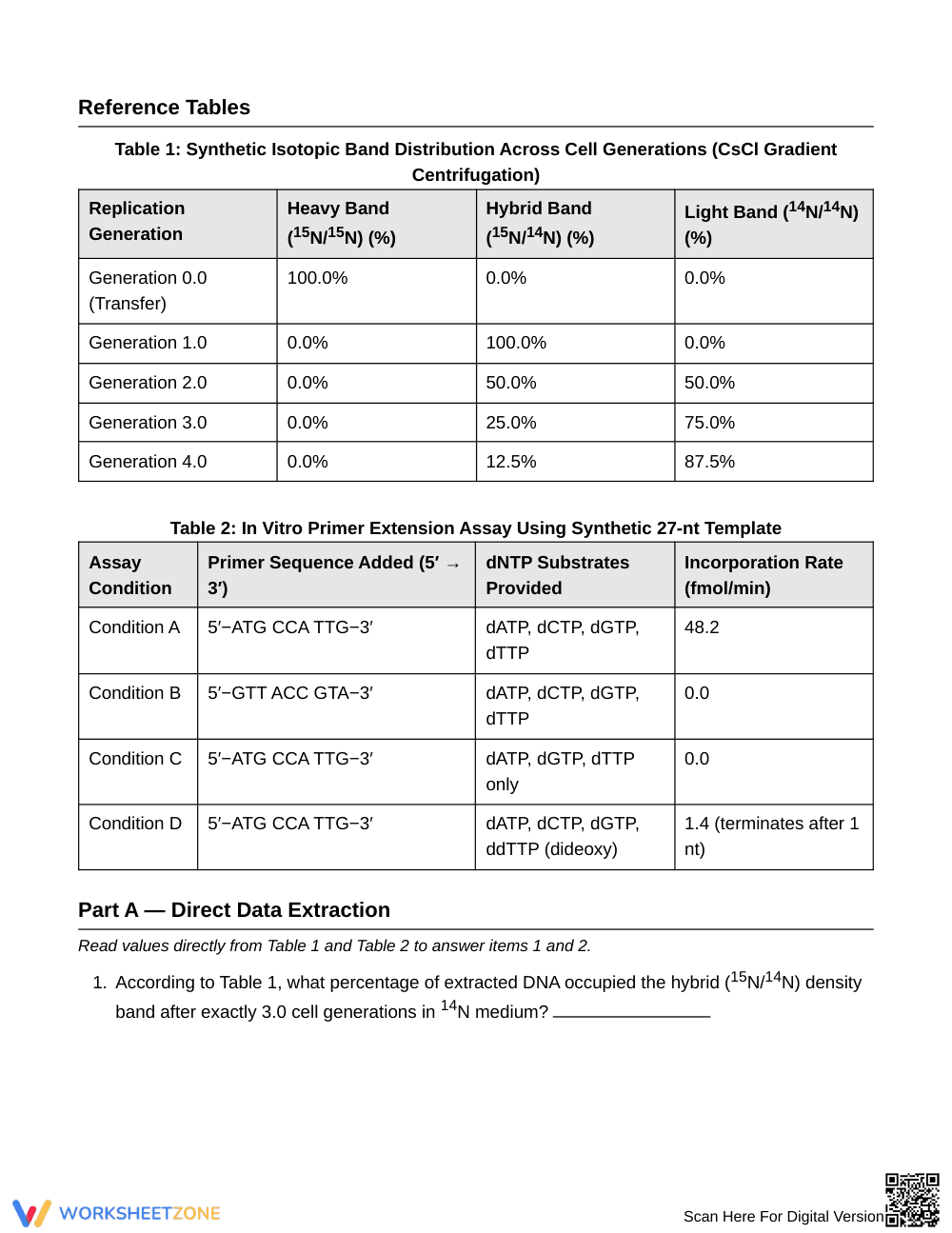
Across 5 thoughtfully organized pages, this resource presents 10 challenging analytical tasks grounded in two synthetic investigations: a Meselson-Stahl cesium chloride gradient experiment and a 32P-labeled primer extension assay. Structural features include complete reference tables, defined template sequences, and an exhaustive 3-page answer key detailing biochemical rationales, mathematical formulas, and common student errors.
Skill Progression
- Guided Practice (Items 1–2): Students extract direct data points from reference tables, confirming isotopic band percentages and identifying active primer sequences under complete scaffolded support.
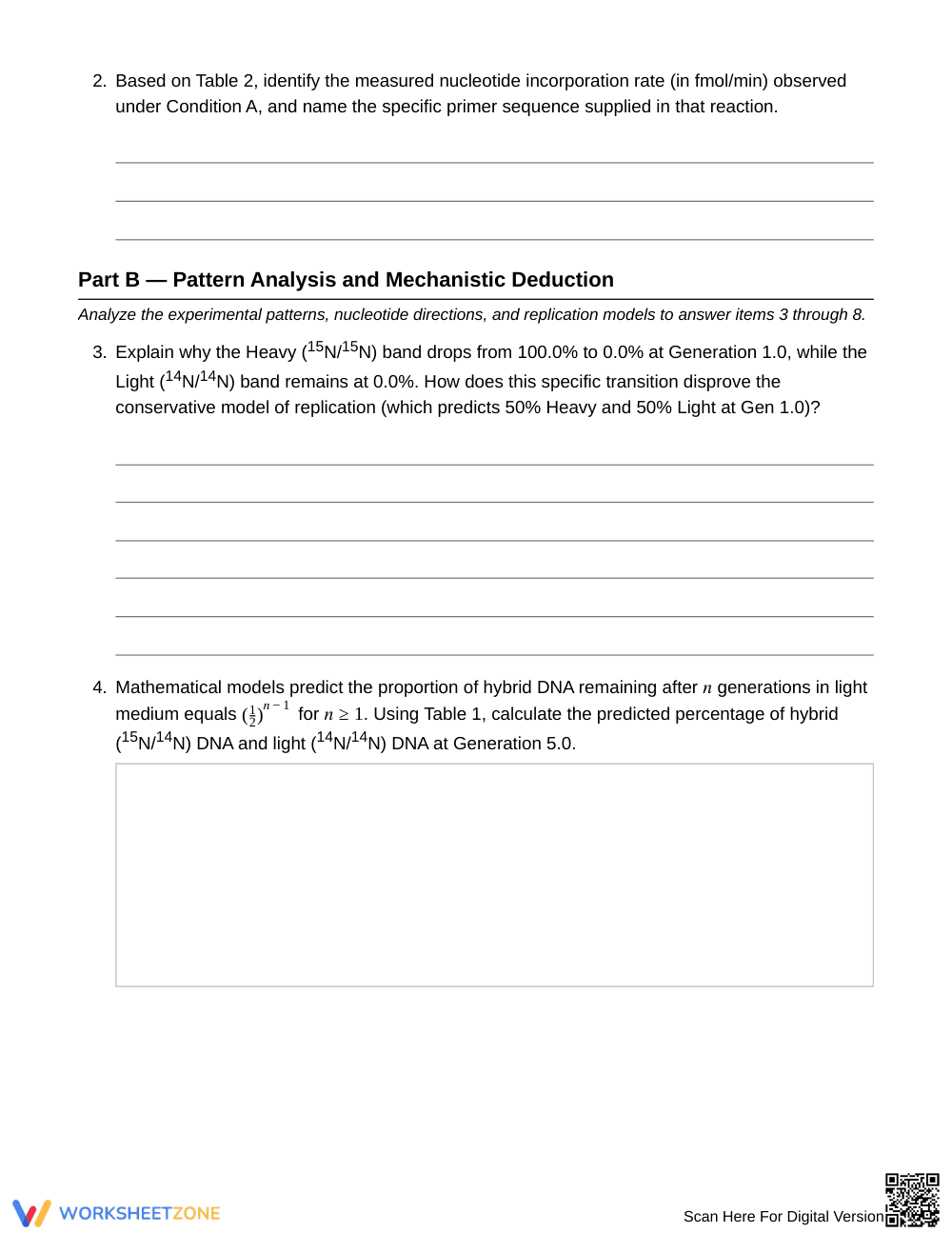
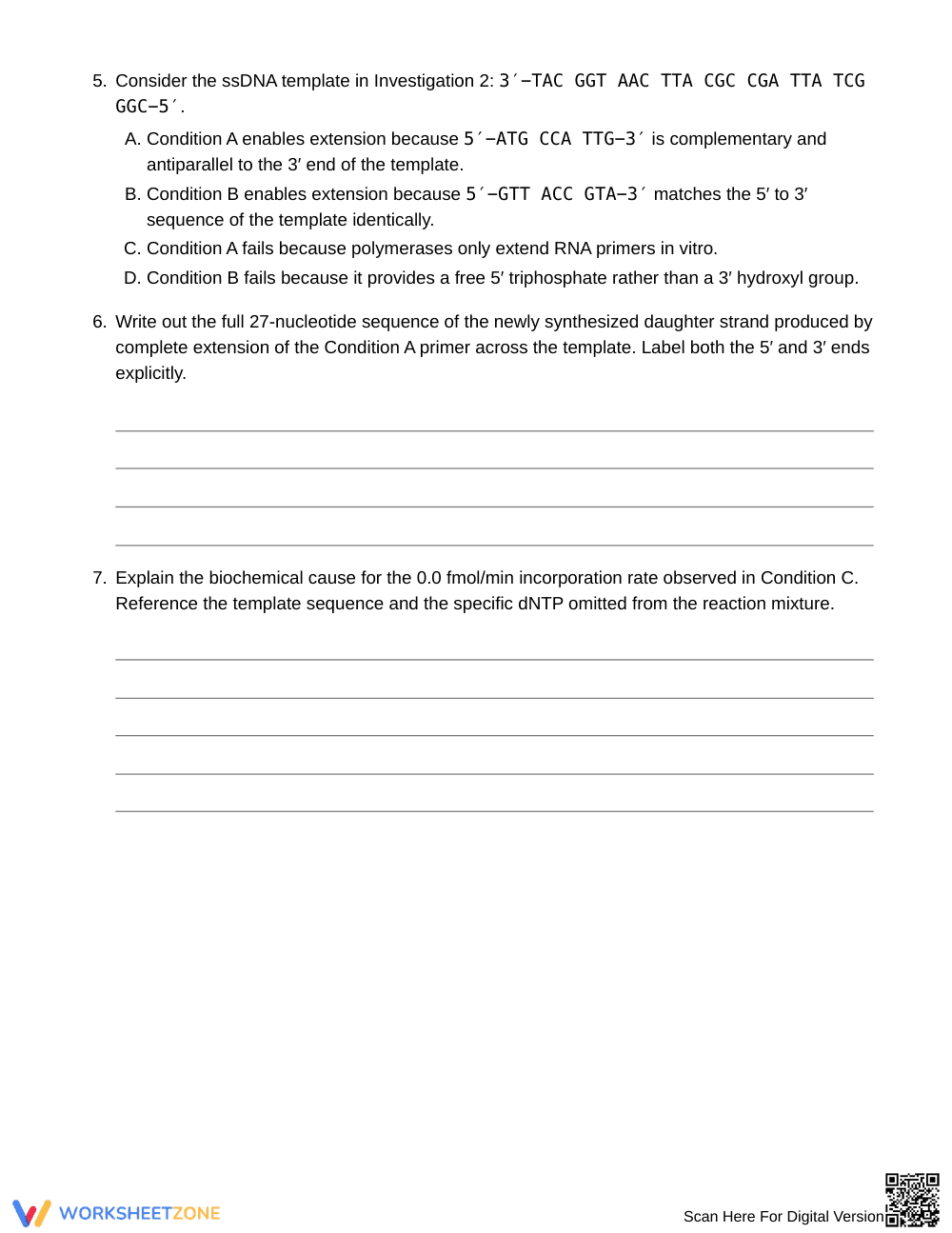
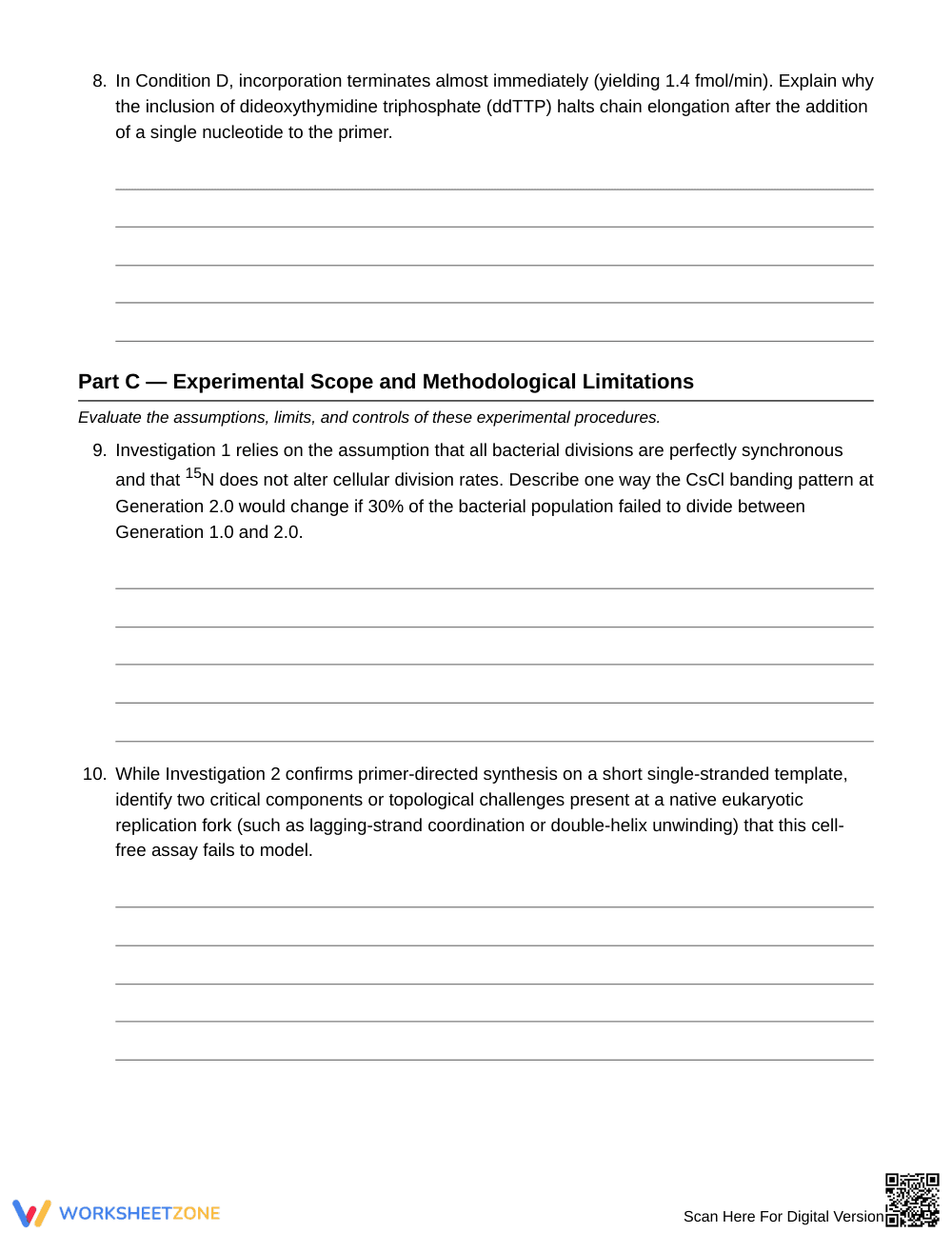
- Supported Practice (Items 3–8): Learners calculate multi-generational band distributions, explain why intermediate bands disprove conservative models, and deduce chain termination mechanisms caused by dideoxynucleotides.
- Independent Practice (Items 9–10): Students synthesize deep conceptual knowledge to predict banding shifts from non-synchronous division and critique the physiological limitations of in vitro assays.
This sequence mirrors the gradual-release framework, advancing students from foundational data retrieval to sophisticated mechanistic reasoning.
Standards Alignment
This worksheet aligns with high school molecular biology learning targets requiring students to evaluate empirical evidence supporting DNA structure and replication. Learners analyze quantitative data to defend the semi-conservative model over competing hypotheses and explain enzymatic 5′ to 3′ synthesis constraints. Both standard codes can be copied directly into lesson plans, IEP goals, or district curriculum mapping tools.
How to Use It
Deploy this worksheet after direct instruction on the Meselson-Stahl experiment and replication fork enzymes. As a formative assessment during independent study, observe whether students identify that dideoxynucleotides lack a 3′ hydroxyl group during Item 8; this reveals whether they understand the structural mechanics of elongation. Plan for 45 to 55 minutes of focused student work.
Who It's For
Designed for Grade 10 general biology and honors molecular genetics classrooms, this activity supports students ready for rigorous quantitative data analysis. For differentiated support, pair this worksheet with a physical nucleotide manipulation model or an interactive replication fork diagram to help visual learners trace strand antiparallelism before completing the open-response items.
Interpreting labeled-DNA evidence requires students to coordinate chemical principles, experimental models, and quantitative data. According to Fisher & Frey (2014), structured progression through scaffolded data tasks enables secondary science students to transition successfully from factual comprehension to complex causal argumentation. When analyzing isotopic density bands and primer extension assays, learners must not only extract raw numerical values from reference tables but also construct rigorous mechanistic claims regarding semi-conservative replication and antiparallel synthesis. Empirical research confirms that working directly with experimental findings solidifies conceptual understanding far more effectively than passive memorization. This ten-task worksheet operationalizes these cognitive demands through progressive analytical prompts and targeted methodological evaluation. By requiring students to explain biochemical anomalies—such as dideoxynucleotide chain termination and non-synchronous bacterial division—the resource effectively fosters the analytical precision and critical thinking demanded in modern high school life science courses.


