




























Views
Downloads



Essential Idea Development Worksheet | Grade 7 ELA

Paste this activity's link or code into your existing LMS (Google Classroom, Canvas, Teams, Schoology, Moodle, etc.).
Students can open and work on the activity right away, with no student login required.
You'll still be able to track student progress and results from your teacher account.
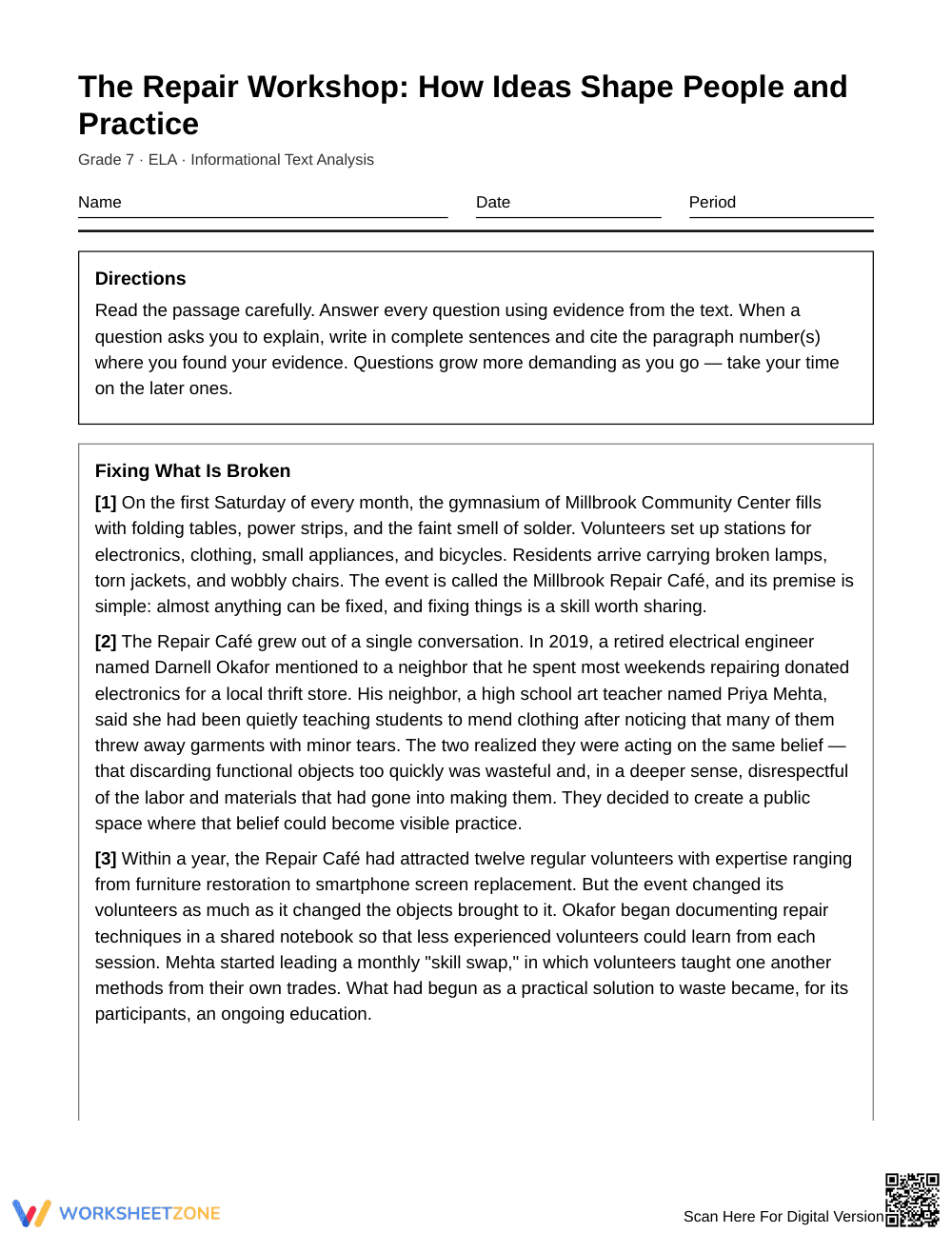
This Grade 7 informational text worksheet equips middle school readers to analyze how individuals, ideas, and events influence one another within a complete narrative nonfiction passage. Students read a multi-paragraph text about the Millbrook Repair Cafe, tracking conceptual shifts and evaluating how practical actions transform community perspectives through structured, text-dependent analysis questions.
At a Glance
- Grade: 7 · Subject: ELA
- Standard:
RI.7.3— Analyze how individuals, events, and ideas interact in informational text- Skill Focus: Idea-Development Reading Check
- Format: 5 pages · 12 problems · Answer key included · PDF
- Best For: Informational text reading comprehension check
- Time: 40–50 minutes
What's Inside
The 5-page printable resource includes the complete informational article “Fixing What Is Broken,” followed by 12 sequentially arranged questions divided into three distinct phases. Students engage with direct factual recall, analytical short responses, one text-structure multiple-choice question, and multi-paragraph synthesis prompts. A comprehensive 5-page answer key provides complete model responses and paragraph citations for efficient grading.
Skill Progression
- Guided Practice (Part A — Foundation): 3 targeted questions establish baseline comprehension by prompting students to retrieve explicit facts and cite specific paragraph numbers.
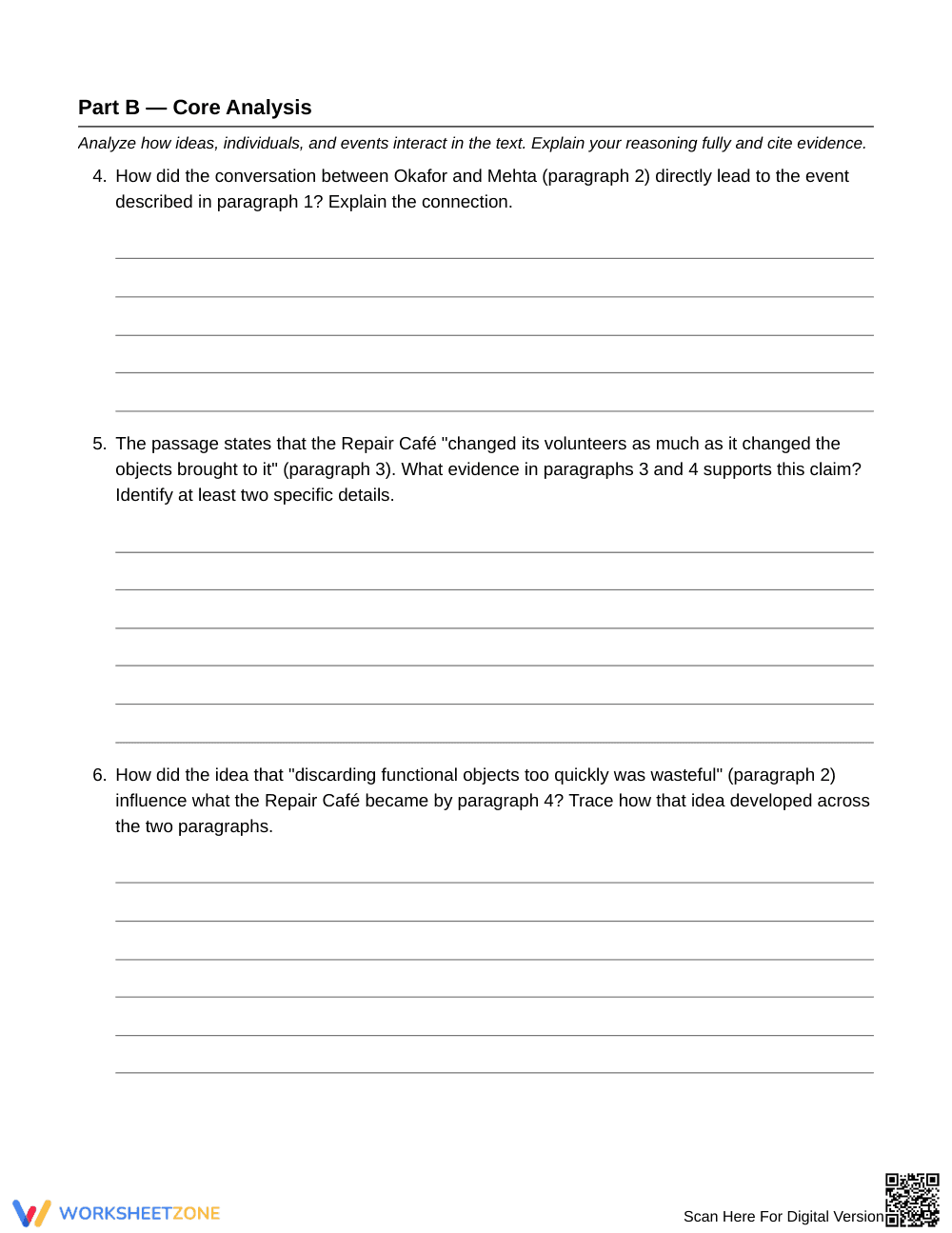
- Supported Practice (Part B — Core Analysis): 6 rigorous questions require learners to trace how founding ideas evolved across paragraphs and influenced volunteer actions.
- Independent Practice (Part C — Synthesis and Challenge): 3 evaluative prompts challenge students to contrast conflicting ideas and counter simplified claims using evidence from at least three paragraphs.
This sequence follows a gradual-release model, moving students systematically from foundational recall to complex textual synthesis.
Standards Alignment
This worksheet directly targets `RI.7.3`: “Analyze the interactions between individuals, events, and ideas in a text (e.g., how ideas influence individuals or events, or how individuals influence ideas or events).” As a supporting standard, `RI.7.1` reinforces citing several pieces of textual evidence to support inferences drawn from the passage. Both standard codes can be copied directly into lesson plans, IEP goals, or district curriculum mapping tools.
How to Use It
Deploy this activity during the guided practice phase of an informational text unit or immediately following direct instruction on idea tracking. To conduct a quick formative assessment, examine students’ responses to Part B, item 3; difficulty tracing how the anti-waste philosophy transformed into a learning exchange signals a need to re-teach conceptual development. The entire reading check requires approximately 40 to 50 minutes of focused class time.
Who It's For
Designed for Grade 7 general education ELA classes, this reading check also provides necessary structure for co-taught sections and intervention blocks. Paragraph markers and clear section headers support English learners and striving readers without lowering cognitive expectations. Pair this worksheet directly with a whole-group anchor chart on tracking cause-and-effect relationships across nonfiction texts.
Mastering standard `RI.7.3` requires students to analyze how individuals, ideas, and events interact in informational text rather than treating details in isolation. According to Fisher & Frey (2014), structured close-reading progressions that pair text-dependent prompts with explicit paragraph referencing significantly strengthen adolescent literacy and complex reasoning. When middle school students trace how an abstract concept develops across multiple paragraphs, they build the cognitive architecture required for sophisticated synthesis and high-level critical thinking. This 12-task worksheet implements that evidence-based instructional framework by guiding Grade 7 learners from explicit textual retrieval through nuanced structural critique. By grounding every response in concrete textual evidence, students demonstrate measurable mastery of core informational reading standards while developing analytical endurance for complex academic passages. Educators can utilize these diagnostic prompts to verify individual comprehension and inform targeted instructional interventions.


