




























Views
Downloads




Essential Idea Development Worksheet | Grade 7 ELA

Paste this activity's link or code into your existing LMS (Google Classroom, Canvas, Teams, Schoology, Moodle, etc.).
Students can open and work on the activity right away, with no student login required.
You'll still be able to track student progress and results from your teacher account.
This informational text analysis worksheet guides seventh-grade students through tracing how an author introduces, illustrates, and elaborates on a central concept across an entire passage. Working with an engaging informational text about community repair clinics, students analyze how interactions between individuals and events build deeper thematic claims.
At a Glance
- Grade: 7 · Subject: ELA
- Standard:
RI.7.3— Analyze how an author develops interactions between individuals, events, and ideas in informational text- Skill Focus: How One Idea Develops
- Format: 5 pages · 12 problems · Answer key included · PDF
- Best For: Close reading and informational text analysis
- Time: 40–50 minutes
What's Inside
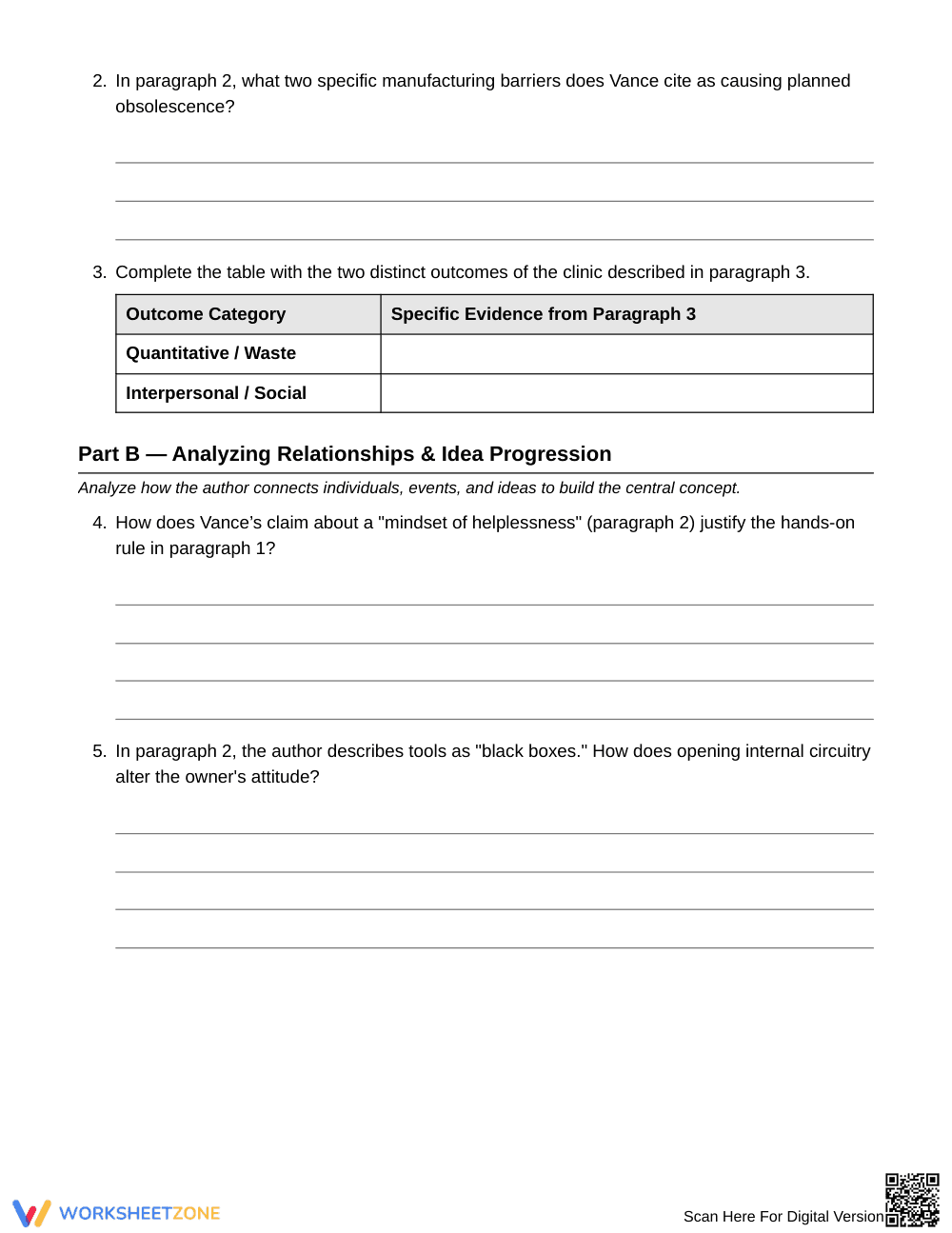
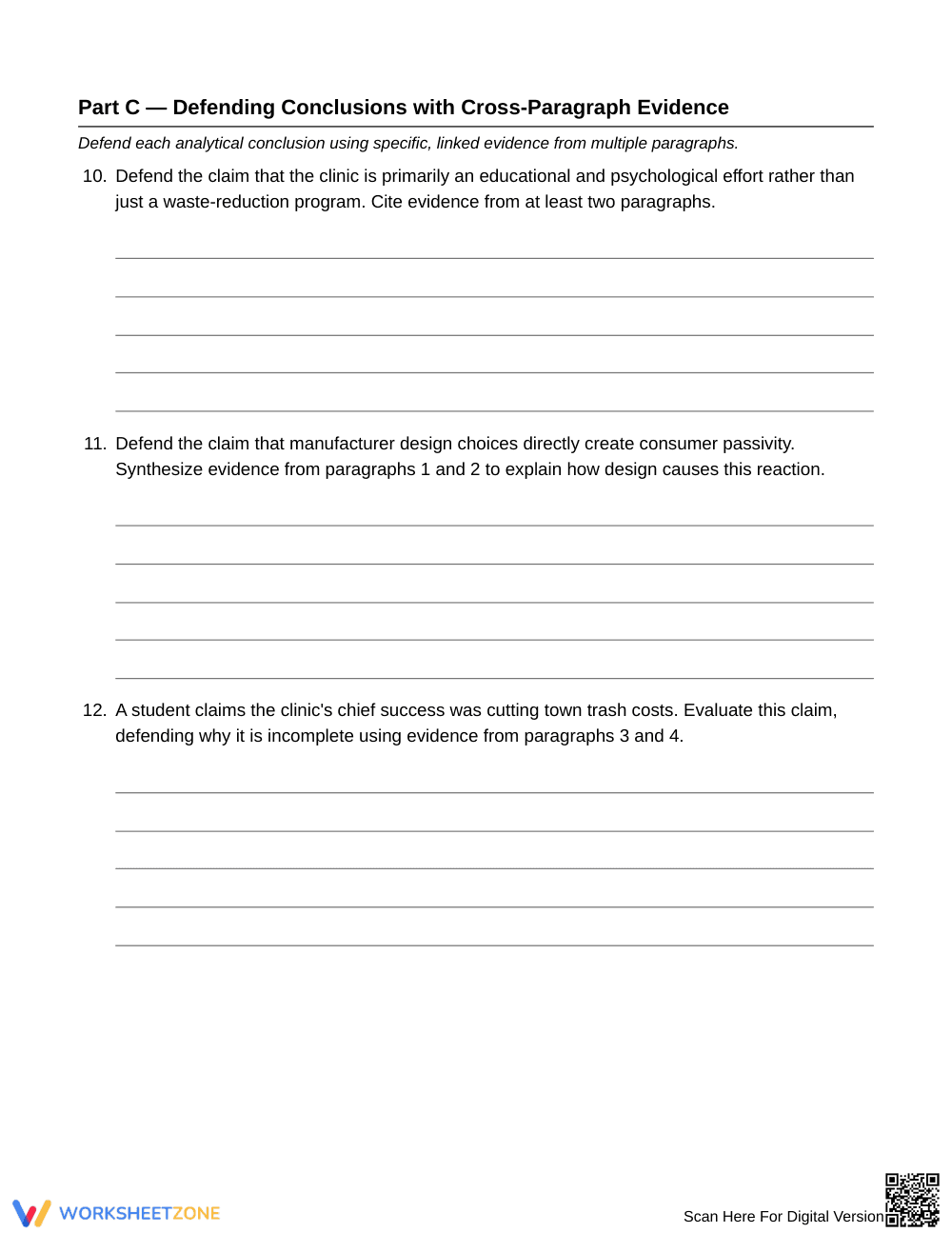
This 5-page printable packet features an original informational article, "Tracing Idea Development: The Maplewood Fixers Collective," paired with 12 targeted text-dependent questions. Tasks include multiple-choice identification, two-column evidence completion tables, short-answer relationship analyses, and multi-paragraph synthesis prompts, supported by a complete 2-page answer key.
Skill Progression
- Guided practice (Part A, Problems 1–3): Students identify explicit textual details and sort quantitative versus interpersonal outcomes into an evidence table with minimal inference demands.
- Supported practice (Part B, Problems 4–9): Students explain how specific quotes, metaphors, and generational interactions connect earlier paragraphs to later conceptual developments.
- Independent practice (Part C, Problems 10–12): Students defend multi-layered claims by synthesizing cross-paragraph evidence and evaluating competing arguments without prompting scaffolds.
This structured progression reflects the gradual release of responsibility model, moving students systematically from literal comprehension to rigorous analytical defense.
Standards Alignment
This resource directly targets RI.7.3: Analyze the interactions between individuals, events, and ideas in a text (e.g., how ideas influence individuals or events, or how individuals influence ideas or events). It also reinforces supporting standard RI.7.1 through rigorous citation requirements across all constructed-response items. Both standard codes can be copied directly into lesson plans, IEP goals, or district curriculum mapping tools.
How to Use It
Deploy this worksheet after direct instruction on informational text structures and author craft. For a whole-class lesson, read the central passage together, model the Part A evidence chart under a document camera, and assign Parts B and C for partnered or individual completion. During independent practice, circulate and observe whether students cite evidence from multiple paragraphs when answering Part C; students who quote only one paragraph need prompting to re-examine paragraph 4. Expected completion time is 40 to 50 minutes.
Who It's For
This activity is designed for general education Grade 7 ELA classes, co-taught inclusion settings, and Tier 2 reading intervention groups targeting informational analysis. Pair this practice set with an anchor chart on text-structure transitional phrases or a direct-instruction lesson on identifying author purpose.
According to Fisher & Frey (2014), purposeful close reading instruction requires students to move beyond surface-level recall into analyzing how authors structure and connect ideas across whole texts. This 12-task worksheet explicitly operationalizes standard RI.7.3 by requiring students to analyze how an author develops interactions between individuals, events, and central ideas. Through a carefully scaffolded informational passage, learners examine the development of civic agency from a local garage workshop into public school science classrooms. Students evaluate cause-and-effect relationships, interpret metaphorical language, and synthesize cross-paragraph evidence to defend complex textual arguments. The included 2-page answer key provides clear exemplar responses and criteria for analytical accuracy. This rigorous practice ensures middle school readers build the necessary evaluative skills to master complex informational texts across all content areas.


