


























Views
Downloads




Essential Fraction Division Worksheet | Grade 6 Math
Paste this activity's link or code into your existing LMS (Google Classroom, Canvas, Teams, Schoology, Moodle, etc.).
Students can open and work on the activity right away, with no student login required.
You'll still be able to track student progress and results from your teacher account.
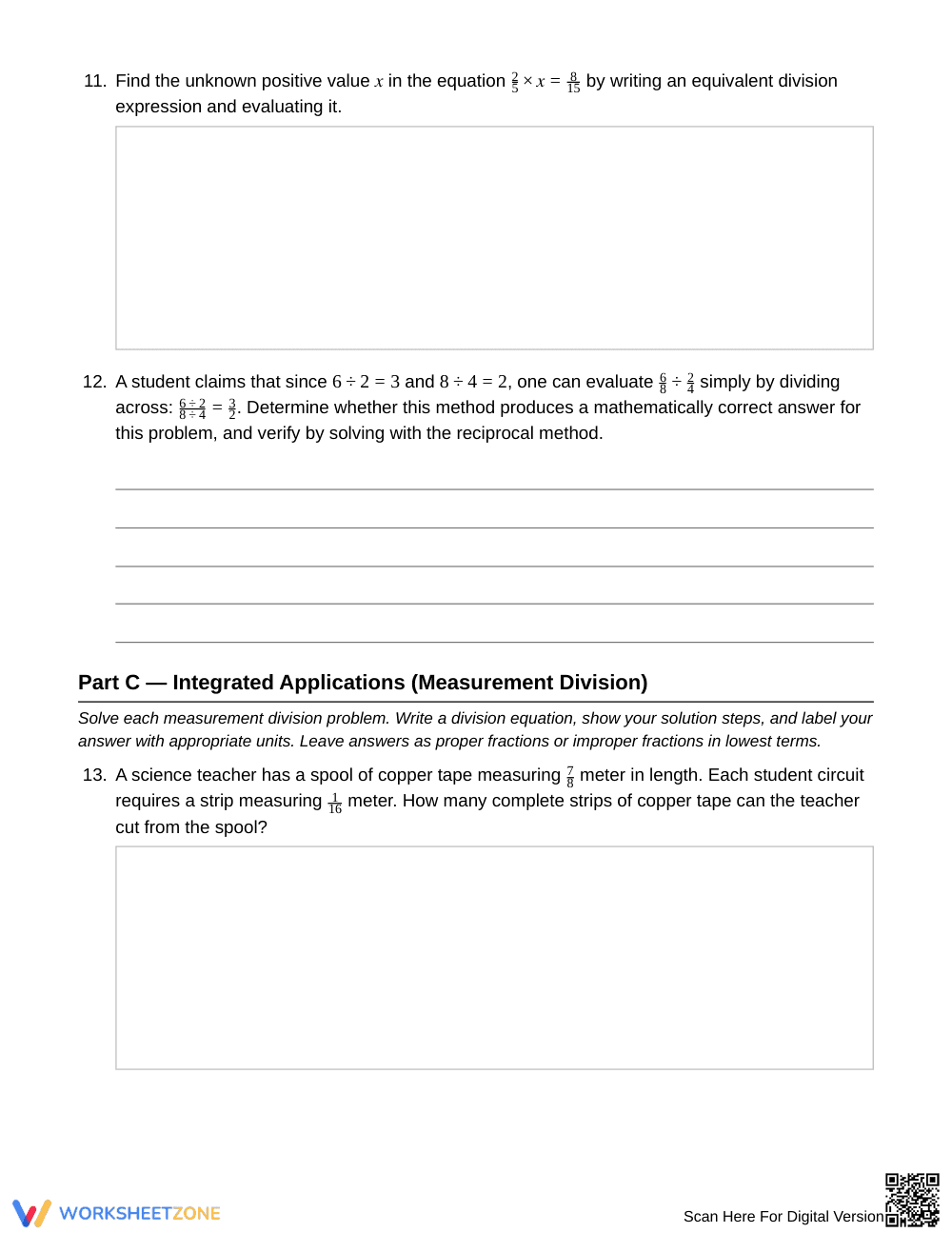
Mastering fraction division requires conceptual understanding and procedural fluency. This Grade 6 math worksheet provides 16 structured problems designed to help learners compute quotients, compare division methods, and simplify answers to lowest terms. Students build calculation skills while interpreting real-world measurement division scenarios.
At a Glance
- Grade: 6 · Subject: Math
- Standard:
6.NS.A.1— Compute fraction quotients and solve division word problems.- Skill Focus: Mix Fraction Quotients and Simplification
- Format: 5 pages · 16 problems · Answer key included · PDF
- Best For: Guided practice and skill mastery
- Time: 40–50 minutes
This 5-page printable PDF features 16 math tasks organized across three progressive sections, supported by a 3-page step-by-step answer key. Students solve conceptual prompts, compare solution strategies in a dual-method table, evaluate peer reasoning, and complete measurement word problems. A dedicated reference box provides explicit reciprocal and common-denominator rules.
The structured problem sequence provides intentional scaffolding across three distinct phases:
- Guided Practice (Part A, Problems 1–4): Learners prove reciprocals using multiplication equations, calculate quotients, and define measurement division meanings with strong structural support.
- Supported Practice (Part B, Problems 5–12): Students select efficient strategies, complete a method-comparison matrix, solve fractional equations, and critique non-standard student claims.
- Independent Practice (Part C, Problems 13–16): Students independently solve authentic measurement word problems involving science circuits, laboratory solutions, trail markers, and fractional volume scoops.
This gradual-release structure builds foundational confidence before requiring independent mathematical application.
This resource aligns with primary standard `6.NS.A.1`: Interpret and compute quotients of fractions, and solve word problems involving division of fractions. It also connects to supporting standard `6.EE.B.7` by requiring students to solve one-step fractional equations. Both standard codes can be copied directly into lesson plans, IEP goals, or district curriculum mapping tools.
Use this worksheet during or after direct instruction on dividing fractions. Pair students during Part B to debate method efficiency using the comparison table. Next, assign Part C as an independent formative assessment. Monitor whether students invert the correct fraction or forget to simplify quotients. Expected completion time is 40 to 50 minutes.
This worksheet serves Grade 6 math classrooms and provides targeted intervention for Grade 7 students needing prerequisite reinforcement. The explicit rule box supports English learners and striving students. Pair this resource with hands-on fraction bar manipulatives or an anchor chart displaying visual measurement models.
According to research documented in Fisher & Frey (2014), structured instructional sequences that move systematically from conceptual foundations to independent application significantly enhance student mastery of complex mathematical procedures. This Grade 6 instructional resource operationalizes standard 6.NS.A.1 by establishing firm conceptual grounds before requiring independent computation. By prompting learners to compute quotients of fractions, justify reciprocal relationships, and evaluate the mathematical validity of alternative strategies, the material reinforces flexible arithmetic reasoning. Students connect formal algorithmic procedures—such as inverting divisors and finding common denominators—directly to concrete measurement division contexts. Structured method-comparison charts and real-world application items ensure that learners not only calculate correct values but also articulate the quantitative meaning of fractional quotients. This dual focus on procedural fluency and conceptual justification promotes lasting retention and prepares middle school students for advanced algebraic operations.


