


























Views
Downloads



Essential Fraction Division Worksheet | Grade 6 Math
Paste this activity's link or code into your existing LMS (Google Classroom, Canvas, Teams, Schoology, Moodle, etc.).
Students can open and work on the activity right away, with no student login required.
You'll still be able to track student progress and results from your teacher account.
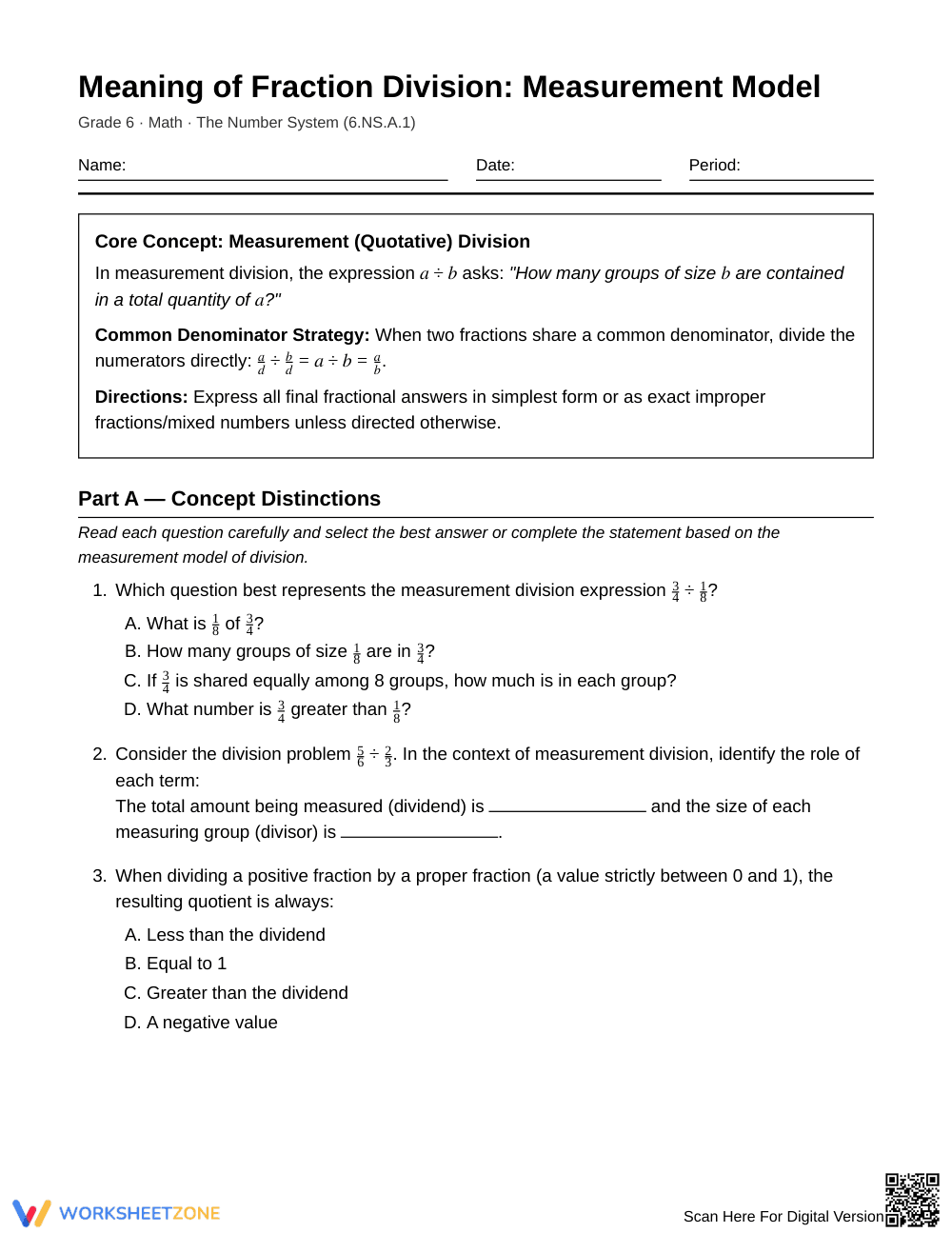
This Grade 6 math worksheet develops conceptual understanding of fraction division through the quotative measurement model. Students analyze division expressions, compute quotients using common denominators, and justify their reasoning through written explanations and error analysis. It moves learners from rote algorithms toward genuine mathematical comprehension.
At a Glance
- Grade: 6 · Subject: Math
- Standard:
6.NS.A.1— Interpret and compute quotients of fractions using models and equations- Skill Focus: Meaning of Fraction Division
- Format: 5 pages · 16 problems · Answer key included · PDF
- Best For: Conceptual math practice and intervention
- Time: 35–45 minutes
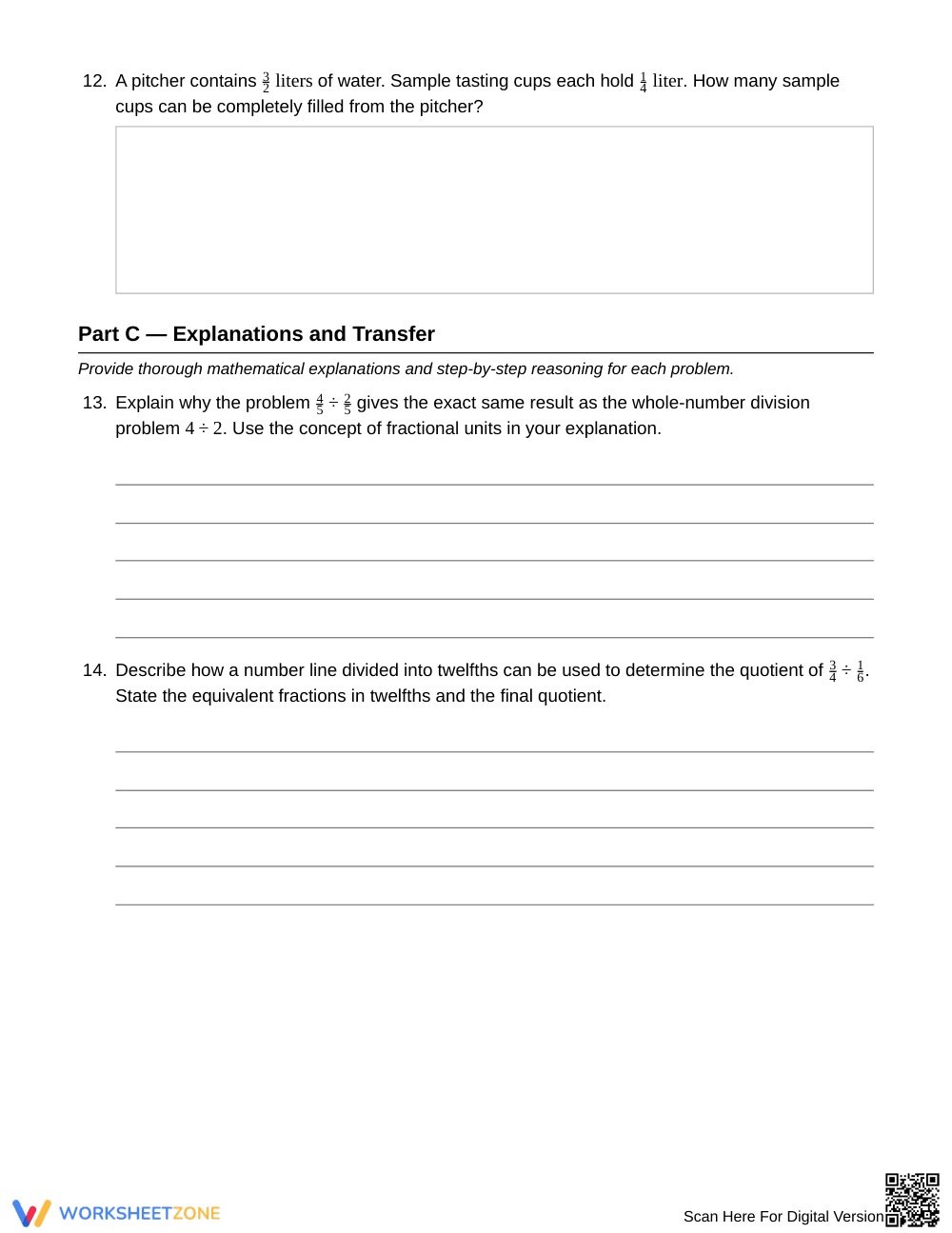
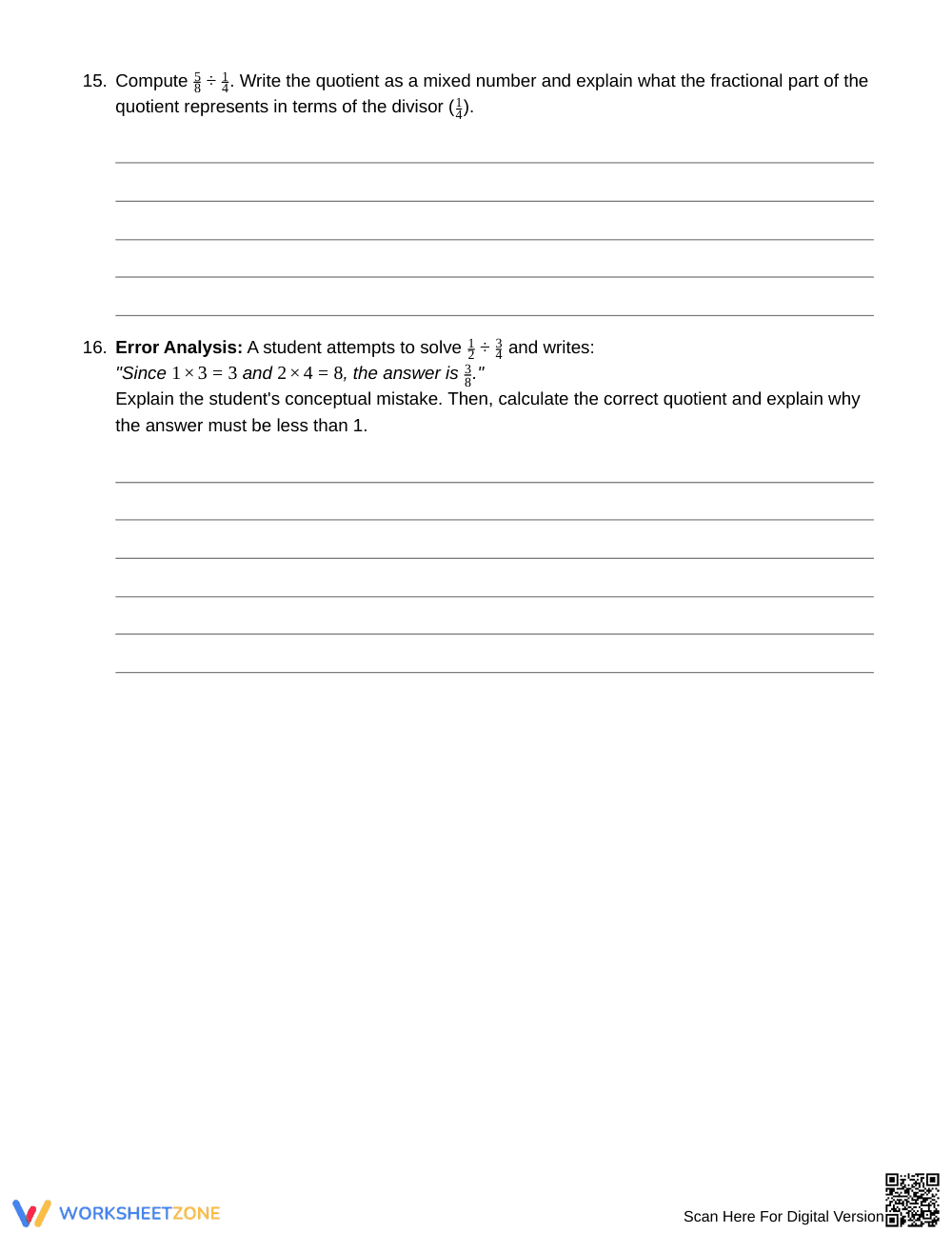
What's Inside: The 5-page worksheet includes a core concept reference box defining quotative division, followed by 16 math tasks. Students encounter conceptual identification questions, direct computation, ribbon and liquid measurement word problems, and transfer prompts. A complete 2-page answer key provides fully worked solutions for every problem.
Skill Progression
- Guided Practice (Part A, 4 items): Conceptual questions prompt students to identify dividend and divisor roles, examine quotient magnitude, and evaluate common denominator setups.
- Supported Practice (Part B, 8 items): Computational exercises and real-world measurement word problems require students to apply common denominators or reciprocal multiplication.
- Independent Practice (Part C, 4 items): High-demand transfer tasks challenge students to write unit fraction justifications, interpret remainder fractions on number lines, and perform error analysis.
This structured progression follows the gradual release of responsibility framework.
Standards Alignment
This resource aligns directly with standard 6.NS.A.1: Interpret and compute quotients of fractions, and solve word problems involving fraction division. It also supports mathematical practice MP.3 by requiring students to construct arguments and critique reasoning during error analysis. Both standard codes can be copied directly into lesson plans, IEP goals, or district curriculum mapping tools.
How to Use It
Deploy this worksheet after introducing fraction division models, or use it during targeted intervention to address procedural gaps. During independent work, observe whether students confuse dividend and divisor in Part A before computing in Part B. Most sixth-grade students complete all 16 tasks within 35 to 45 minutes of class time.
Who It's For
This activity is designed for sixth-grade math students, intervention cohorts needing conceptual reinforcement, and resource specialists supporting IEP goals. For students needing extra scaffolding, pair this worksheet with visual fraction tile manipulatives or a fraction number line anchor chart.
Mastering the conceptual meaning of fraction division under standard 6.NS.A.1 requires students to connect quotative measurement models to symbolic computation. According to Fisher & Frey (2014), structured instructional materials that sequence foundational concept identification, contextual word problems, and metacognitive error analysis significantly increase student retention and transfer in middle school mathematics. This 5-page worksheet provides 16 focused problems designed to bridge procedural fluency and conceptual depth. By asking learners to explain why common denominator division functions identically to whole-number division and analyze common arithmetic missteps, the resource prevents common misconceptions surrounding fraction operations. Teachers can use this standards-aligned resource for whole-class instruction, small-group remediation, or formative assessment to ensure every Grade 6 student demonstrates true mathematical reasoning before progressing to multi-step rational number operations.


