




























Views
Downloads



Essential Figurative Language Worksheet | Grade 6 ELA

Paste this activity's link or code into your existing LMS (Google Classroom, Canvas, Teams, Schoology, Moodle, etc.).
Students can open and work on the activity right away, with no student login required.
You'll still be able to track student progress and results from your teacher account.
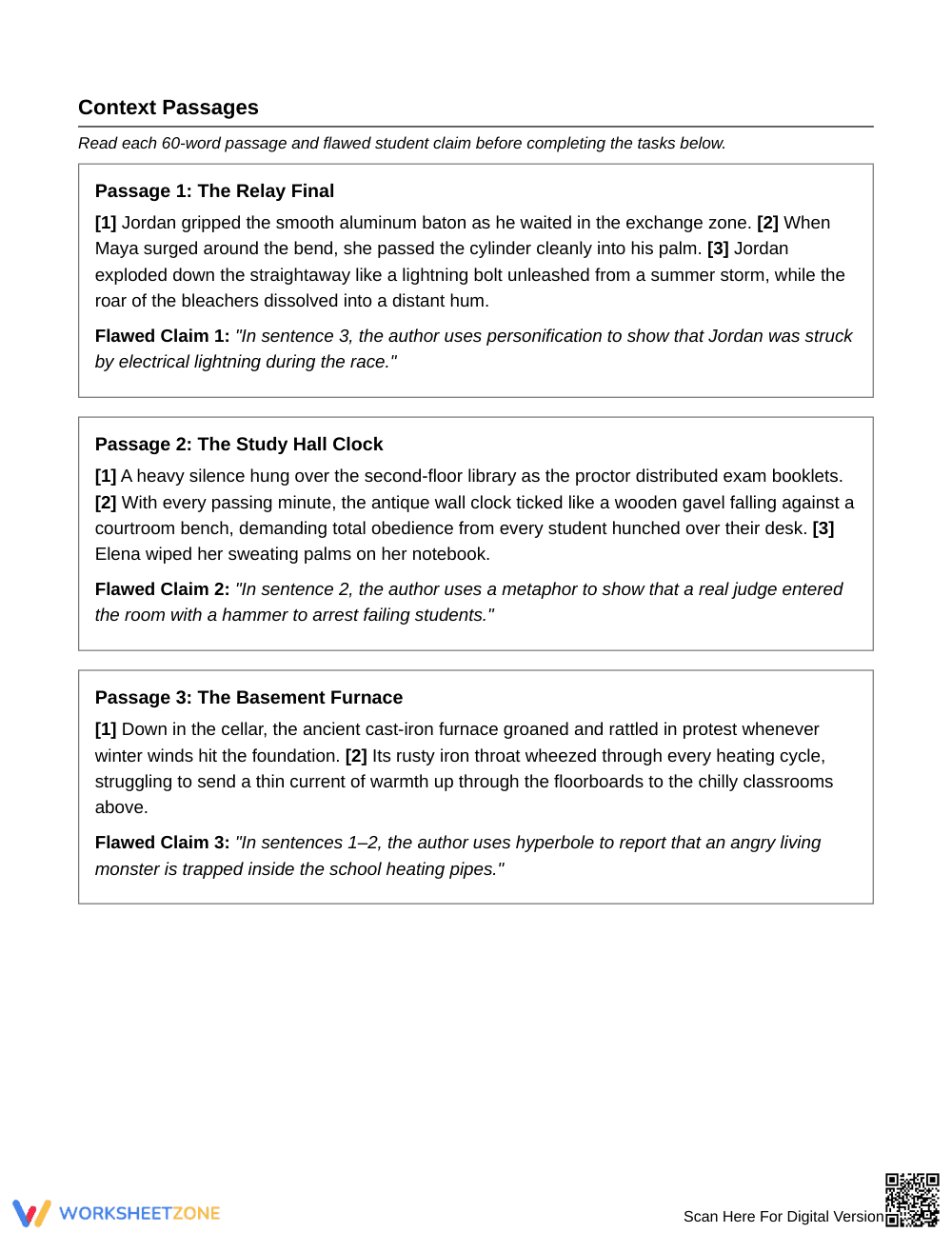
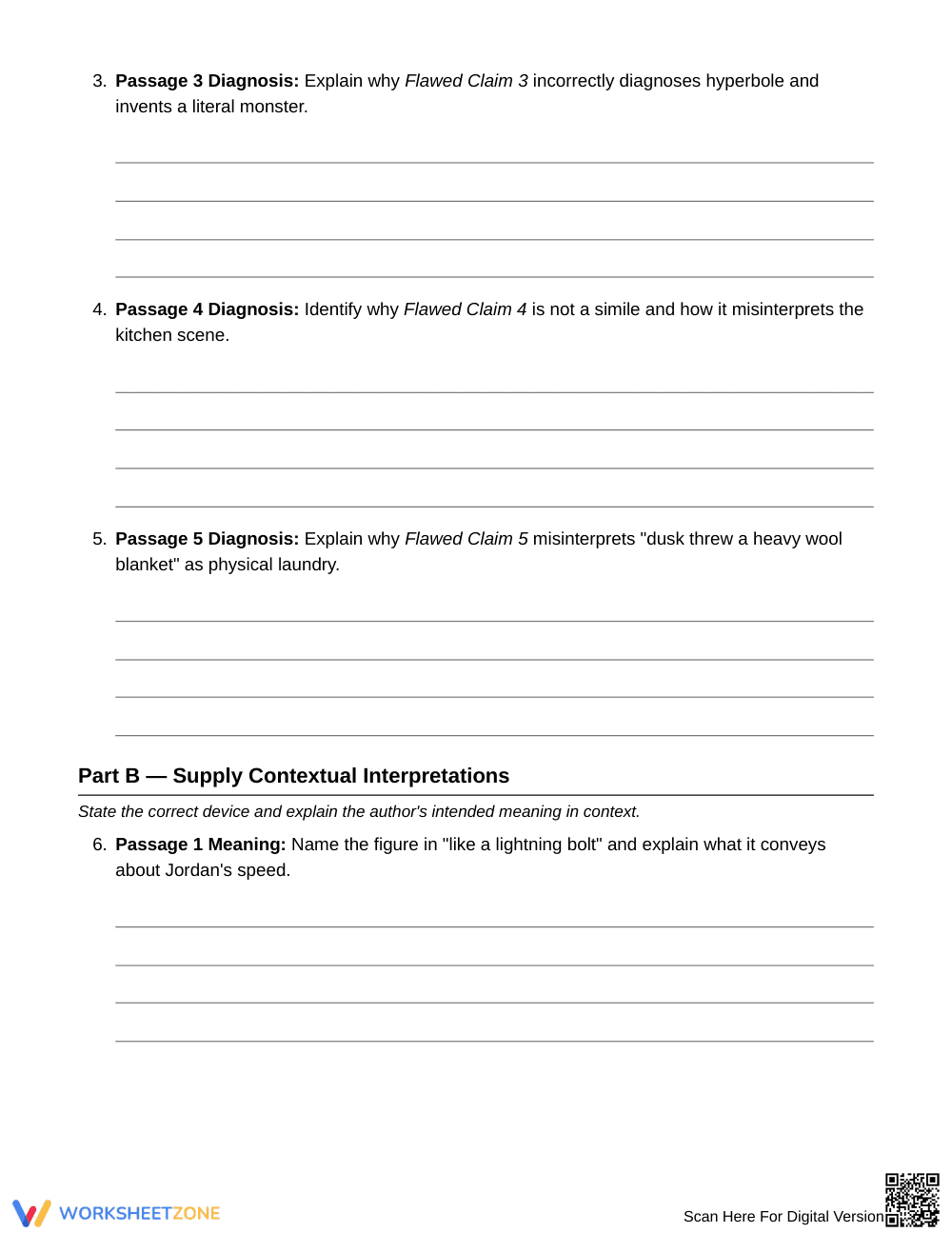
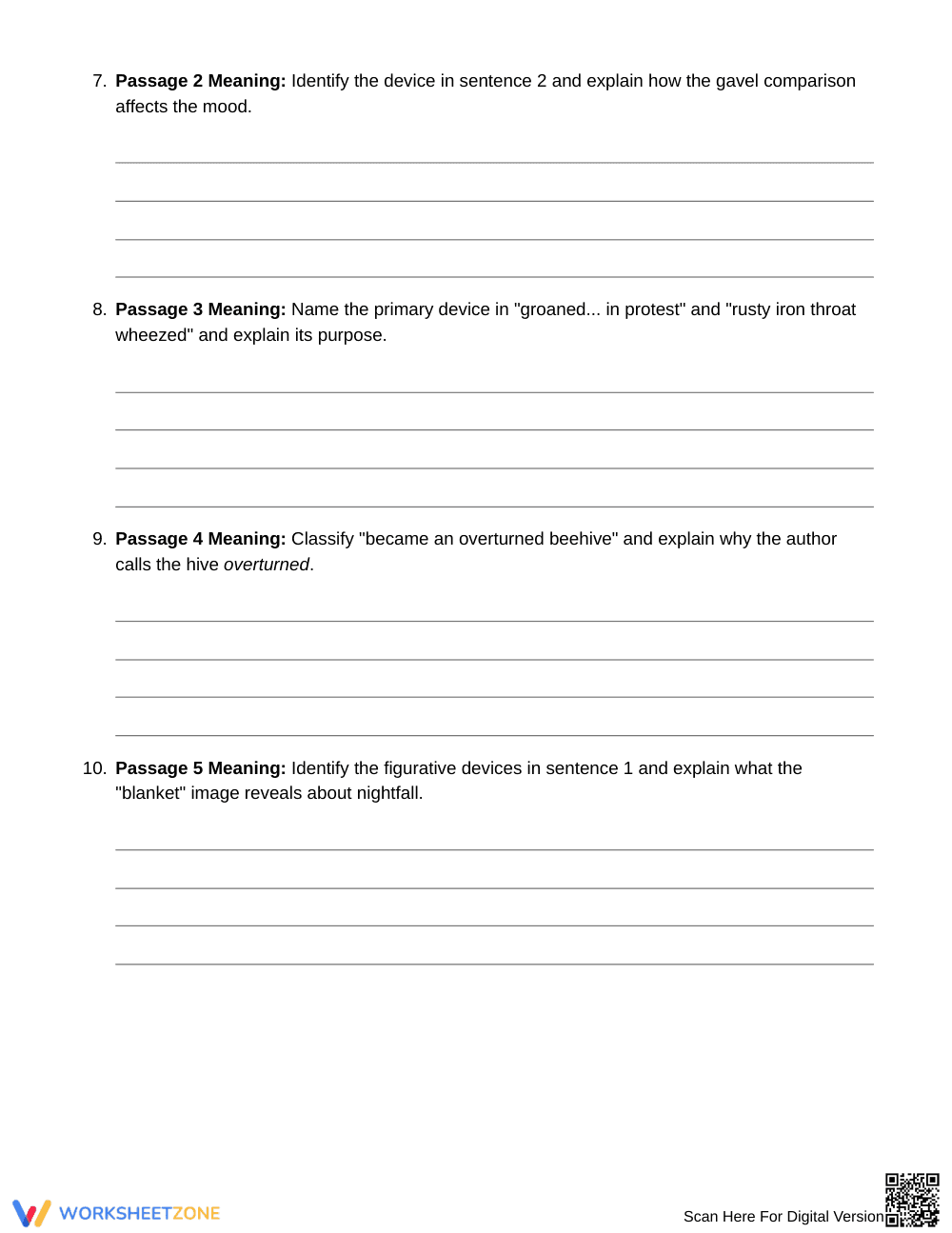
This Grade 6 ELA worksheet trains students to detect, diagnose, and correct literal misinterpretations of figurative language across authentic narrative passages. Students evaluate flawed student claims, identify correct devices, and explain intended non-literal meanings in context to master standard L.6.5.a.
At a Glance
- Grade: 6 · Subject: ELA
- Standard:
L.6.5.a— Interpret figures of speech in context and explain their non-literal meaning- Skill Focus: Repairing misread figures of speech
- Format: 5 pages · 10 problems · Answer key included · PDF
- Best For: Independent practice, intervention, or test review
- Time: 30–45 minutes
What's Inside
This 5-page printable resource includes a comprehensive Figurative Language Guide defining similes, metaphors, personification, and hyperboles with signal words. It features a complete model error repair, five 60-word narrative passages with flawed student claims, 10 analytical tasks split into diagnosis and contextual interpretation sections, and a full 2-page answer key.
Skill Progression
- Guided practice: Students examine a reference chart defining 4 core figurative devices alongside a fully annotated model repair that demonstrates how to unpack and correct a flawed literal claim.
- Supported practice (Part A, 5 tasks): Learners diagnose 5 misidentified claims, explaining why each claim confuses literal events with literary devices like hyperbole, personification, or simile.
- Independent practice (Part B, 5 tasks): Students independently identify the true device in each passage and compose written interpretations explaining what the author conveys in context.
This structured progression follows a proven gradual-release model, moving middle school readers from error detection to deep contextual analysis.
Standards Alignment
This worksheet directly aligns with primary standard `L.6.5.a`: Interpret figures of speech (e.g., personification) in context. It also supports RL.6.4 by requiring students to determine the meaning of words and phrases as they are used in a text, including figurative meanings. Both standard codes can be copied directly into lesson plans, IEP goals, or district curriculum mapping tools.
How to Use It
Administer this worksheet after direct instruction on figures of speech to assess whether students can distinguish literal descriptions from figurative imagery. During independent work time, circulate to observe whether students confuse vehicle and tenor when analyzing metaphors like the kitchen hive or harbor blanket. Expect completion within 30 to 45 minutes.
Who It's For
This activity is designed for Grade 6 general education English classes, reading intervention groups, and multilingual learners who benefit from explicit contrastive analysis between literal and non-literal statements. It pairs naturally with narrative short stories or descriptive poetry units.
According to Fisher & Frey (2014), explicit error analysis and guided modeling accelerate adolescent literacy development by prompting students to monitor comprehension and actively correct faulty assumptions. Teaching students to interrogate misconceptions surrounding figurative devices directly reinforces standard L.6.5.a, which requires Grade 6 learners to interpret figures of speech in context rather than defaulting to surface-level literal decodings. When middle school readers systematically distinguish between literal reality and metaphorical meaning across varied narrative passages, their text-level comprehension and analytical writing skills improve measurably.


