


























Views
Downloads


Essential Fair Phase-Change Worksheet | Grade 7 Science
Paste this activity's link or code into your existing LMS (Google Classroom, Canvas, Teams, Schoology, Moodle, etc.).
Students can open and work on the activity right away, with no student login required.
You'll still be able to track student progress and results from your teacher account.
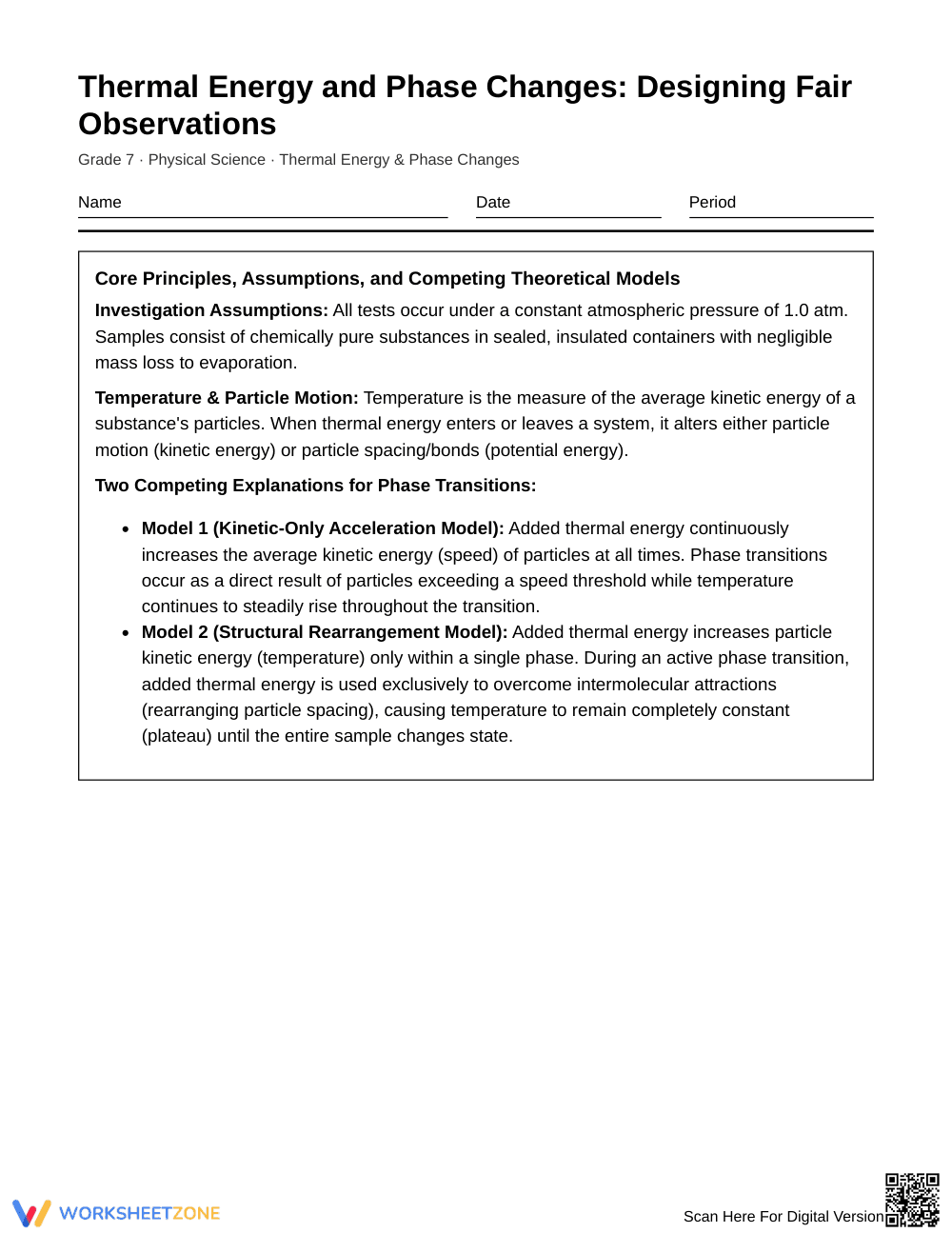
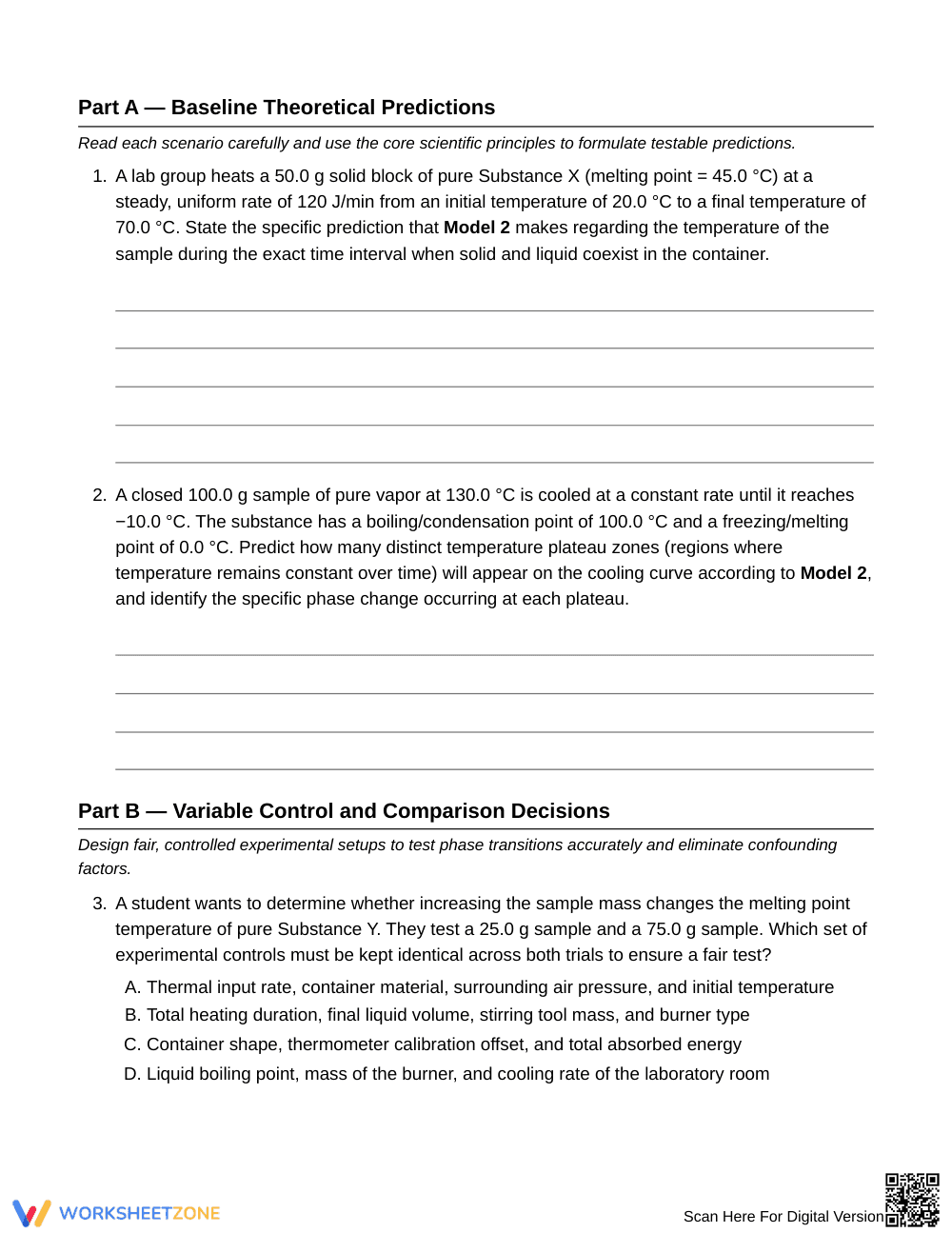
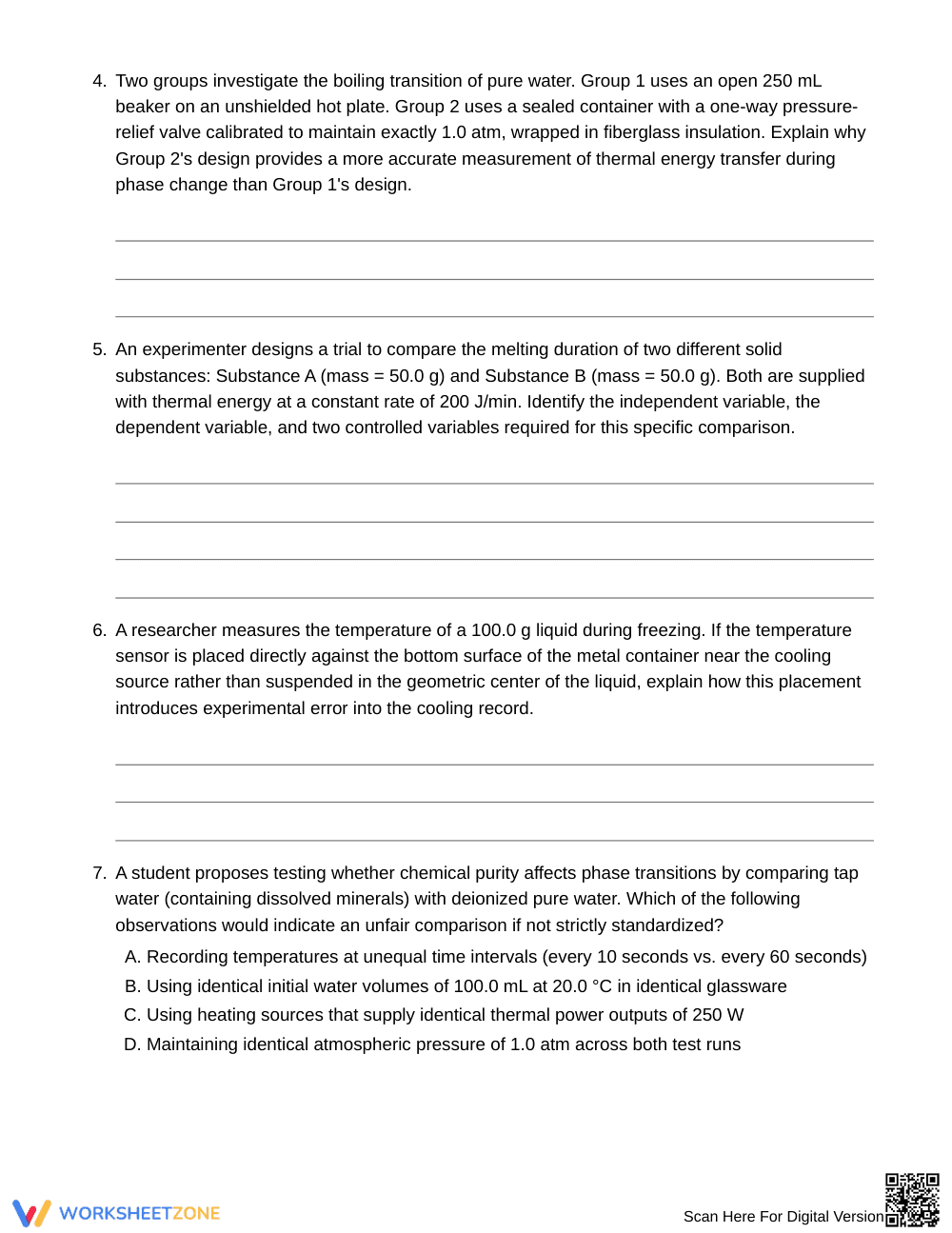
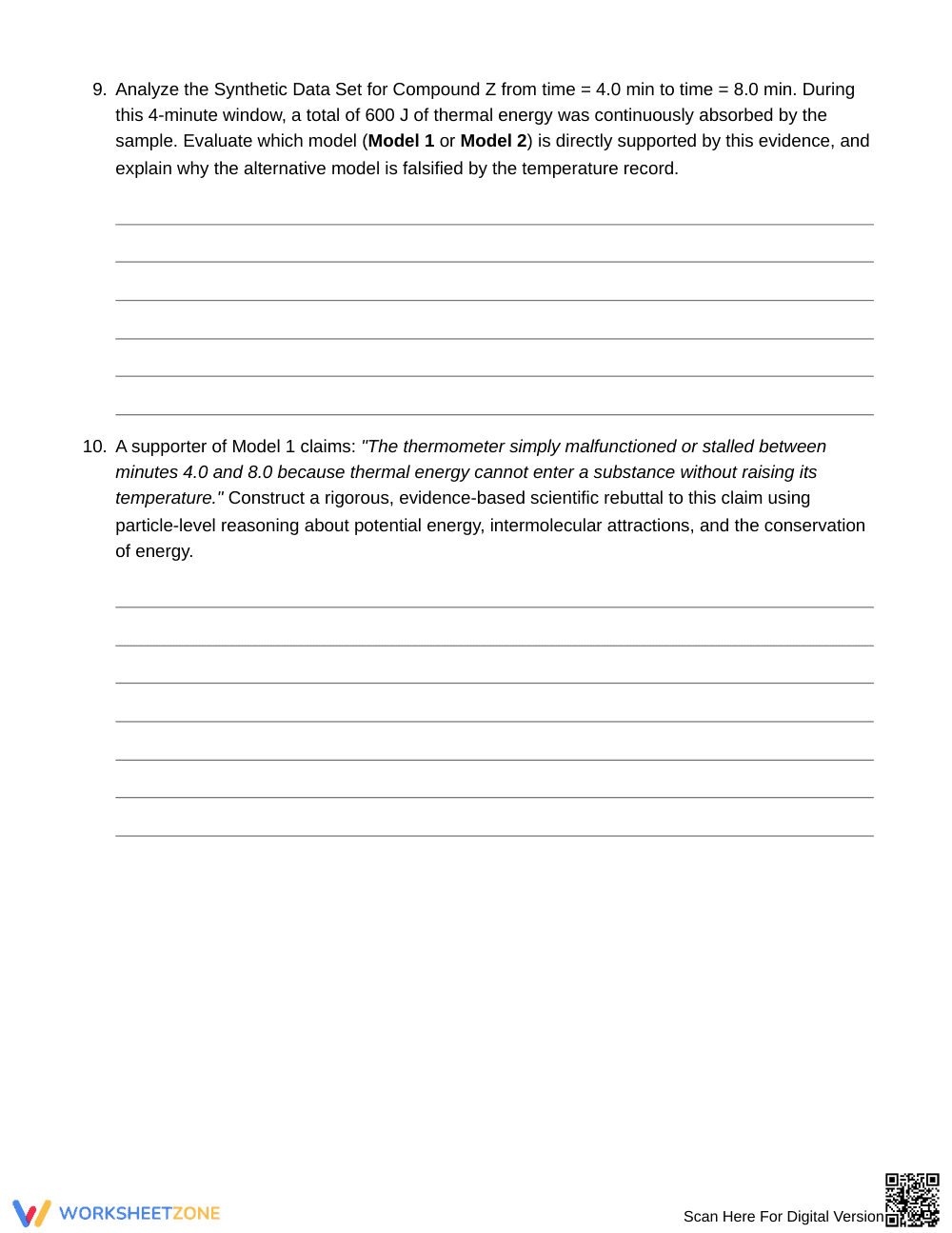
This physical science worksheet equips Grade 7 students with practice in designing controlled thermal investigations. Across 10 analytical tasks, learners evaluate competing theoretical models, control experimental variables during phase changes, and interpret empirical heating datasets to explain particle motion and energy transfer.
At a Glance
- Grade: 7 · Subject: Science
- Standard: Physical Science — Design fair investigations to observe phase changes and thermal energy
- Skill Focus: Design a Fair Phase-Change Observation
- Format: 5 pages · 10 problems · Answer key included · PDF
- Best For: Lab preparation, variable control, and inquiry
- Time: 40–50 minutes
What's Inside
This 5-page printable resource delivers 10 structured analytical tasks. Students evaluate competing particle models, critique experimental setups for fair testing, and interpret empirical heating tables. A comprehensive 3-page answer key includes model explanations and particle-level reasoning guides.
Skill Progression
- Guided practice (Tasks 1–2): Students apply theoretical principles to predict plateau behavior on heating and cooling curves.
- Supported practice (Tasks 3–8): Learners evaluate variable control, sensor placement, insulation, and standardization across 6 experimental scenarios.
- Independent practice (Tasks 9–10): Students analyze a synthetic dataset for Compound Z and write an evidence-based rebuttal regarding latent heat.
This structured sequence follows a gradual-release model, building from conceptual prediction to complex experimental critique.
Standards Alignment
This resource aligns with middle school physical science expectations for thermal energy and matter interactions. Students examine how heat input affects particle motion and state changes during fair tests. Standard descriptions can be copied directly into lesson plans, IEP goals, or district curriculum mapping tools.
How to Use It
Use this worksheet mid-unit after introducing kinetic theory and before laboratory investigations. It serves as an effective pre-lab readiness task or small-group activity. Formatively assess whether students recognize constant temperature plateaus during active phase transitions in Task 9. Expected completion time is 40 to 50 minutes.
Who It's For
Designed for Grade 7 science students in general education, honors, or co-taught classrooms. Scaffolding supports emerging learners with structured tables, while open responses challenge advanced thinkers. It pairs naturally with a phase-change direct instruction lesson or a heating curve lab.
According to research in science pedagogy by Fisher & Frey (2014), structured inquiry tasks that require middle school students to evaluate competing scientific models significantly improve conceptual retention and analytical reasoning. When Grade 7 students analyze controlled variables and evaluate temperature plateaus in empirical datasets, they develop a robust understanding of thermal energy transfer, particle motion, and phase equilibrium. Educational research demonstrates that isolating experimental variables through explicit written critiques prepares students for authentic laboratory investigations. By contrasting continuous kinetic acceleration models with structural rearrangement principles across 10 structured tasks, learners directly confront persistent misconceptions regarding latent heat and constant temperature during physical state transitions. This systematic instructional progression successfully bridges theoretical kinetic-molecular concepts with rigorous empirical verification, ensuring that students articulate coherent claims supported by scientific evidence, conservation of energy principles, and quantitative experimental data.


