




























Views
Downloads

Essential Explorers Word Search | Grades 7–8 Social Studies

Paste this activity's link or code into your existing LMS (Google Classroom, Canvas, Teams, Schoology, Moodle, etc.).
Students can open and work on the activity right away, with no student login required.
You'll still be able to track student progress and results from your teacher account.
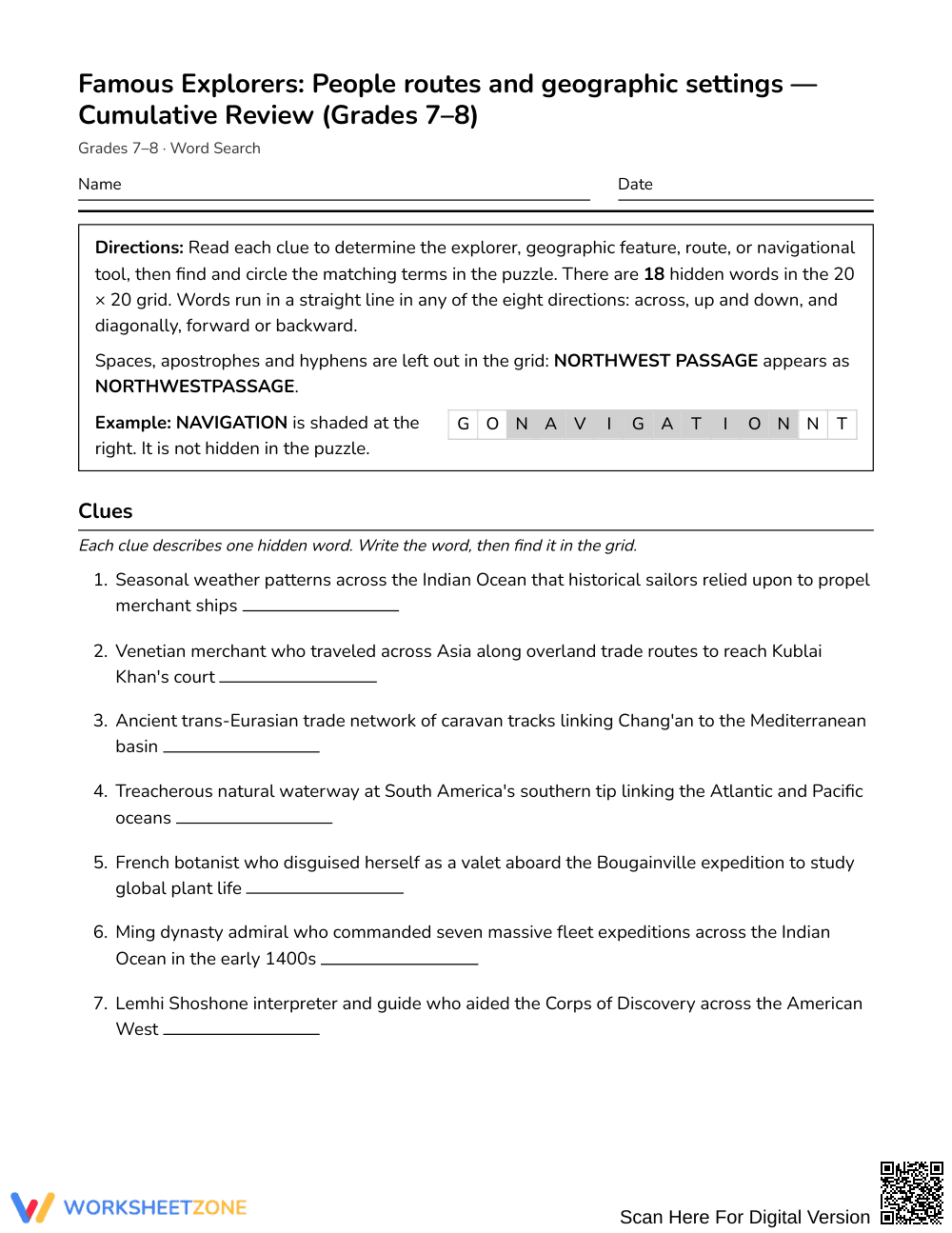
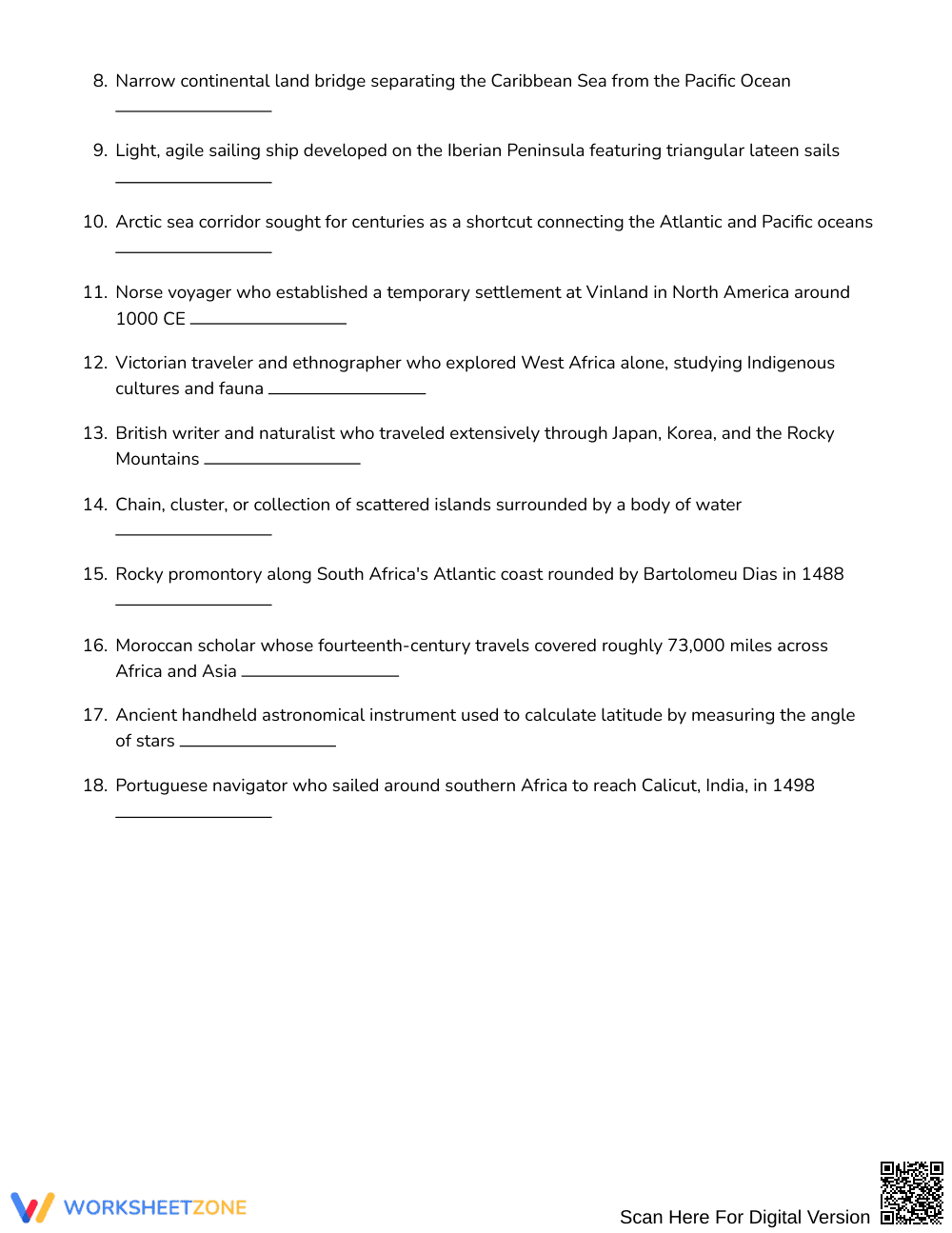
This social studies word search reinforces critical geography and historical exploration vocabulary for middle school learners. Students identify historical voyagers, maritime routes, navigation instruments, and physical landforms across global history. By matching rigorous clues to hidden terms, learners strengthen domain-specific recall and build spatial awareness across world regions.
At a Glance
- Grade: Grades 7–8 · Subject: Social Studies
- Standard: Not standards-assessed — vocabulary enrichment
- Skill Focus: Famous explorers, navigation, and geographic settings
- Format: 3 pages · 18 words · Answer key included · PDF
- Best For: Vocabulary review and unit consolidation
- Time: 25–35 minutes
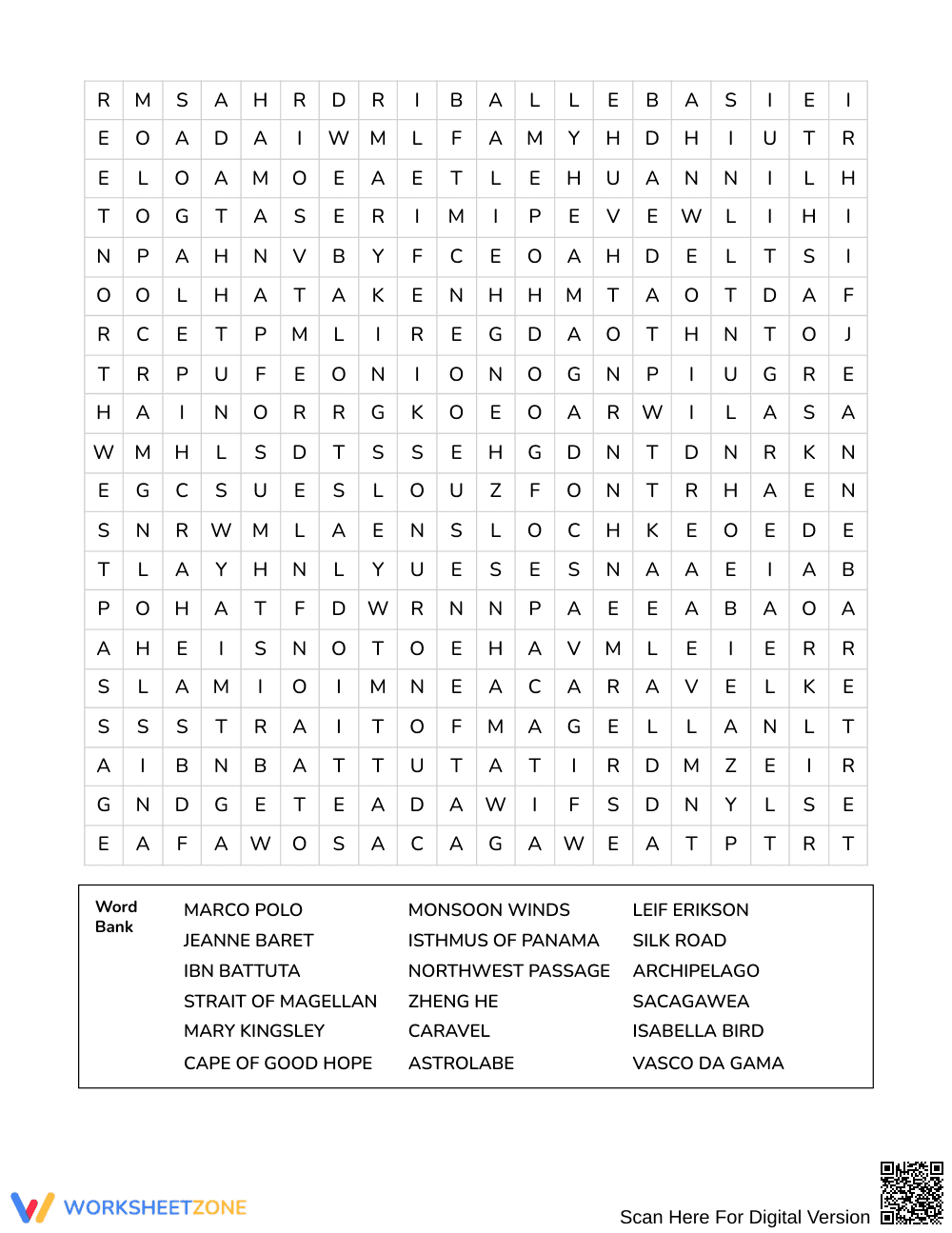
The activity spans 3 printable pages and includes 18 hidden vocabulary terms embedded in a dense letter matrix. Each term is paired with a content-rich historical clue covering maritime expeditions, ancient trade networks, natural corridors, and influential women travelers. A comprehensive 4-page answer key provides clear solution paths and term locations for rapid checking.
The puzzle features a challenging 20 by 20 grid designed for Grades 7–8 students. Words are positioned in all eight possible compass directions: north, northeast, east, southeast, south, southwest, west, and northwest. A shuffled word bank accompanies detailed descriptive clues, requiring students to synthesize historical facts before scanning the letter array for corresponding names and geographical features.
This activity serves strictly as cross-curricular vocabulary enrichment and is not aligned to a single state or national standard. It supports broader historical literacy and geographical comprehension by reinforcing specialized terminology encountered during early modern exploration units and global trade studies.
Deploy this word search as an engaging introductory preview before starting an Age of Exploration unit, or assign it as a consolidation activity after completing direct instruction on maritime trade routes. While students scan the grid, conduct formative checks by asking individuals to orally explain how terms like the astrolabe or caravel enabled transoceanic journeys. Most learners complete the full search within 25 to 35 minutes.
This resource is tailored for seventh and eighth grade social studies classrooms, world geography units, and early modern world history courses. For students requiring extra support, allow peer pairs to match clues before searching the grid; offer advanced learners an extension task to map each explorer's route on a blank global projection. Pair this activity with an interactive world atlas or historical route map.
Academic vocabulary acquisition serves as a critical foundation for conceptual mastery in secondary social studies curricula. According to research on disciplinary literacy by Fisher & Frey (2014), intentional exposure to domain-specific terminology through puzzle-based retrieval and contextual definition matching accelerates long-term retention of complex historical narratives. When middle school students actively connect navigational instruments, regional trade corridors, and biographical profiles to spatial puzzle structures, they transition from passive memorization to meaningful conceptual schema building. The 18 targeted vocabulary terms in this resource bridge geographical spatial reasoning with world exploration history across multiple eras, establishing background knowledge essential for reading challenging primary source documents and historical cartography. By integrating clue-driven word searches into structured review routines, educators ensure that diverse adolescent learners build the cognitive fluency and informational stamina required for advanced historical analysis and sustained academic reading comprehension across content areas.


