


























Views
Downloads


Essential Explaining Evidence Worksheet | Grade 6 ELA
Paste this activity's link or code into your existing LMS (Google Classroom, Canvas, Teams, Schoology, Moodle, etc.).
Students can open and work on the activity right away, with no student login required.
You'll still be able to track student progress and results from your teacher account.
Students often struggle to move beyond simple quote restatement when writing argumentative essays. This worksheet teaches sixth graders how to craft logical reasoning that connects factual data directly to argumentative claims. Through structured textual analysis of an informational report, learners distinguish genuine explanation from superficial summary and build defensible written justifications.
At a Glance
- Grade: 6 · Subject: ELA
- Standard:
W.6.1.b— Support claims with clear reasons and relevant evidence using credible sources.- Skill Focus: Explaining evidence significance and reasoning
- Format: 5 pages · 8 problems · Answer key included · PDF
- Best For: Argumentative writing and CER unit practice
- Time: 35–45 minutes
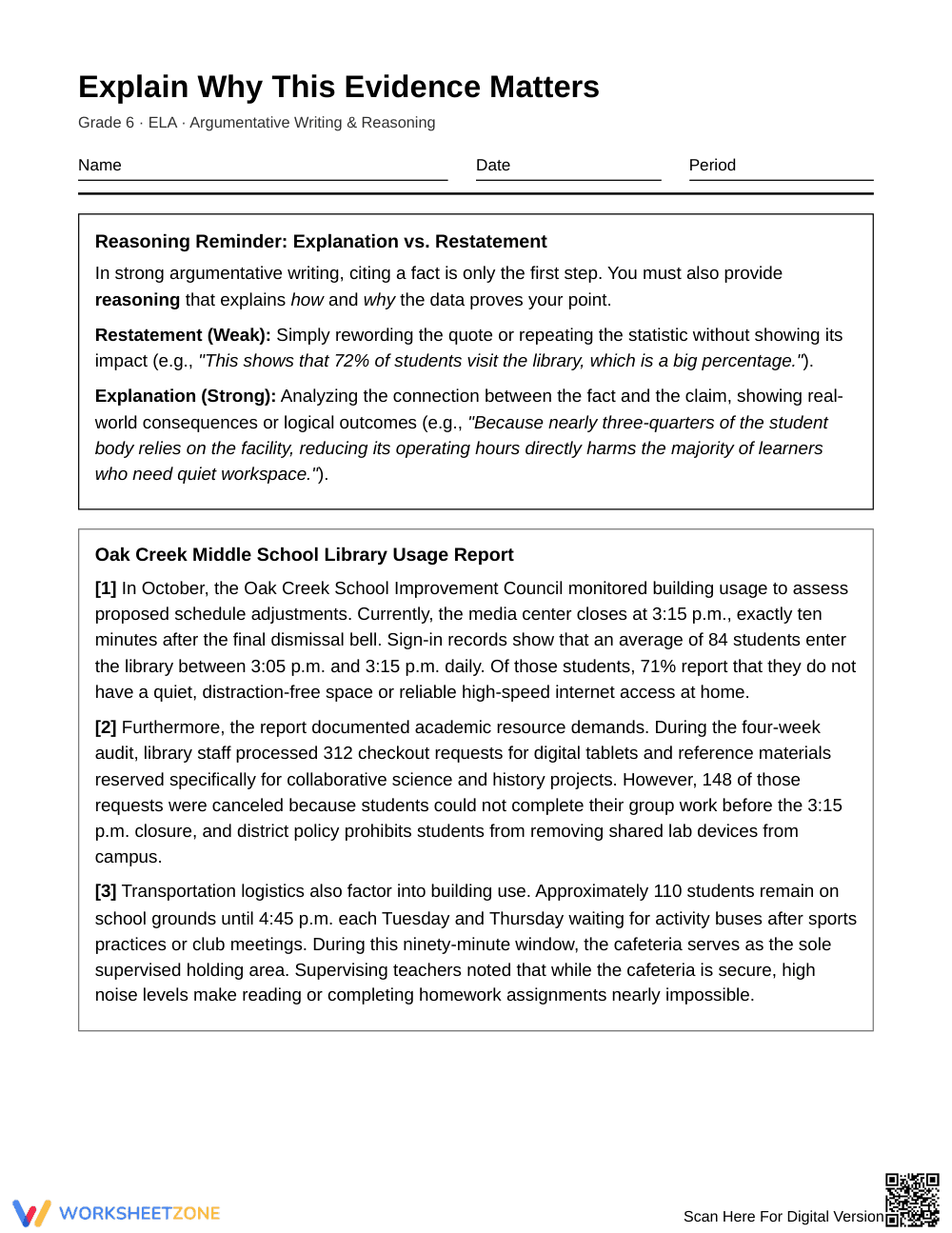
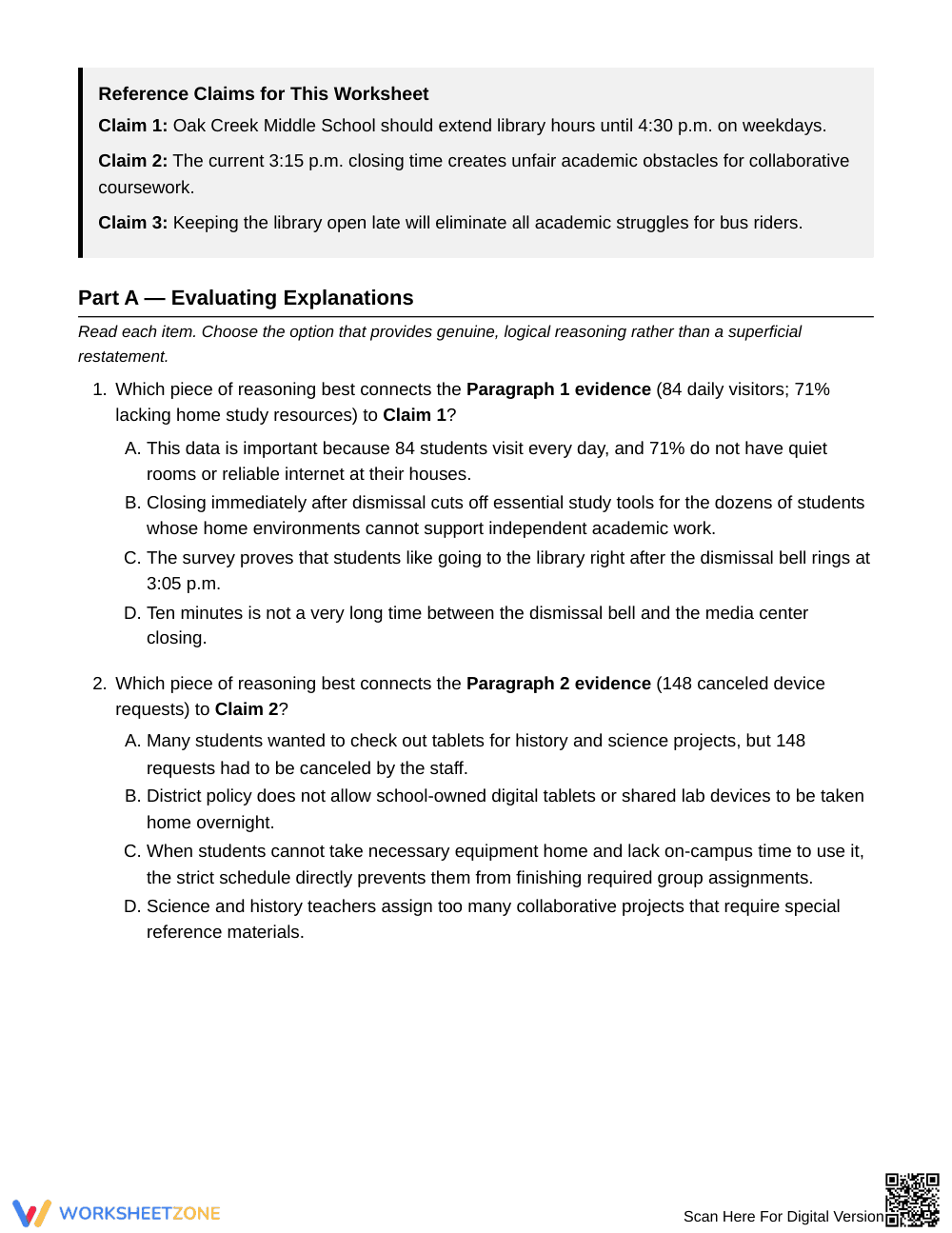
This 5-page printable resource includes an anchor concept guide detailing explanation versus restatement, followed by an informational case report on middle school library usage. Across 8 rigorous tasks, students evaluate multiple-choice justifications, compose original reasoning bridges, and critique overextended claims. A comprehensive 2-page answer key provides exemplar responses for rapid evaluation and targeted student feedback.
Skill Progression
- Guided Practice: In Part A (tasks 1–2), students evaluate contrasting explanations, selecting strong analytical rationales over weak restatements using scaffolded multiple-choice options.
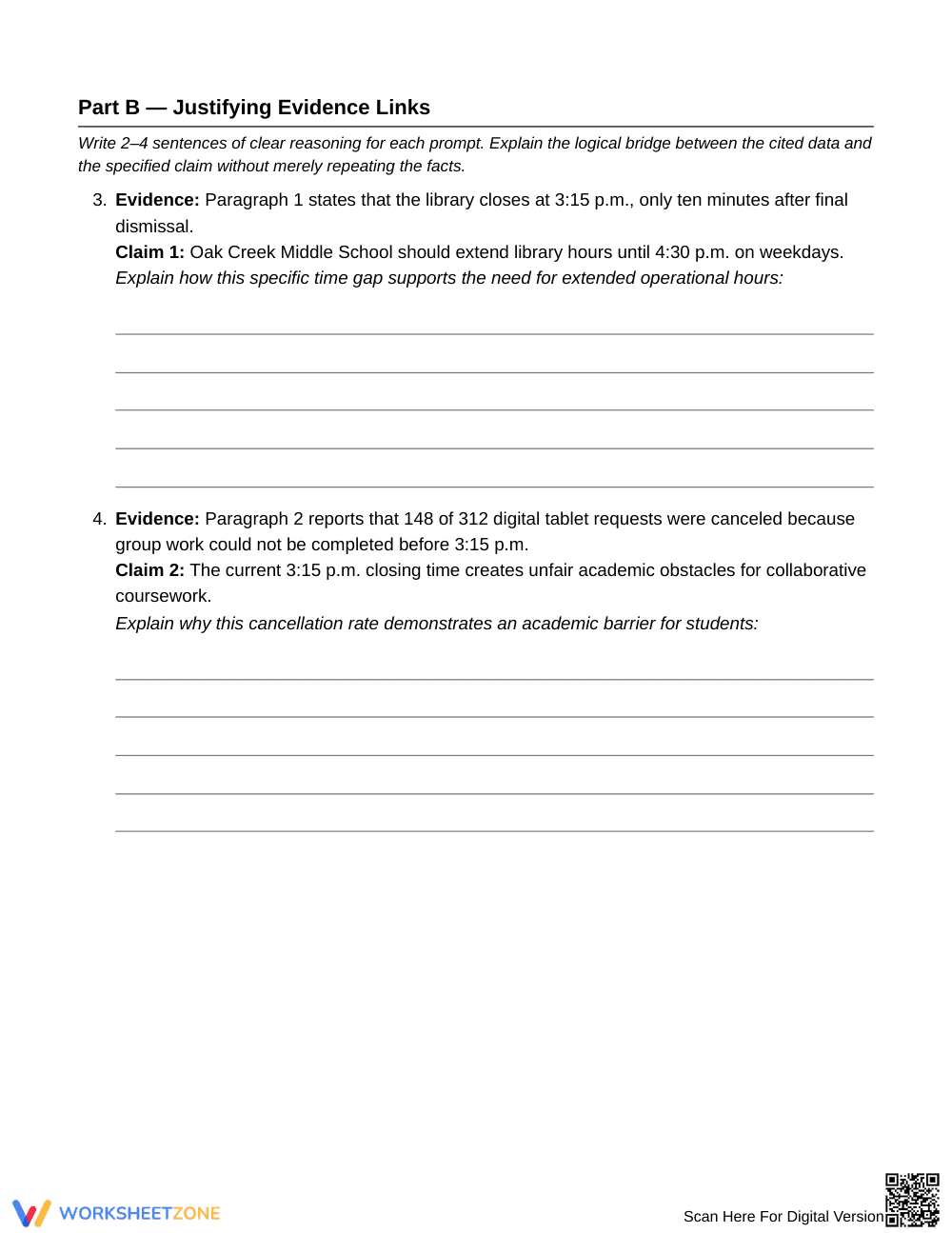
- Supported Practice: In Part B (tasks 3–6), learners compose 2–4 sentences of original reasoning connecting cited statistics to claims with guided prompt cues.
- Independent Practice: In Part C (tasks 7–8), students independently analyze unsupported general claims, diagnose evidentiary gaps, and rewrite claims using nuanced qualifying language.
This sequence mirrors the gradual-release framework, scaffolding students from analytical identification to independent written justification.
Standards Alignment
This resource aligns directly with Common Core State Standard W.6.1.b: "Support claim(s) with clear reasons and relevant evidence, using credible sources and demonstrating an understanding of the topic or text." It also reinforces supporting standard RI.6.8 by requiring students to trace and evaluate arguments and specific claims within an informational text. Both standard codes can be copied directly into lesson plans, IEP goals, or district curriculum mapping tools.
How to Use It
Deploy this activity during the guided phase of an argumentative writing unit after introducing claim-evidence-reasoning structures. It also serves as an effective small-group intervention for students who repeatedly summarize quotations rather than analyzing them. During the activity, check Part B prompts formatively to ensure students avoid circular reasoning that merely repeats data figures. Expected completion time is 35 to 45 minutes.
Who It's For
This exercise is designed for Grade 6 general education ELA classes, writing intervention groups, and multi-language learners developing academic discourse. Differentiate by providing sentence starters for Part B or challenging advanced writers to formulate counterclaims. Pair this worksheet alongside an argumentative mentor text or an anchor chart highlighting cause-and-effect transitions.
Middle school writers frequently identify relevant textual evidence but stumble when explaining why that evidence matters, often falling back on mere plot summary or verbatim restatement. Grounded in the gradual release of responsibility instructional model articulated by Fisher & Frey (2014), this focused lesson targets Common Core standard W.6.1.b by breaking reasoning into discrete evaluative steps. Students first differentiate between superficial repetition and substantive explanation across structured scenarios before drafting their own analytical bridges. In the final phase, learners evaluate absolute statements and apply qualifying phrasing, mastering the transition from raw data citation to defensible academic argumentation. By explicitly modeling how evidence substantiates a central premise, this 8-task exercise equips sixth-grade writers with the cognitive tools necessary to construct coherent argumentative logic across disciplines and state standardized assessments.


