




























Views
Downloads




Essential Evidence Evaluation Worksheet | Grade 7 ELA

Paste this activity's link or code into your existing LMS (Google Classroom, Canvas, Teams, Schoology, Moodle, etc.).
Students can open and work on the activity right away, with no student login required.
You'll still be able to track student progress and results from your teacher account.
This Grade 7 reading worksheet builds critical evaluation skills by teaching students to judge whether an author's evidence is relevant and sufficient. Working through a proposal about community center study spaces, students evaluate quantitative data, examine reasoning, and determine if cited evidence genuinely supports the author's claims.
At a Glance
- Grade: 7 · Subject: ELA
- Standard:
RI.7.8— Trace and evaluate arguments, distinguishing sound claims from weak evidence- Skill Focus: Judge Evidence Relevance and Sufficiency
- Format: 5 pages · 12 problems · Answer key included · PDF
- Best For: Argumentative text analysis and close reading
- Time: 40–50 minutes
What's Inside
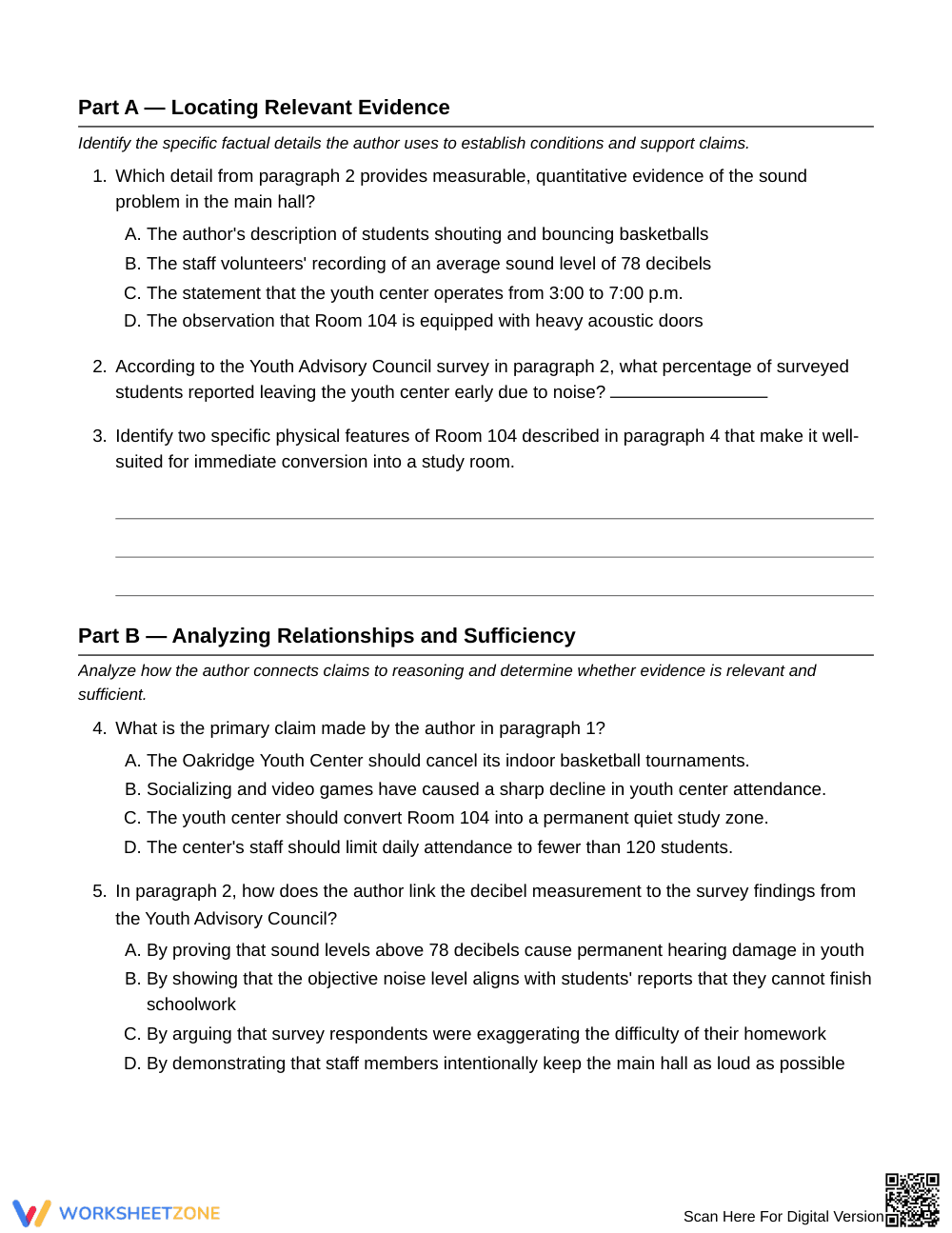
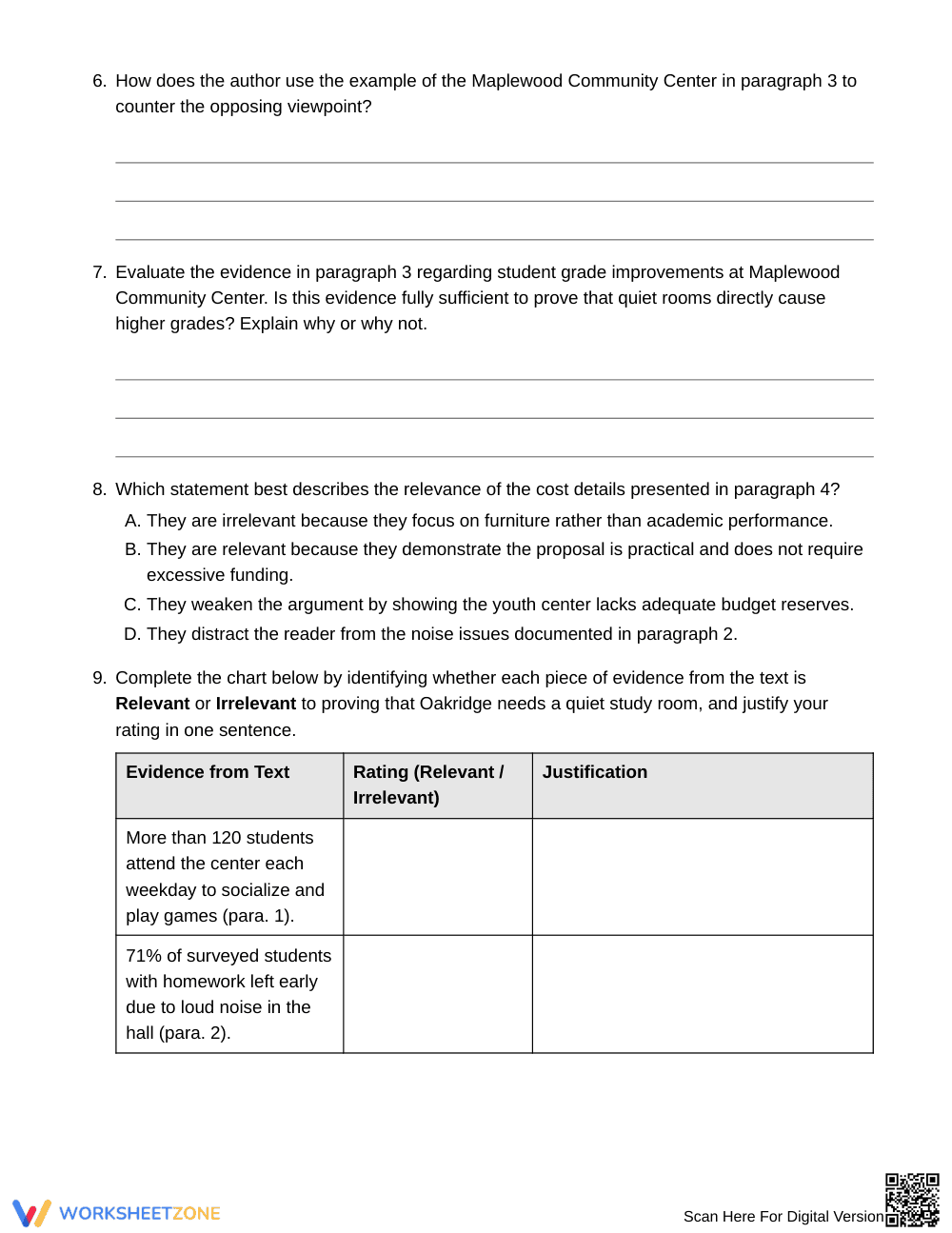
The 5-page resource presents an informational proposal titled "Why Oakridge Youth Center Needs Designated Quiet Study Zones" alongside a reference framework defining claims, relevance, and sufficiency. Across 12 structured tasks, students complete multiple-choice items, a relevance classification table, and short-answer evaluations. A 3-page answer key provides complete rationales for every question.
Skill Progression
- Guided practice (Part A, 3 items): Students locate quantitative data and physical evidence using direct paragraph cues.
- Supported practice (Part B, 6 items): Students analyze relationships between claims and evidence, complete a rating chart, and assess sufficiency.
- Independent practice (Part C, 3 items): Students synthesize arguments across paragraphs and defend the proposal against counterarguments.
This gradual release progression guides learners from basic identification to rigorous textual evaluation.
Standards Alignment
The primary standard addressed is RI.7.8: Trace and evaluate the argument and specific claims in a text, assessing whether the reasoning is sound and the evidence is relevant and sufficient. The resource also reinforces RI.7.1 by requiring textual evidence to justify every analytical judgment. Both standard codes can be copied directly into lesson plans, IEP goals, or district curriculum mapping tools.
How to Use It
Use this worksheet after direct instruction on argumentative structures. During guided practice, have students read the passage and complete Part A in pairs. Then assign Parts B and C for independent analysis. Formatively observe whether students can distinguish relevant data from interesting background details in Part B's chart. Expected completion time is 40 to 50 minutes.
Who It's For
This resource is designed for Grade 7 ELA classrooms, reading intervention groups, and English learners needing structured reading support. Scaffolds such as explicit definitions and paragraph markers ensure access for diverse learners. Pair this printable with an argumentative writing lesson or an anchor chart on logical reasoning.
Evaluating evidence relevance and sufficiency represents a pivotal critical reading milestone defined in standard RI.7.8. According to Fisher & Frey (2014), middle school readers require systematic scaffolding to move beyond basic factual recall toward independently assessing how effectively textual evidence substantiates an author's central claim. Without structured practice differentiating relevant facts from extraneous background information, students routinely struggle to evaluate the validity of written arguments. This Grade 7 instructional resource directly targets that developmental need through a 12-task analytical progression focused on an authentic community center proposal. Learners evaluate quantitative decibel measurements, survey statistics, and comparative program outcomes to judge whether the author's reasoning is sound and adequate. By requiring students to justify their evaluations in writing, the resource deepens informational reading comprehension and strengthens essential analytical discourse skills necessary for high school literacy readiness.


