




























Views
Downloads


Essential Evidence-Based Commentary Worksheet | Grade 8 ELA

Paste this activity's link or code into your existing LMS (Google Classroom, Canvas, Teams, Schoology, Moodle, etc.).
Students can open and work on the activity right away, with no student login required.
You'll still be able to track student progress and results from your teacher account.
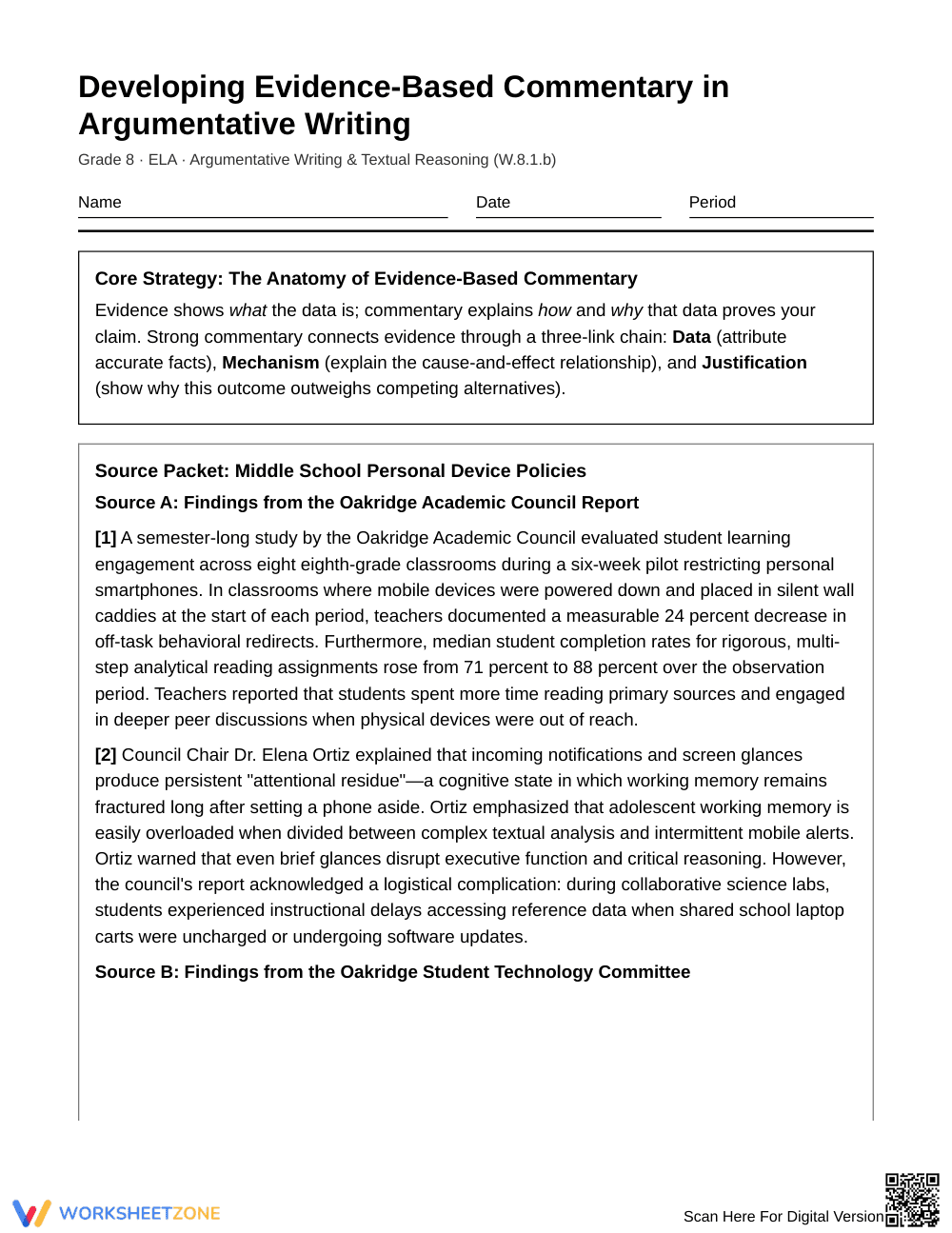
This Grade 8 argumentative writing worksheet trains students to construct evidence-based commentary that links factual data to argumentative claims. Middle school writers analyze paired informational texts, evaluate model reasoning mechanisms, draft reasoned paragraphs on personal device policies, and revise superficial restatements into analytical prose.
At a Glance
- Grade: 8 · Subject: ELA
- Standard:
W.8.1.b— Support claims with logical reasoning and relevant evidence using credible sources.- Skill Focus: Evidence-Based Commentary
- Format: 5 pages · 8 problems · Answer key included · PDF
- Best For: Argumentative writing units and textual analysis
- Time: 45–60 minutes
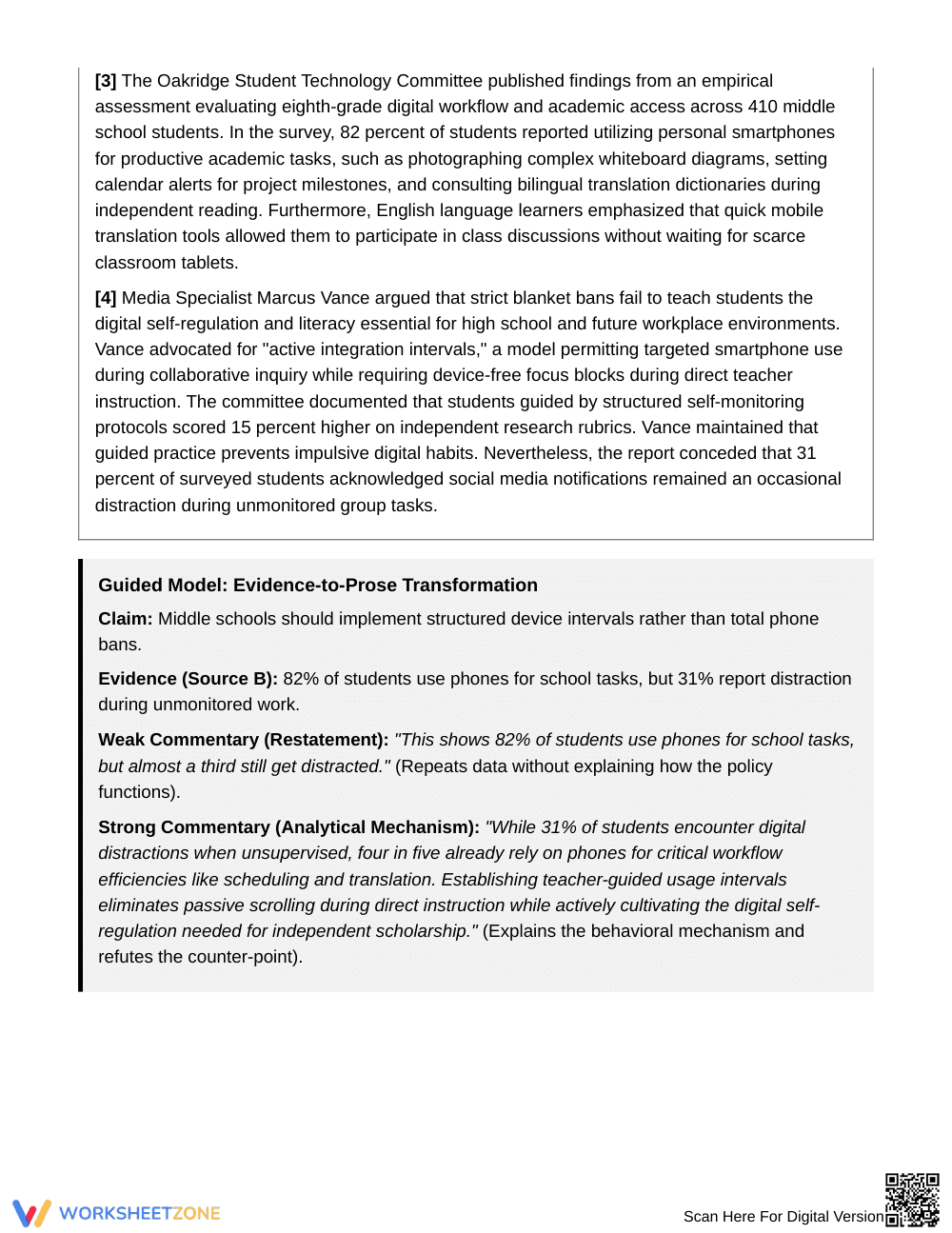
This 5-page printable packet contains 8 targeted analytical tasks organized around a two-source packet examining school personal device policies. Students explore empirical data from council reports and surveys, evaluate a model showing weak restatement versus strong reasoning, and apply a three-link analytical chain: data, mechanism, and justification. A 4-page answer key provides complete model responses.
Skill Progression
- Guided practice (Tasks 1–2): Students analyze a model comparing restatement to mechanism-based commentary, identifying counter-evidence clauses and isolating analytical moves that establish causal logic.
- Supported practice (Tasks 3–6): Writers declare a policy stance, address opposing survey data, construct a three-sentence commentary chain, and draft an integrated 250- to 350-word synthesis paragraph.
- Independent practice (Tasks 7–8): Students revise weak peer excerpts, applying cognitive concepts like attentional residue and justifying systemic trade-offs to eliminate restatements.
This sequence follows the gradual-release model, moving writers from deconstruction to guided application and independent revision.
Standards Alignment
This worksheet directly targets primary standard W.8.1.b: Support claim(s) with logical reasoning and relevant evidence, using credible sources. In supporting work, students address RI.8.8 by evaluating arguments across two conflicting technical texts.
How to Use It
Deploy this resource during argumentative drafting or revision workshops to eliminate quote-dropping habits. As students work, check whether they actively unpack behavioral mechanisms rather than repeating raw percentages. Learners typically complete the 8 tasks within a 45- to 60-minute instructional block.
Who It's For
This resource serves eighth-grade ELA students mastering argumentative commentary, as well as striving writers who need explicit structural scaffolds. English language learners benefit from contrasting model examples and sentence-level prompts.
Argumentative writing proficiency in middle school hinges on moving beyond factual regurgitation toward substantive textual analysis. According to Fisher & Frey (2014), explicit modeling of disciplinary reasoning followed by structured guided practice enables adolescent learners to transition successfully from surface comprehension to complex written argumentation. Under Common Core standard W.8.1.b, eighth-grade students must support claims with logical reasoning and relevant evidence using credible sources, an expectation that requires understanding how facts function as proof rather than standalone truths. By deconstructing the cognitive mechanisms behind real-world data—such as attentional residue and digital workflow habits—this instructional resource helps students articulate cause-and-effect relationships within formal argumentative prose. Structured revision tasks reinforce this developmental shift, teaching writers to isolate counter-evidence, concede valid opposing constraints, and defend policy recommendations through logical justification. This systematic approach ensures sustained mastery across multi-source synthesis tasks and standardized writing assessments.


