


























Views
Downloads



Essential Energy Transfer Worksheet | Grade 7 Science
Paste this activity's link or code into your existing LMS (Google Classroom, Canvas, Teams, Schoology, Moodle, etc.).
Students can open and work on the activity right away, with no student login required.
You'll still be able to track student progress and results from your teacher account.
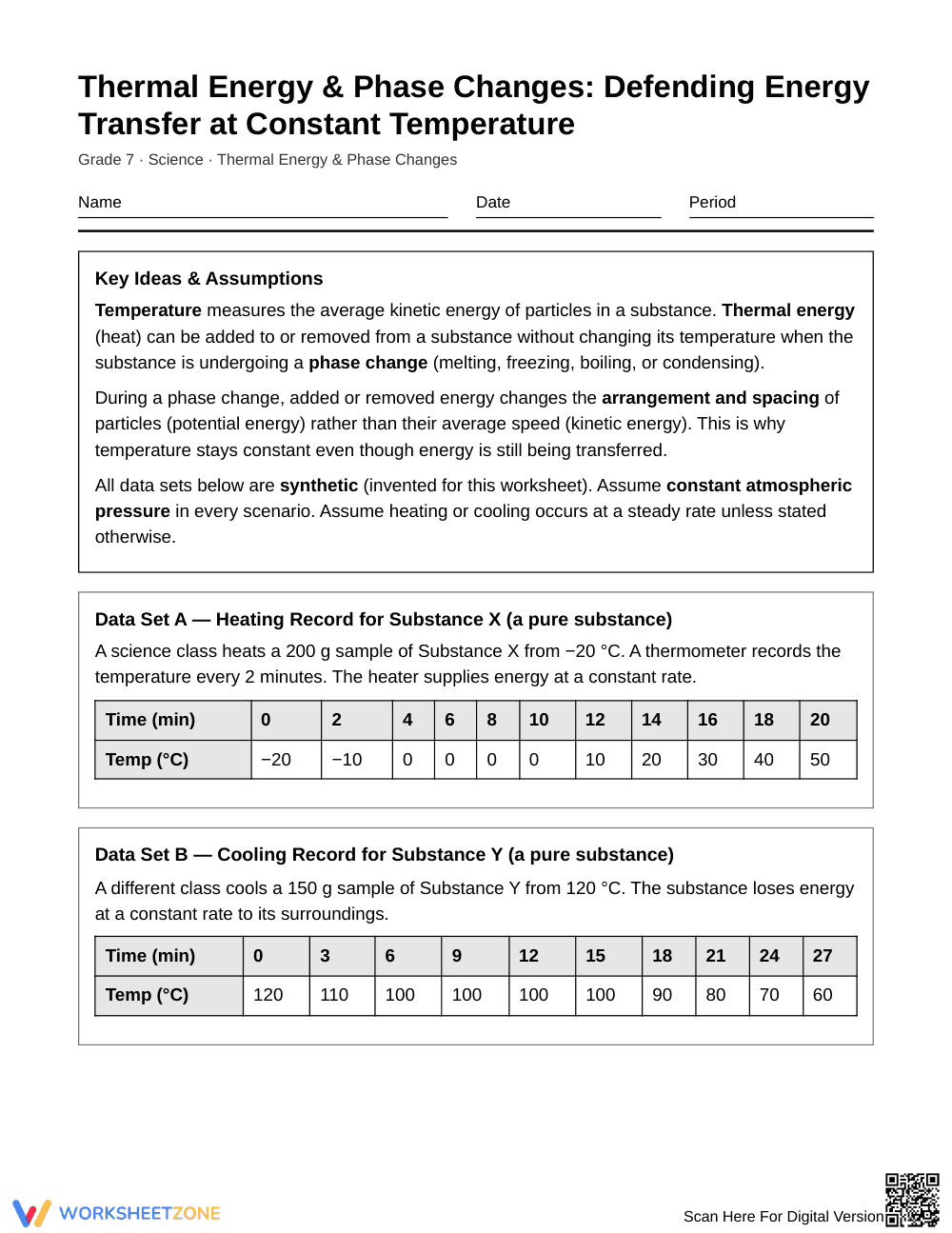
This Grade 7 science worksheet enables students to defend energy transfer during constant temperature phase changes. Across 8 problems on 5 pages, learners analyze heating and cooling data tables, relate thermal energy to particle potential energy, and critique common misconceptions about latent heat.
At a Glance
- Grade: 7 · Subject: Science
- Standard: Thermal Energy Transfer — Construct evidence-based explanations of particle behavior and energy flow during constant temperature phase changes
- Skill Focus: Defend Energy Transfer During Constant Temperature
- Format: 5 pages · 8 problems · Comprehensive answer key included · PDF
- Best For: Formative assessment, scientific argumentation, and lab follow-up
- Time: 40–50 minutes
The 5-page worksheet includes a core concept reference box, two synthetic heating and cooling data tables, and 8 structured analytical prompts. Students identify empirical evidence, construct particle-level explanations, and evaluate competing claims regarding boiling and melting scenarios. A complete 5-page answer key provides detailed teacher solutions and diagnostic notes.
Skill Progression
- Guided practice: Tasks 1 and 2 guide students to locate evidence in data tables showing constant thermal transfer during steady temperatures.
- Supported practice: Tasks 3 through 6 prompt learners to connect macro evidence to particle spacing and potential energy mechanisms.
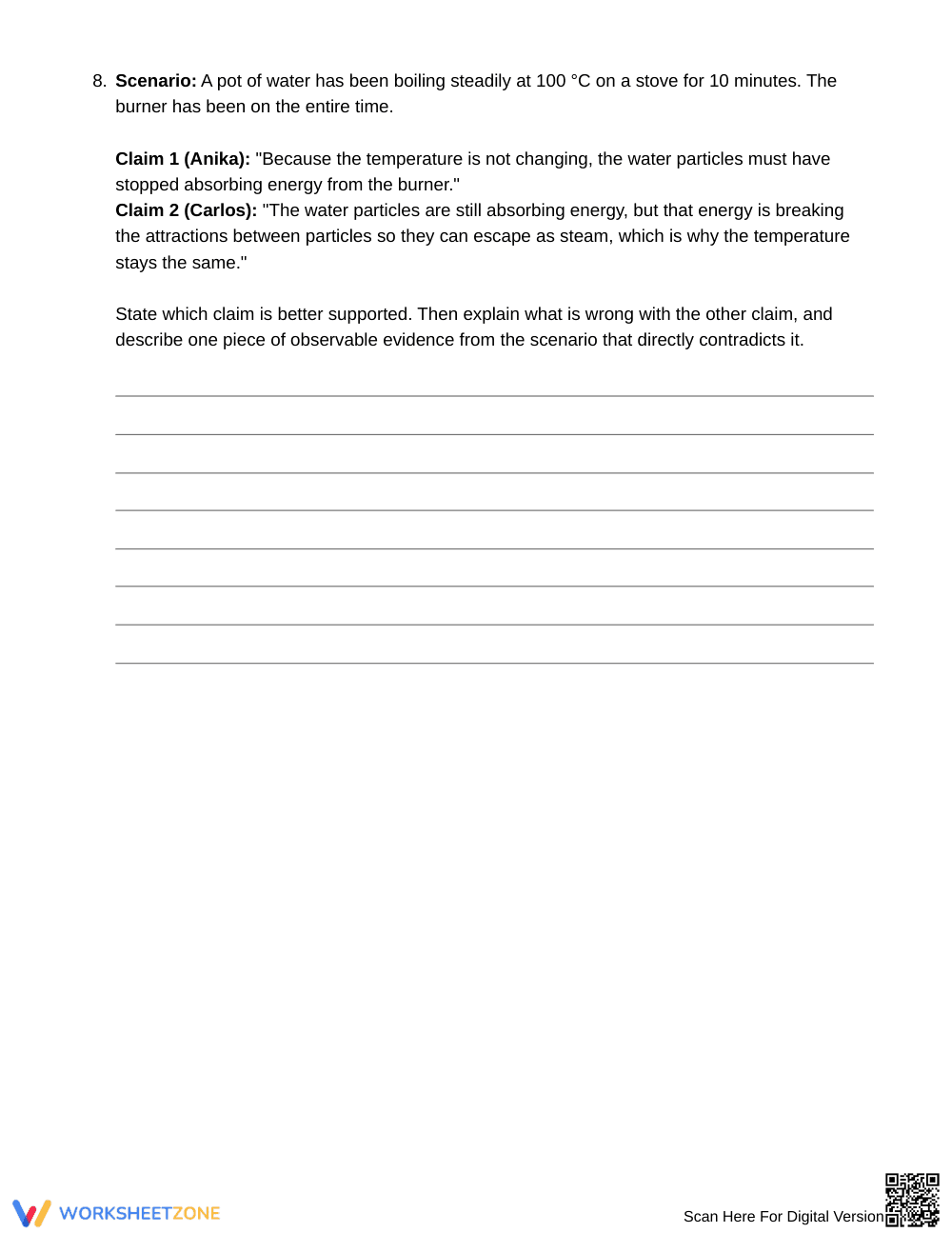
- Independent practice: Tasks 7 and 8 require students to independently evaluate and refute common peer misconceptions.
This sequence implements gradual release, leading students from data extraction to robust scientific argumentation.
Standards Alignment
This worksheet aligns with middle school physical science standards for thermal energy and matter interactions. Students construct explanations demonstrating that thermal energy transfer during phase changes alters particle arrangement rather than kinetic temperature. Both standard concepts can be copied directly into lesson plans, IEP goals, or district curriculum mapping tools.
How to Use It
Use this resource after introducing kinetic molecular theory to reinforce thermal energy transfer concepts over 40 to 50 minutes. It functions smoothly as a paired data-analysis activity or a formative mid-unit check. As students work, check whether they confuse steady temperature with absent energy transfer, redirecting them to the constant heating conditions in Data Set A.
Who It's For
This practice set suits Grade 7 science students exploring thermodynamics and molecular models. Built-in reference definitions support English learners and developing readers, while rigorous claim refutations challenge advanced thinkers. Pair this printable with a phase change laboratory investigation or an interactive computer simulation for maximum conceptual reinforcement.
Developing scientific explanations that defend energy transfer during constant temperature requires students to decouple observable thermal readouts from submicroscopic particle behavior. Research summarized by Fisher & Frey (2014) emphasizes that intentional gradual release frameworks—moving from structured evidence extraction to independent refutation of competing claims—significantly improve conceptual retention in secondary science domains. When middle school learners engage with synthetic data sets reflecting constant heat addition during phase changes, they actively confront the widespread misconception that a flat thermal plateau indicates a cessation of energy input. By articulating how energy alters particle arrangement and potential energy rather than kinetic velocity, students build robust mental models of thermodynamic systems. The 8 items across these 5 pages offer targeted practice that reinforces rigorous empirical reasoning, equipping Grade 7 students to defend abstract scientific phenomena with observable evidence and clear mechanistic logic across comprehensive classroom assessments.


