


























Views
Downloads


Essential Electronegativity Worksheet | Grade 8-12 Science
Paste this activity's link or code into your existing LMS (Google Classroom, Canvas, Teams, Schoology, Moodle, etc.).
Students can open and work on the activity right away, with no student login required.
You'll still be able to track student progress and results from your teacher account.
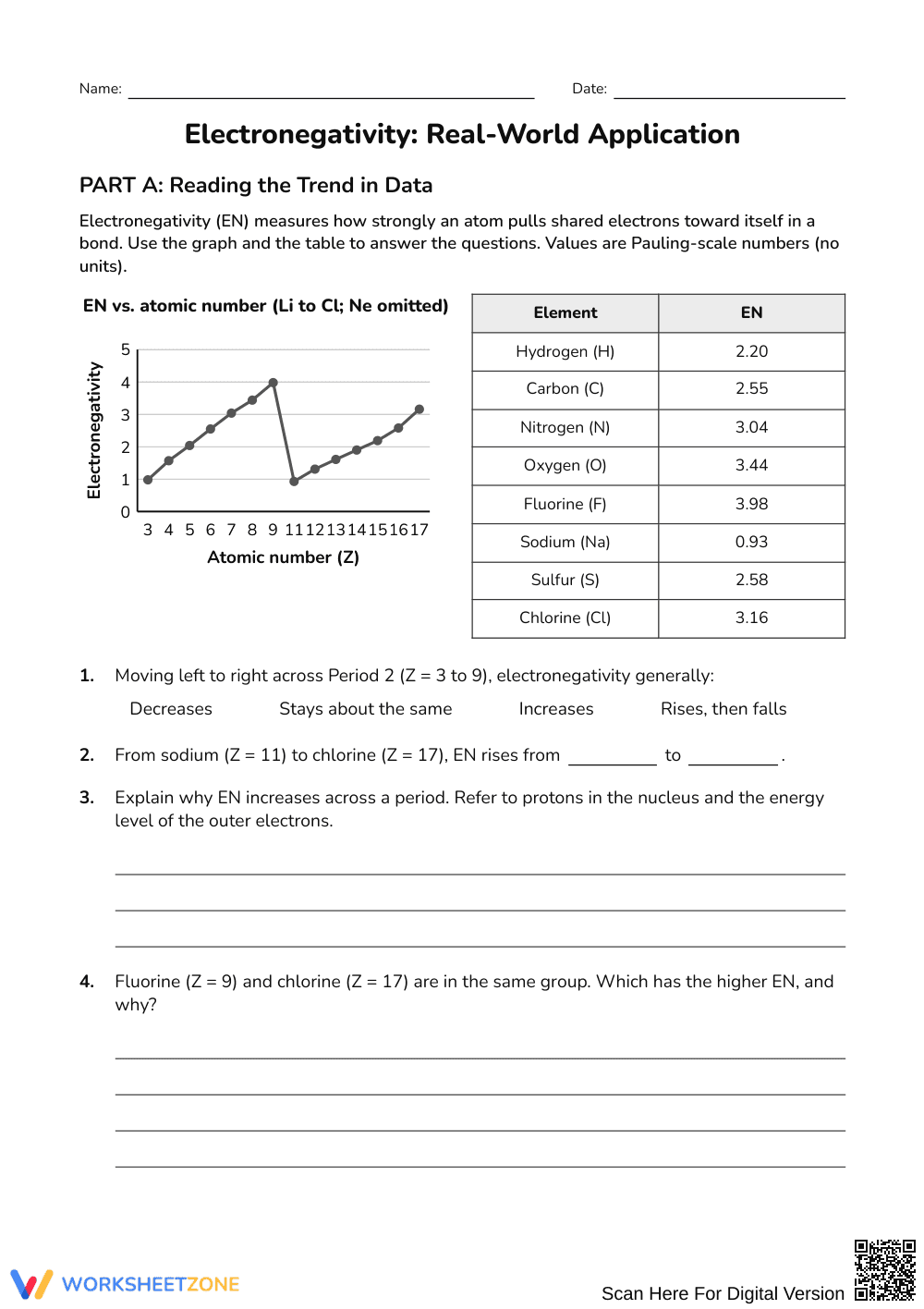
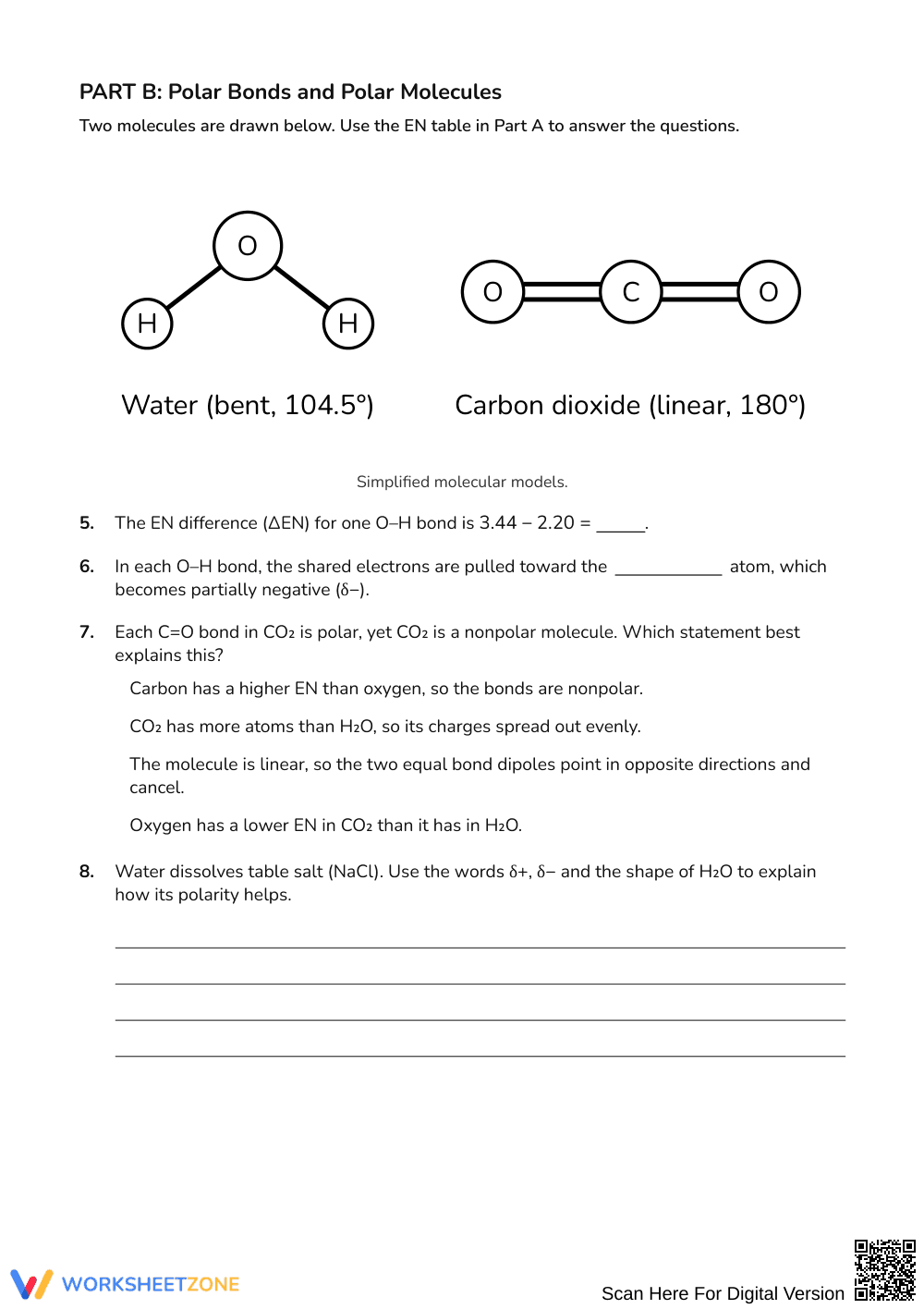
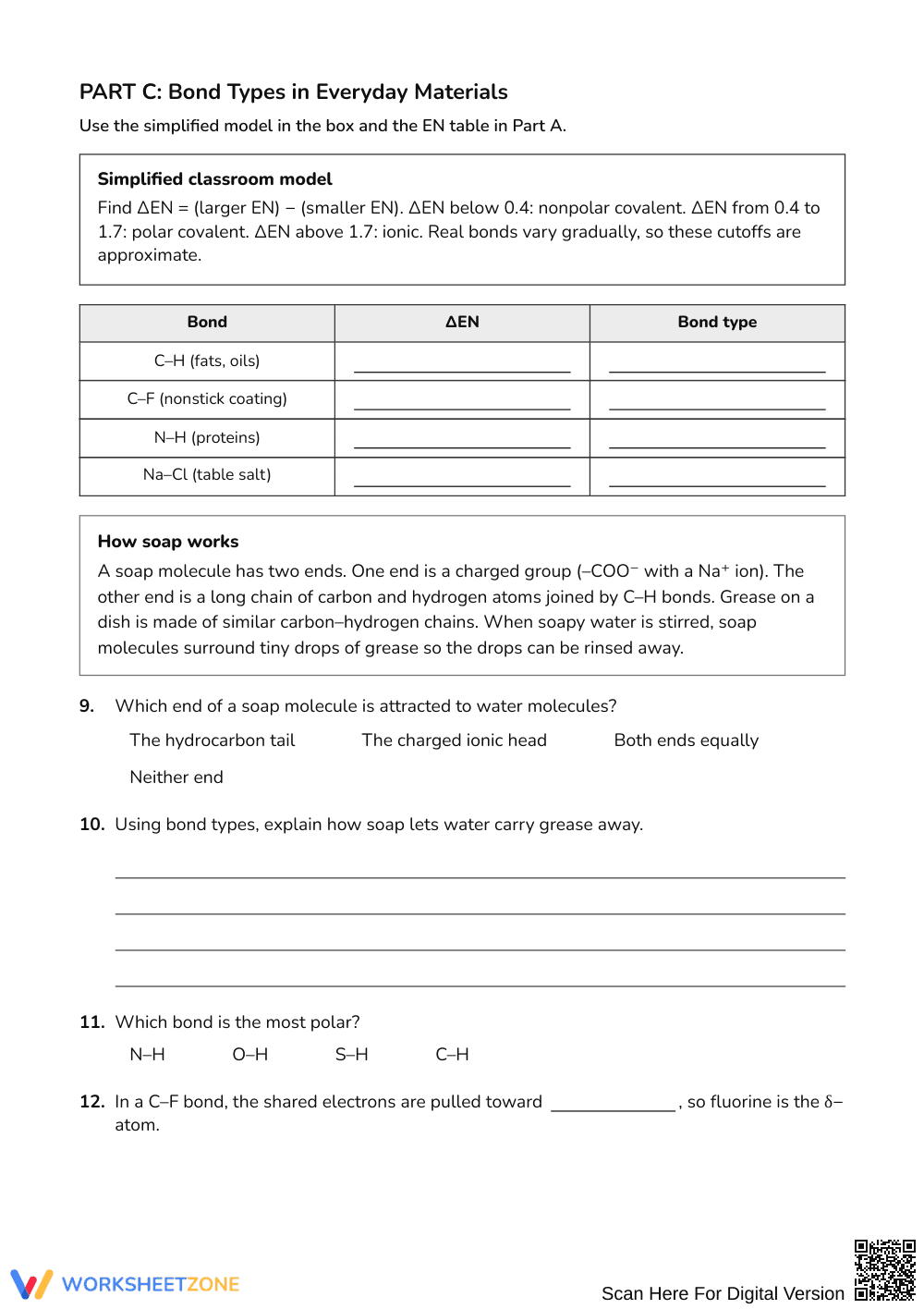
This comprehensive science worksheet equips secondary chemistry students to analyze periodic electronegativity values and connect bond polarity directly to macroscopic real-world phenomena. Across four structured pages, learners evaluate data trends, distinguish molecular shapes, predict bond categories, and write evidence-based scientific explanations for real-world scenarios such as soap action and oil spills.
At a Glance
- Grade: 8–12 · Subject: Science
- Standard: Relate periodic trends and electronegativity differences to chemical bonding and material properties
- Skill Focus: Real-world applications of electronegativity
- Format: 4 pages · 24 problems · Answer key included · PDF
- Best For: Chemistry unit practice or post-lecture review
- Time: 45–60 minutes
What's Inside: The resource features 24 sequential questions spanning four scaffolded parts. Students analyze a Pauling-scale data table and trend graph, evaluate simplified molecular dipole diagrams of water and carbon dioxide, use a numeric reference scale to categorize bond types in fats, proteins, and cookware coatings, and complete short-answer items supported by a full 4-page answer key.
Skill Progression
- Guided practice (Part A, 6 items): Students interpret Pauling electronegativity values and graphical periodic trends across Period 2 and down Group 17 with structured data prompts.
- Supported practice (Parts B & C, 12 items): Learners calculate electronegativity differences (ΔEN) and classify bond types while connecting molecular polarity to soap function and crystal dissolution.
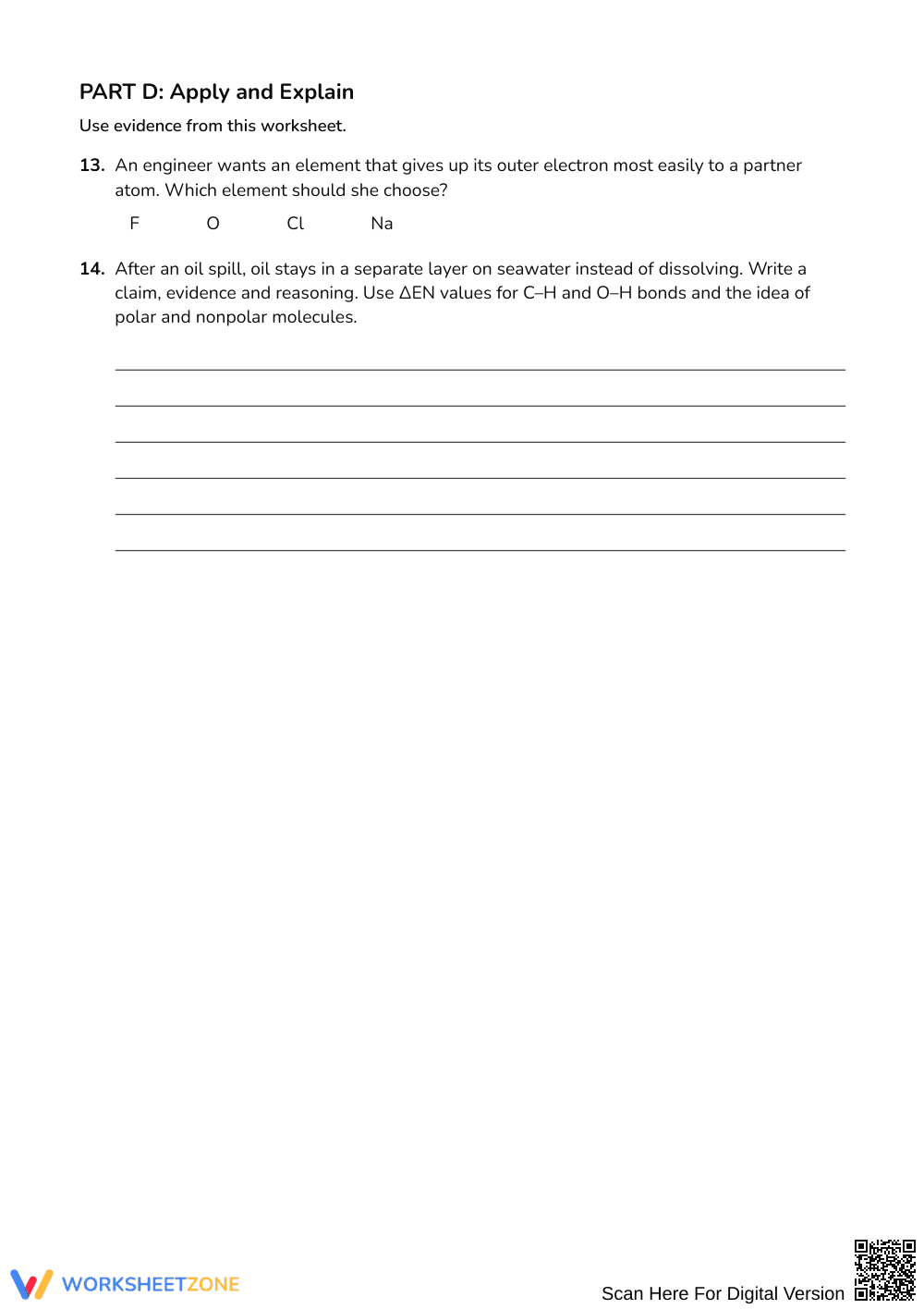
- Independent practice (Part D, 6 items): Students synthesize their learning through open-response analysis and construct a full Claim-Evidence-Reasoning (CER) paragraph explaining why spilled petroleum separates from seawater.
This deliberate sequence reflects the gradual release of responsibility model, shifting students smoothly from scaffolded trend identification to autonomous evidence-based argumentation.
Standards Alignment
This worksheet supports high school physical science standards addressing the structure and properties of matter. Students use the periodic table as a model to predict the relative properties of elements based on the patterns of electrons in the outermost energy level. They directly apply electronegativity differences to explain molecular behavior in biological, industrial, and environmental systems. These curricular targets can be copied directly into lesson plans, IEP goals, or district curriculum mapping tools.
How to Use It
Deploy this worksheet after direct instruction on atomic structure, Coulombic attraction, and covalent bonding. During class, monitor student calculations of ΔEN in Part C to confirm that learners identify partial charges correctly before progressing to macroscopic explanations. Alternatively, assign Part D as an exit assessment to evaluate CER writing proficiency. Most students finish within 45 to 60 minutes.
Who It's For
Designed for introductory chemistry, physical science, and honors science courses in grades 8 through 12. Support developing learners by highlighting the provided Pauling value chart, while challenging advanced students to explain dipole vector cancellation in non-linear geometries. Pair this activity with a physical molecular modeling lab or an aqueous solubility demonstration.
According to Fisher & Frey (2014), structured instructional progressions that guide students from visual data analysis to independent scientific writing produce measurable gains in conceptual retention. This 4-page resource bridges theoretical atomic principles and tangible physical phenomena by requiring students to compute 24 targeted responses. Learners examine electronegativity gradients across periods and groups, interpret polar dipole cancellations in symmetrical molecules, and evaluate the amphiphilic properties of cleaning agents. The concluding Claim-Evidence-Reasoning task challenges students to cite empirical bond differences (ΔEN = 0.35 versus 1.24) when explaining environmental phase separation after ocean oil spills. Complete with an exhaustive 4-page answer key showing full reasoning steps, this resource provides educators with verified instructional materials that build rigorous chemical literacy across secondary science classrooms.


