


























Views
Downloads

Essential DNA Replication Worksheet | Grade 10 Biology
Paste this activity's link or code into your existing LMS (Google Classroom, Canvas, Teams, Schoology, Moodle, etc.).
Students can open and work on the activity right away, with no student login required.
You'll still be able to track student progress and results from your teacher account.
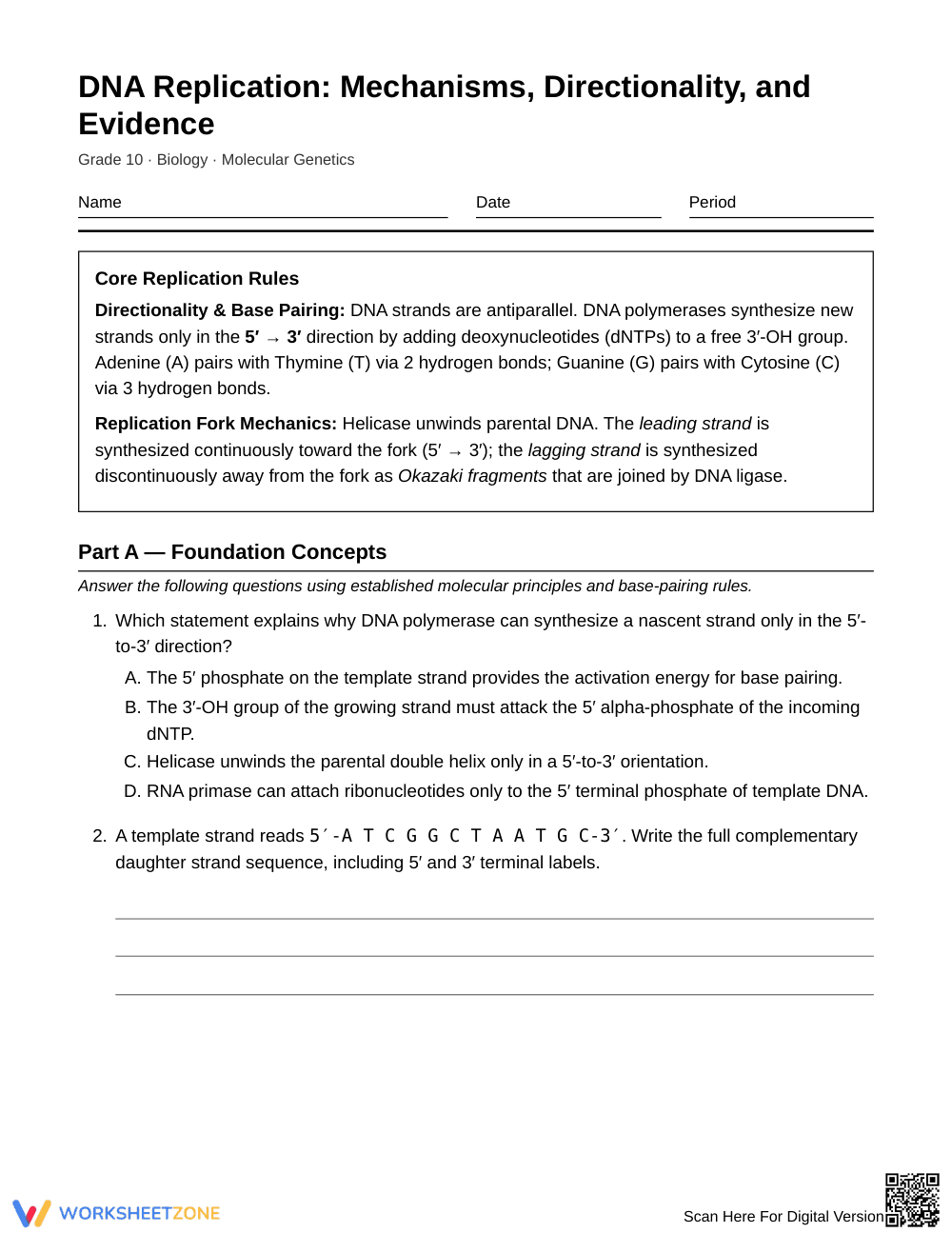
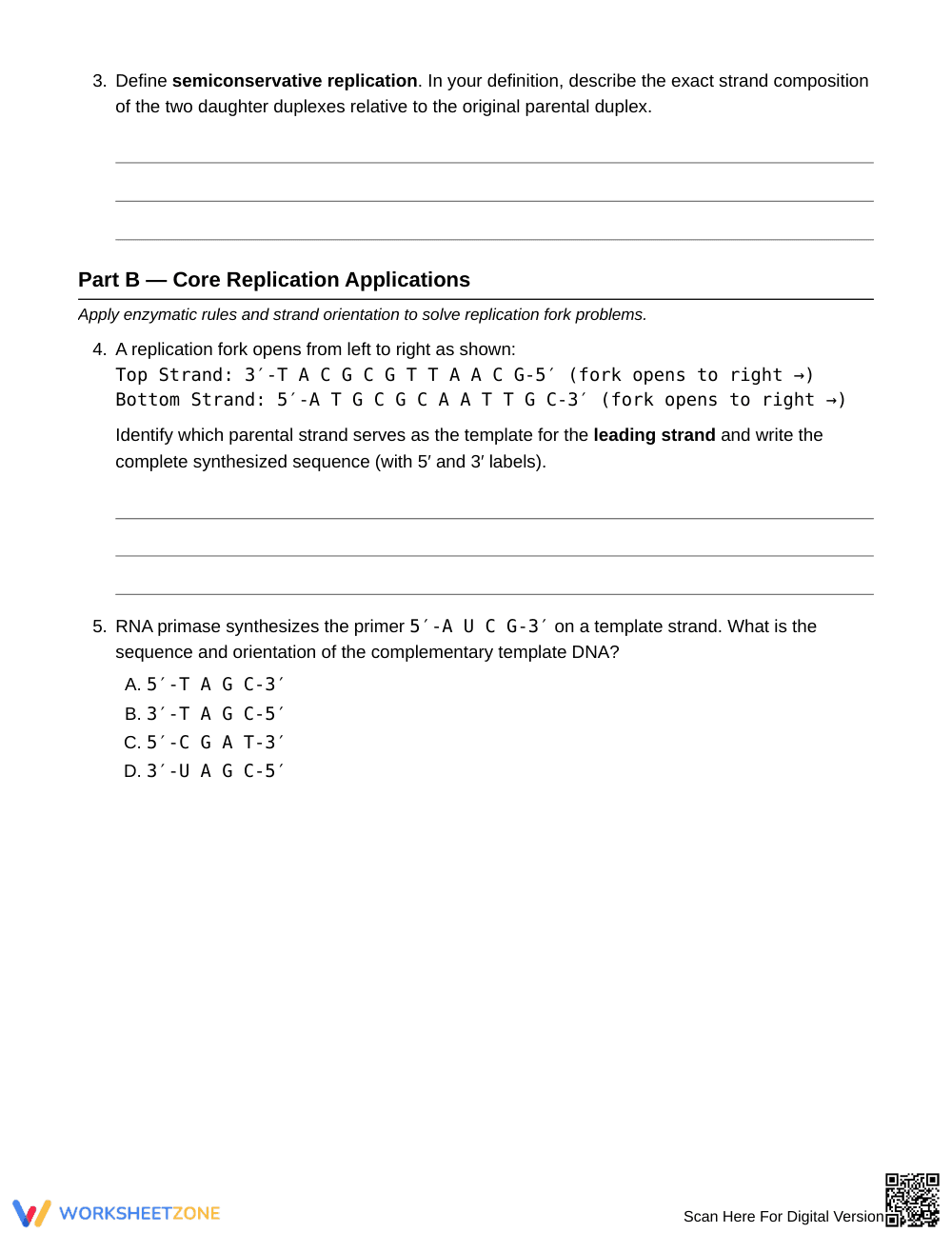
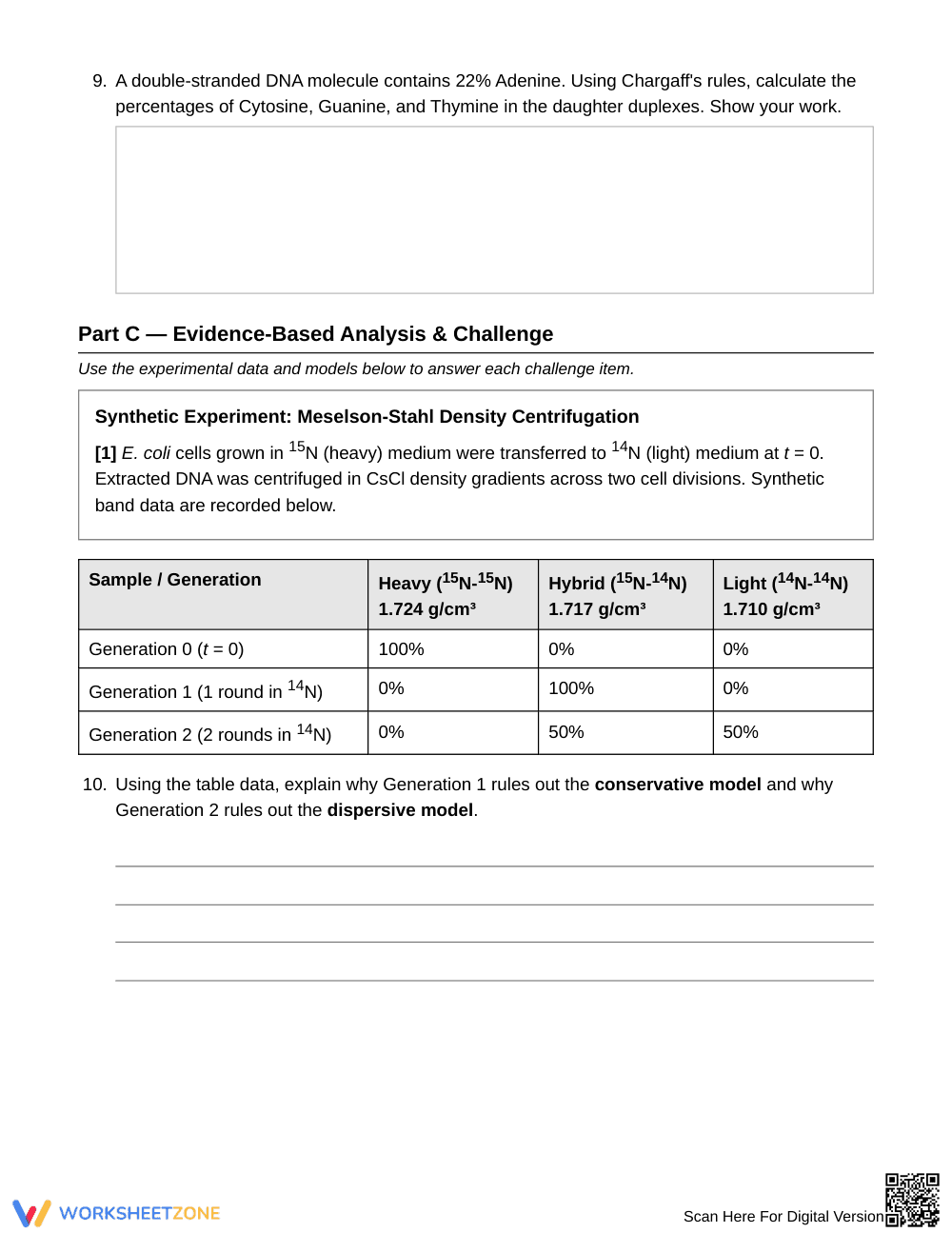
This 12-problem biology worksheet builds student mastery of DNA replication directionality, enzymatic fork mechanics, and experimental evidence. Students analyze antiparallel orientation, predict Okazaki fragment synthesis, calculate Chargaff base ratios, and evaluate Meselson-Stahl density gradient data across five structured pages to solidify core molecular genetics concepts.
At a Glance
- Grade: 10 · Subject: Biology
- Standard: Molecular Genetics — Explain DNA replication mechanisms, enzyme functions, and experimental evidence
- Skill Focus: DNA Replication Directionality and Evidence
- Format: 5 pages · 12 problems · Answer key included · PDF
- Best For: Post-lecture independent practice and review
- Time: 40–50 minutes
What's Inside
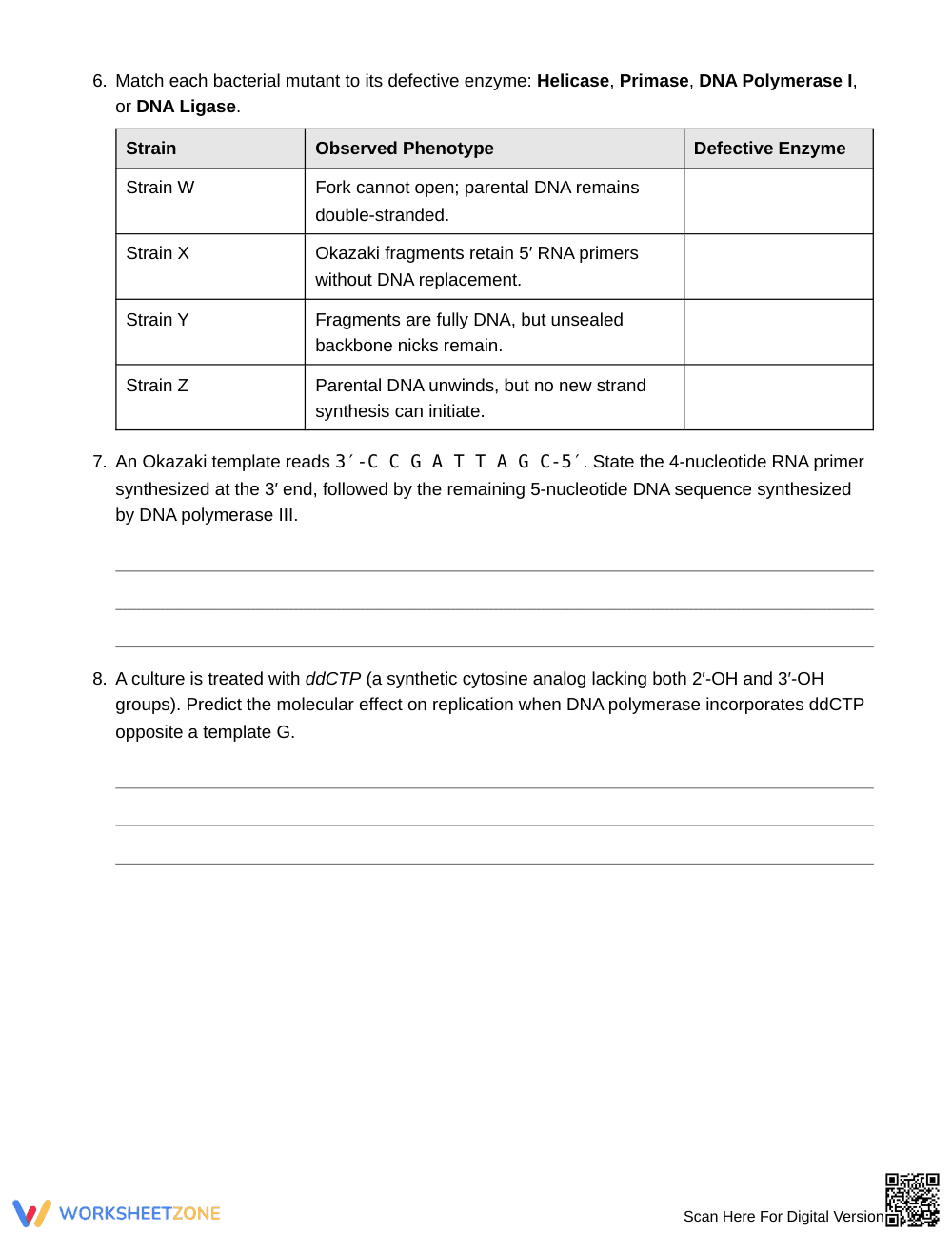
The worksheet provides 12 targeted tasks structured across 5 print-ready pages, accompanied by an in-depth 3-page answer key. Students reference an opening core rule box summarizing antiparallel geometry and replication fork rules before working through multiple-choice questions, sequence writing tasks, enzyme mutant matching tables, biochemical inhibitor predictions, and density centrifugation data charts.
Skill Progression
- Guided practice (Part A — 3 problems): Students review core directionality rules and write complementary strands using foundational base-pairing and 5′-to-3′ synthesis principles.
- Supported practice (Part B — 6 problems): Learners apply enzymatic mechanics to identify leading templates, trace Okazaki fragments, diagnose bacterial enzyme mutants, evaluate chain-terminating ddCTP analogs, and calculate Chargaff percentages.
- Independent practice (Part C — 3 problems): High schoolers interpret Meselson-Stahl density centrifugation data to eliminate non-conservative models, calculate multi-generation isotopic distributions, and explain 3′→5′ exonuclease proofreading fidelity.
This sequence follows a gradual-release instructional model that moves students from basic nucleotide pairing to rigorous experimental evaluation.
Standards Alignment
This activity aligns with high school biology molecular genetics standards requiring students to construct explanations of how DNA stores genetic information and replicates prior to cell division. Students demonstrate how helicase, primase, DNA polymerase, and ligase coordinate to preserve sequence fidelity. Both standard codes can be copied directly into lesson plans, IEP goals, or district curriculum mapping tools.
How to Use It
Deploy this worksheet immediately after direct instruction on the replication fork and Okazaki fragment synthesis. During independent work, conduct targeted formative assessment checks on Part B problem 4: observe whether students accurately orient the 5′-to-3′ synthesis of the leading strand against the 3′-to-5′ template strand. Expected completion time is 40 to 50 minutes.
Who It's For
This resource is tailored for Grade 10 Biology students and honors biology cohorts studying molecular inheritance. Pair this worksheet directly with an interactive replication fork animation or nucleotide base-pairing diagram to support visual learners and provide structured remediation for students developing biochemical reasoning.
Rigorous biology instruction requires high school students to bridge theoretical molecular models with empirical laboratory data. According to foundational research by Fisher & Frey (2014) on the gradual release of responsibility framework, scaffolded scientific problem sets significantly enhance student retention of complex biochemical mechanisms when instructional tasks transition intentionally from rule-based identification to unassisted experimental data analysis. This Grade 10 DNA replication worksheet directly applies these findings by providing 12 structured problems that progress learners from basic 5′-to-3′ strand directionality and complementary base pairing to multi-step enzymatic mutant diagnosis and Meselson-Stahl isotopic centrifugation analysis. By actively resolving quantitative Chargaff percentage calculations, evaluating nucleotide chain termination scenarios, and examining exonuclease proofreading error-rate mechanics, students develop durable scientific literacy in molecular genetics. The accompanying 3-page answer key ensures precise instructional feedback, reinforcing core disciplinary concepts for standard biology courses and advanced life science curricula.


