


























Views
Downloads



Essential DNA Match Evidence Worksheet | Grade 9 Biology
Paste this activity's link or code into your existing LMS (Google Classroom, Canvas, Teams, Schoology, Moodle, etc.).
Students can open and work on the activity right away, with no student login required.
You'll still be able to track student progress and results from your teacher account.
This high school biology worksheet trains students to critically evaluate forensic DNA evidence and refute the misconception that a DNA match guarantees guilt. Through synthetic crime-scene data and targeted error analysis, learners examine random match probabilities, secondary transfer, and lab contamination to construct scientifically sound arguments about biological evidence.
At a Glance
- Grade: 9 · Subject: Biology
- Standard: High School Biology — Evaluate claims, evidence, and reasoning regarding forensic DNA profile matches
- Skill Focus: Correcting flawed claims about DNA-match certainty and evidence
- Format: 4 pages · 10 problems · Complete answer key included · Printable PDF
- Best For: High school forensic genetics and biotechnology unit review
- Time: 35–45 minutes
This 4-page resource includes an introductory forensic brief detailing five short tandem repeat loci alongside a key principle reference box explaining random match probability, transfer mechanisms, and laboratory error. Part A provides 2 multiple-choice conceptual questions analyzing statistical likelihoods in synthetic populations, while Part B delivers 8 error-analysis prompts where students detect flawed statements and write accurate scientific explanations. A comprehensive 2-page answer key provides complete rationales.
Skill Progression
- Guided practice (Problems 1–2): Students analyze scenario data and reference the structured principle box to evaluate probability statements and identify forensic misunderstandings.
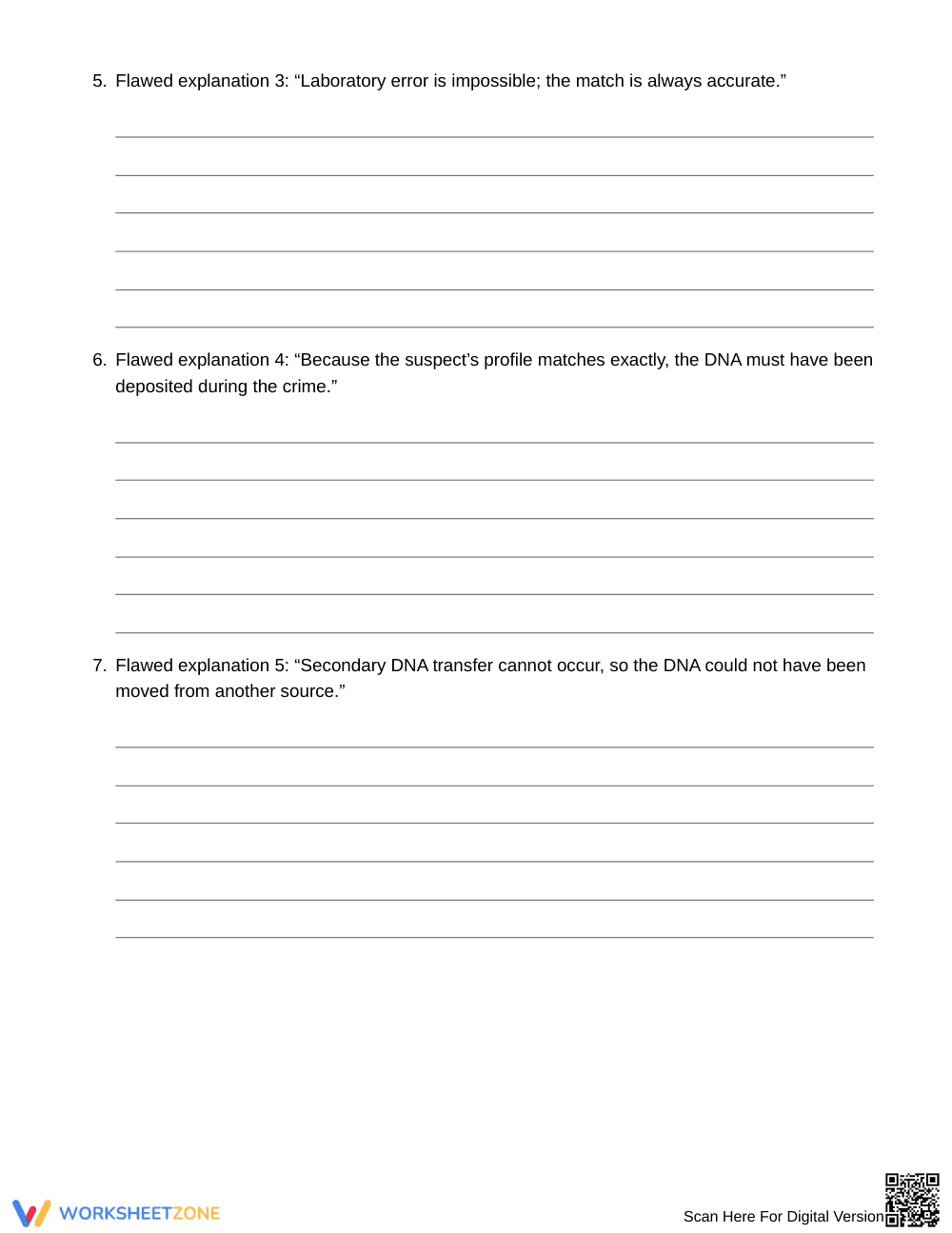
- Supported practice (Problems 3–6): Learners examine four flawed statements regarding transfer mechanisms and mathematical certainty, identifying logical fallacies before drafting initial scientific revisions.
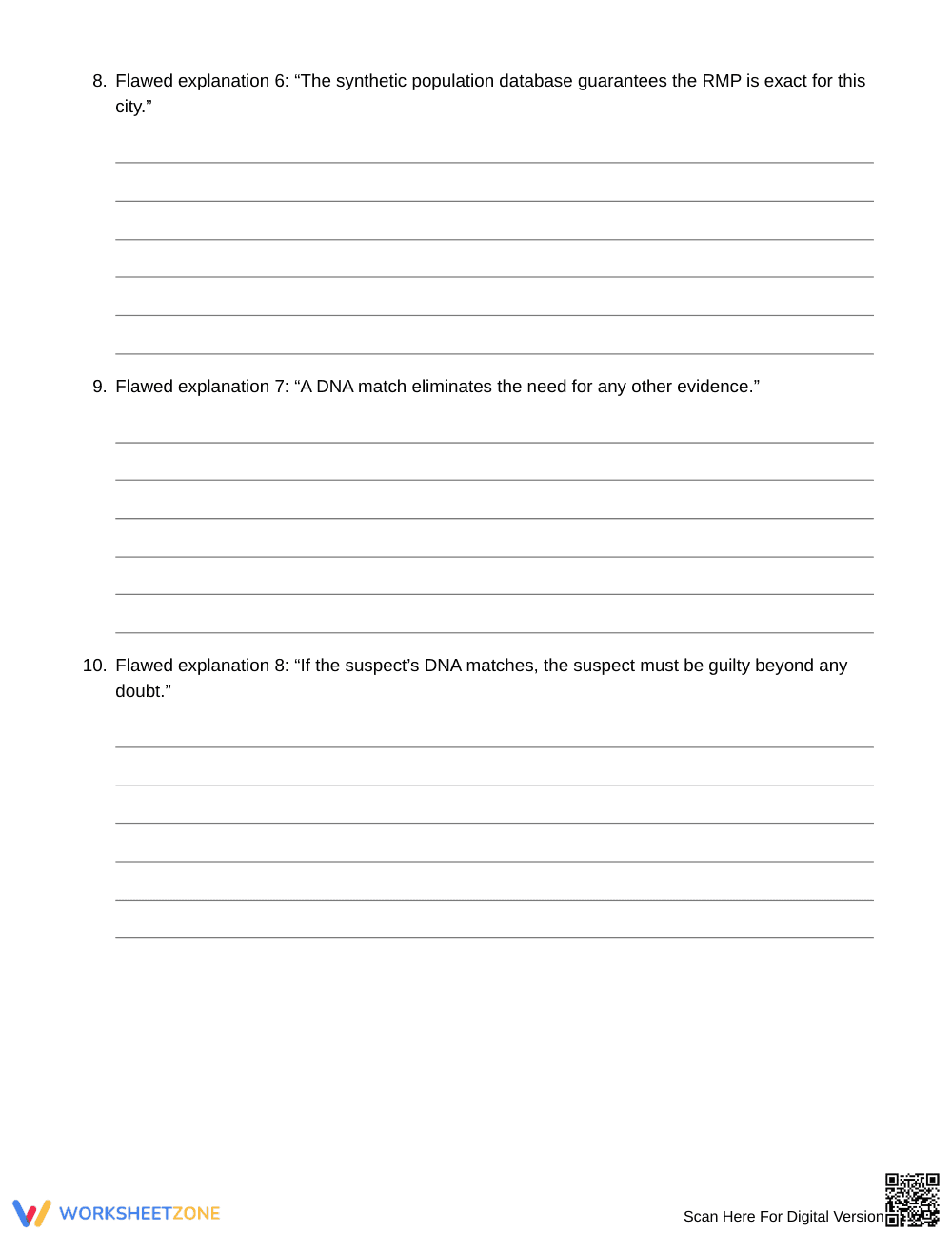
- Independent practice (Problems 7–10): Students independently diagnose complex misconceptions about sample contamination, database accuracy, and absolute guilt, composing complete scientific rebuttals.
This sequence mirrors the gradual release of responsibility model, moving students from guided evaluation to autonomous evidence-based critique.
Standards Alignment
This activity aligns with high school biology curriculum standards for scientific argumentation and evidence evaluation. Students analyze whether empirical data and statistical probabilities support claims regarding biotechnology applications. Both standard competencies can be copied directly into lesson plans, IEP goals, or district curriculum mapping tools.
How to Use It
Deploy this worksheet immediately following direct instruction on short tandem repeat analysis and forensic probability calculations. For an active partner routine, have students complete Part A independently before collaborating on Part B error-analysis prompts. Alternatively, assign Part B as an independent exit ticket to assess scientific writing. During work time, circulate to verify that students differentiate between match probability and proof of criminal guilt. Most ninth graders complete the 10 tasks in 35 to 45 minutes.
Who It's For
This assignment serves Grade 9 biology students studying genetics, biotechnology, or forensic science applications. For students requiring differentiation, provide sentence frames for written revisions or highlight key concepts in the introductory scenario. Pair this resource with a gel electrophoresis lab or an STR profiling simulation to connect laboratory techniques with data analysis.
This high school biology resource provides targeted instructional materials designed to help Grade 9 students correct DNA-match certainty claims and evaluate forensic evidence with scientific accuracy. Rather than treating genetic matches as indisputable proof, students examine short tandem repeat data across five loci, unpack random match probabilities, and address real-world confounding factors including secondary transfer and sample contamination. Grounded in the gradual release framework described by Fisher & Frey (2014), the instructional progression guides students from foundational conceptual analysis through rigorous error correction across ten focused tasks. By identifying scientific fallacies and formulating evidence-based rebuttals, learners develop the analytical reasoning skills required to interpret biotechnology applications and evaluate empirical claims. Teachers can integrate this four-page print-ready module directly into molecular genetics units to strengthen students' capacity to analyze complex data, critique flawed scientific explanations, and ground investigative conclusions in mathematical probability.


