


























Views
Downloads



Essential DNA Evidence Worksheet | Grades 8-12 Science
Paste this activity's link or code into your existing LMS (Google Classroom, Canvas, Teams, Schoology, Moodle, etc.).
Students can open and work on the activity right away, with no student login required.
You'll still be able to track student progress and results from your teacher account.
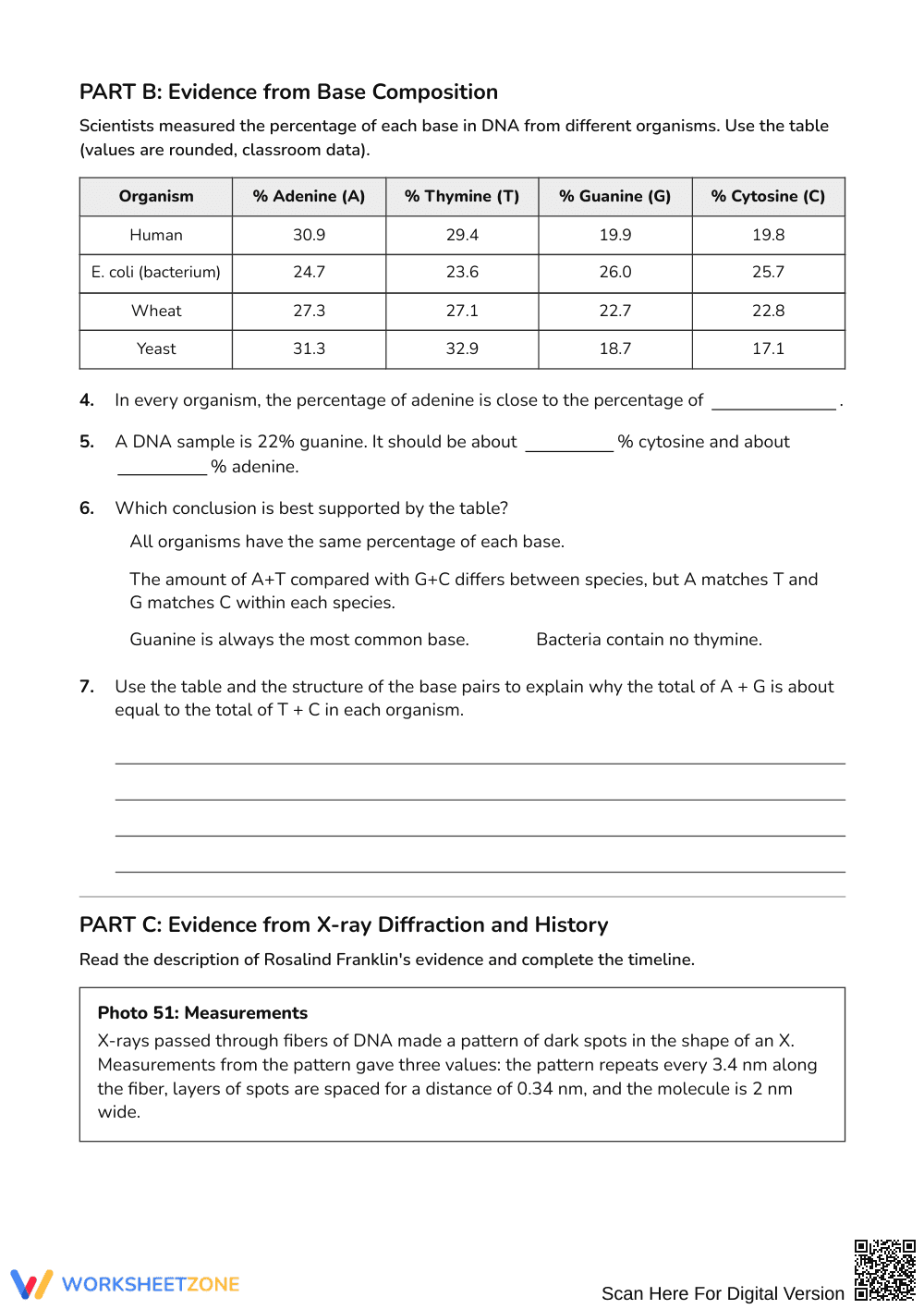
This four-page science worksheet guides students through interpreting empirical evidence and quantitative graphs that reveal the structure of DNA. Learners analyze nucleotide base pairing, examine Chargaff's ratios, inspect Franklin's X-ray diffraction measurements, and evaluate DNA melting curves to explain double-helix stability.
At a Glance
- Grade: Grades 8–12 · Subject: Science
- Standard: Secondary Life Science — Analyze and interpret empirical data to support structural models of DNA
- Skill Focus: DNA the Double Helix: Graph or Evidence Interpretation
- Format: 4 pages · 23 problems · Answer key included · PDF
- Best For: High school biology evidence-based inquiry units
- Time: 45–60 minutes
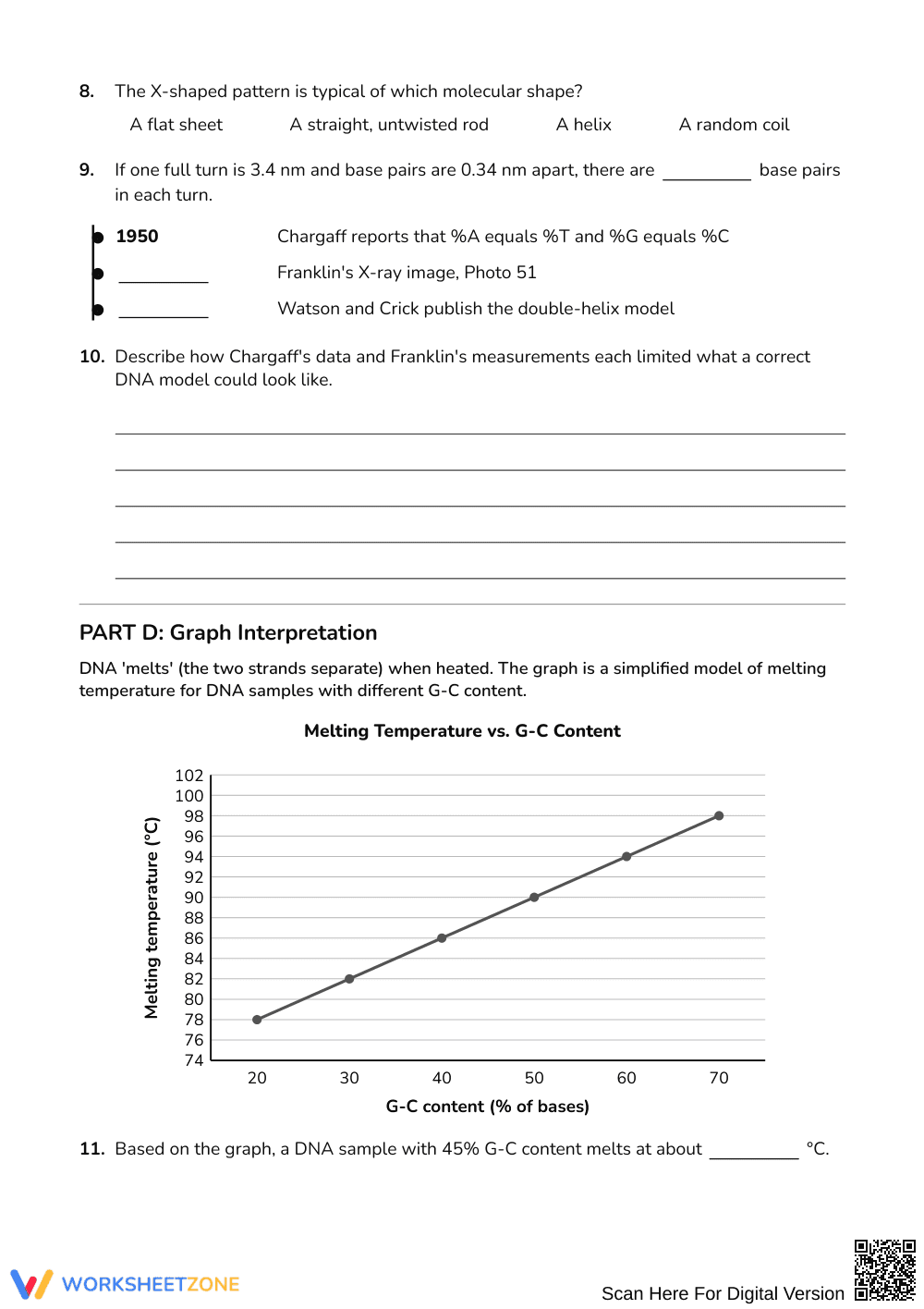
Inside, students complete 23 targeted tasks across four investigative parts. The resource integrates structural ladder diagrams, organism base-composition tables, historical X-ray diffraction data, and thermal denaturation graphs. A complete four-page answer key provides numeric answers, timeline entries, and sample claim-evidence-reasoning explanations for teacher evaluation.
Skill Progression
- Guided practice (Part A, 5 tasks): Students identify ladder components on a model, learning foundational terms for antiparallel strands and purine-pyrimidine pairs.
- Supported practice (Parts B & C, 11 tasks): Learners calculate base proportions using species data and extract dimensions from Photo 51 measurements.
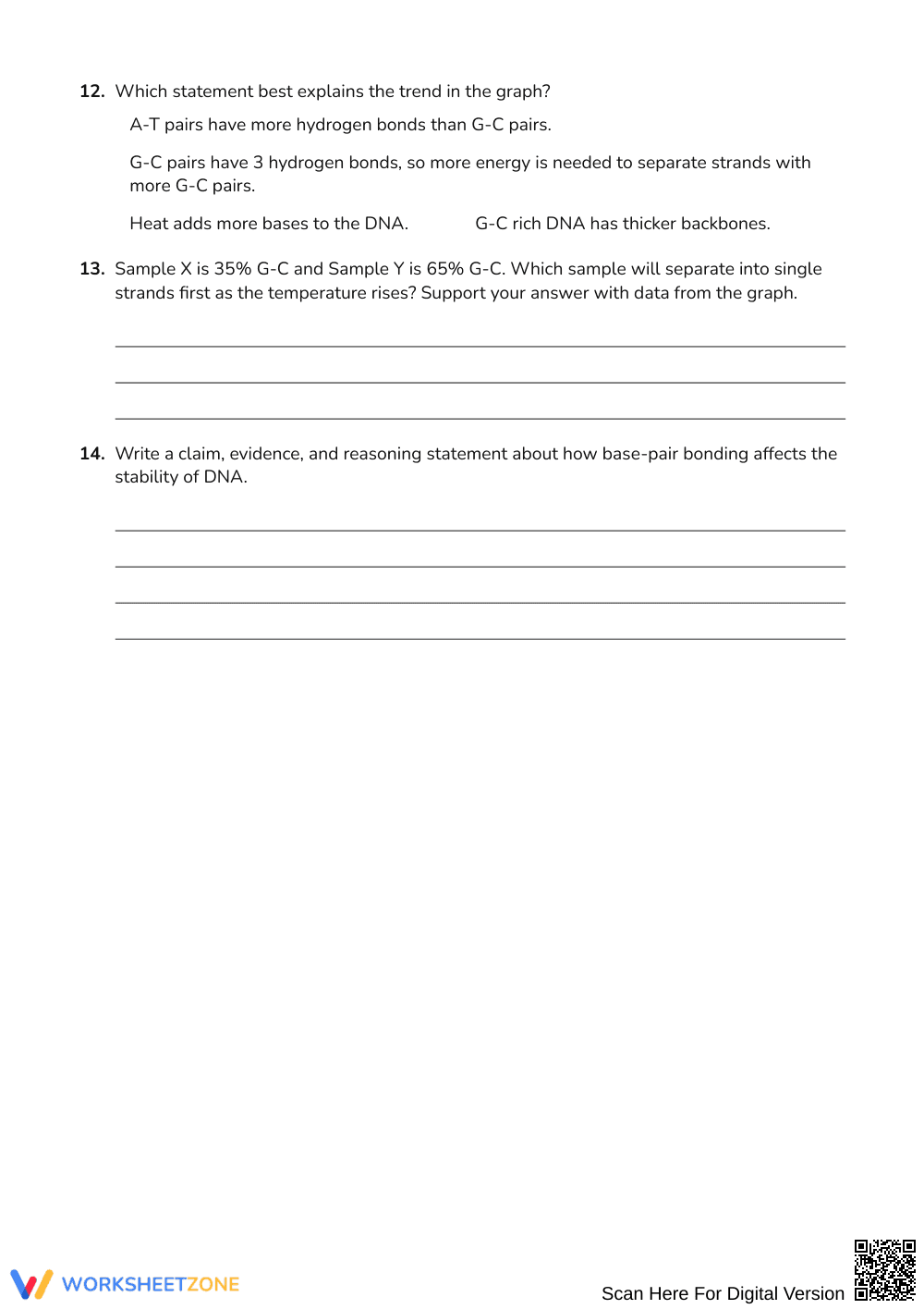
- Independent practice (Part D, 7 tasks): Students interpret melting curves, analyze G-C bond stability, and write an evidence-based argument.
This sequence follows the gradual release of responsibility model, moving students from basic diagram labeling to independent scientific reasoning.
Standards Alignment
This worksheet aligns with secondary life science standards on the molecular structure of DNA and evidence-based scientific argumentation. Students evaluate historical findings and quantitative data to explain how base pairing maintains structural integrity. Both standard descriptions can be copied directly into lesson plans, IEP goals, or district curriculum mapping tools.
How to Use It
Assign this worksheet following direct instruction on DNA structure to reinforce empirical discovery. It also works as a two-day inquiry sequence. For formative assessment, check whether students cite hydrogen bond counts when explaining melting temperatures in Part D. Expected completion time is 45 to 60 minutes.
Who It's For
This resource supports high school biology and genetics students practicing data interpretation. Clear diagrams and structured tables support emerging bilingual learners and students with accommodations. Pair this worksheet directly with physical molecular models or an anchor chart on nucleic acids.
Analyzing scientific evidence and graphical models is a critical milestone in high school life science mastery. This Grade 8–12 science worksheet engages learners in interpreting empirical datasets, including Chargaff's base ratios, Franklin's Photo 51 X-ray crystallography measurements, and DNA melting curves. According to Fisher & Frey (2014), scaffolding tasks through a gradual release framework significantly enhances students' ability to transfer complex data interpretation skills into independent scientific writing. By progressing from structural model labeling to a formal claim-evidence-reasoning response, students demonstrate authentic mastery of molecular genetics concepts. The 23 structured tasks connect physical dimensions, such as the 2-nanometer helical width and 10 base pairs per helical turn, directly to biochemical bonding properties. This comprehensive 4-page resource equips educators with an effective instructional tool that anchors abstract biological concepts firmly in authentic scientific inquiry. Teachers can readily integrate this print-and-go activity to diagnose conceptual gaps before summative unit assessments.


