




























Views
Downloads




Essential Detail Relationships Worksheet | Grade 7 ELA

Paste this activity's link or code into your existing LMS (Google Classroom, Canvas, Teams, Schoology, Moodle, etc.).
Students can open and work on the activity right away, with no student login required.
You'll still be able to track student progress and results from your teacher account.
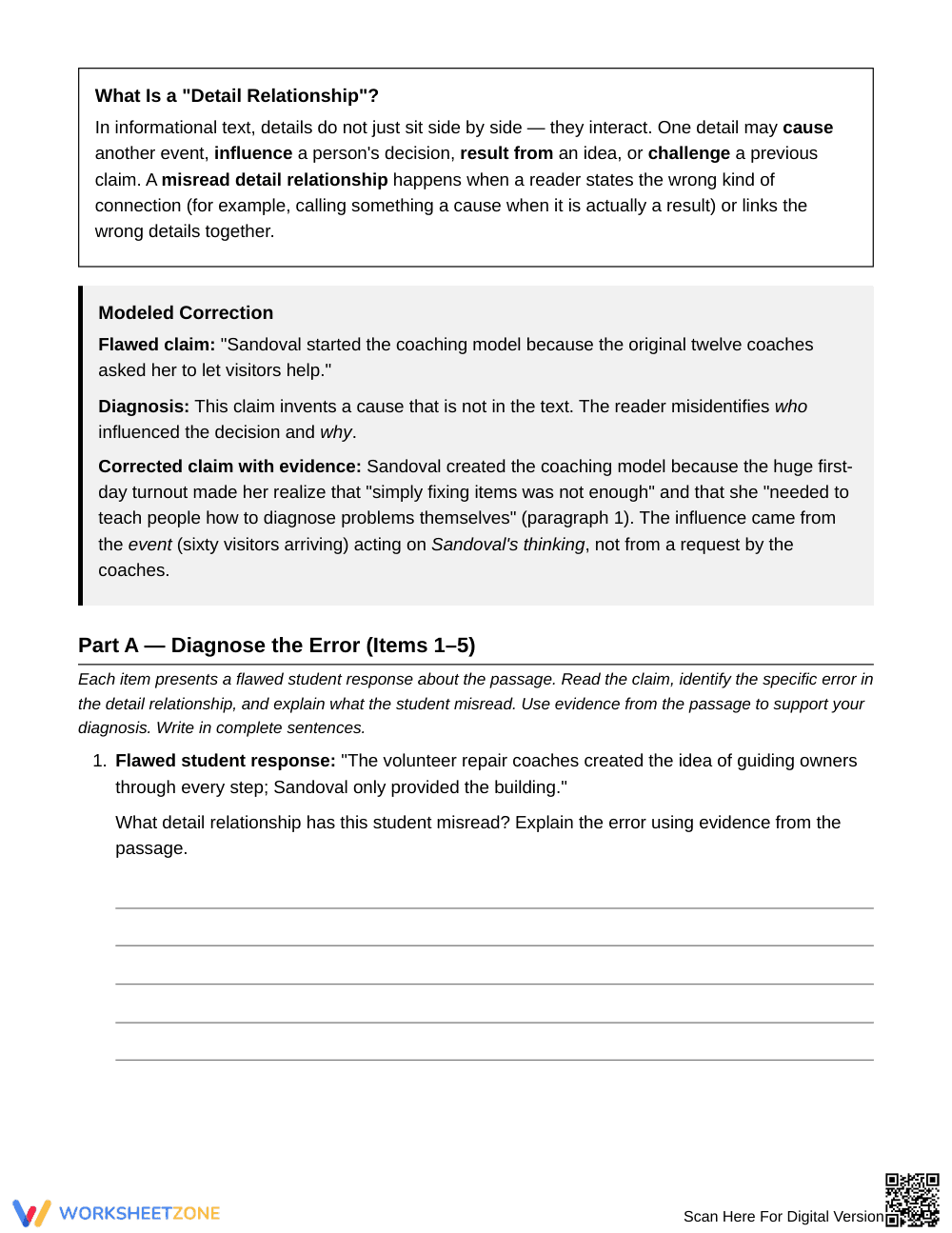
This informational text analysis worksheet guides Grade 7 students to identify and repair flawed cause-and-effect and relational claims within complex passages. Working with an original informational article, students diagnose misread connections between individuals, ideas, and events before constructing rigorous, evidence-supported textual corrections.
At a Glance
- Grade: 7 · Subject: ELA
- Standard:
RI.7.3— Analyze how individuals, events, and ideas interact in informational text- Skill Focus: Repairing misread detail relationships
- Format: 5 pages · 10 problems · Answer key included · PDF
- Best For: Close reading and informational text analysis
- Time: 40–50 minutes
What's Inside
This 5-page printable resource centers on an original multi-paragraph informational text about a community repair workshop. It opens with an explicit concept explanation defining detail relationships alongside a fully modeled diagnostic correction. The activity contains 10 rigorous short-answer tasks organized into two analytical stages, accompanied by a comprehensive 4-page answer key showing complete diagnostic explanations and multi-paragraph citations.
Skill Progression
- Guided practice: A detailed reference anchor breaks down relational errors and provides a complete modeled correction showing how to identify faulty causal reasoning with paragraph citations.
- Supported practice (Items 1–5): In Part A, students evaluate 5 distinct flawed claims, identifying the exact error in relational logic and explaining the misreading using textual evidence.
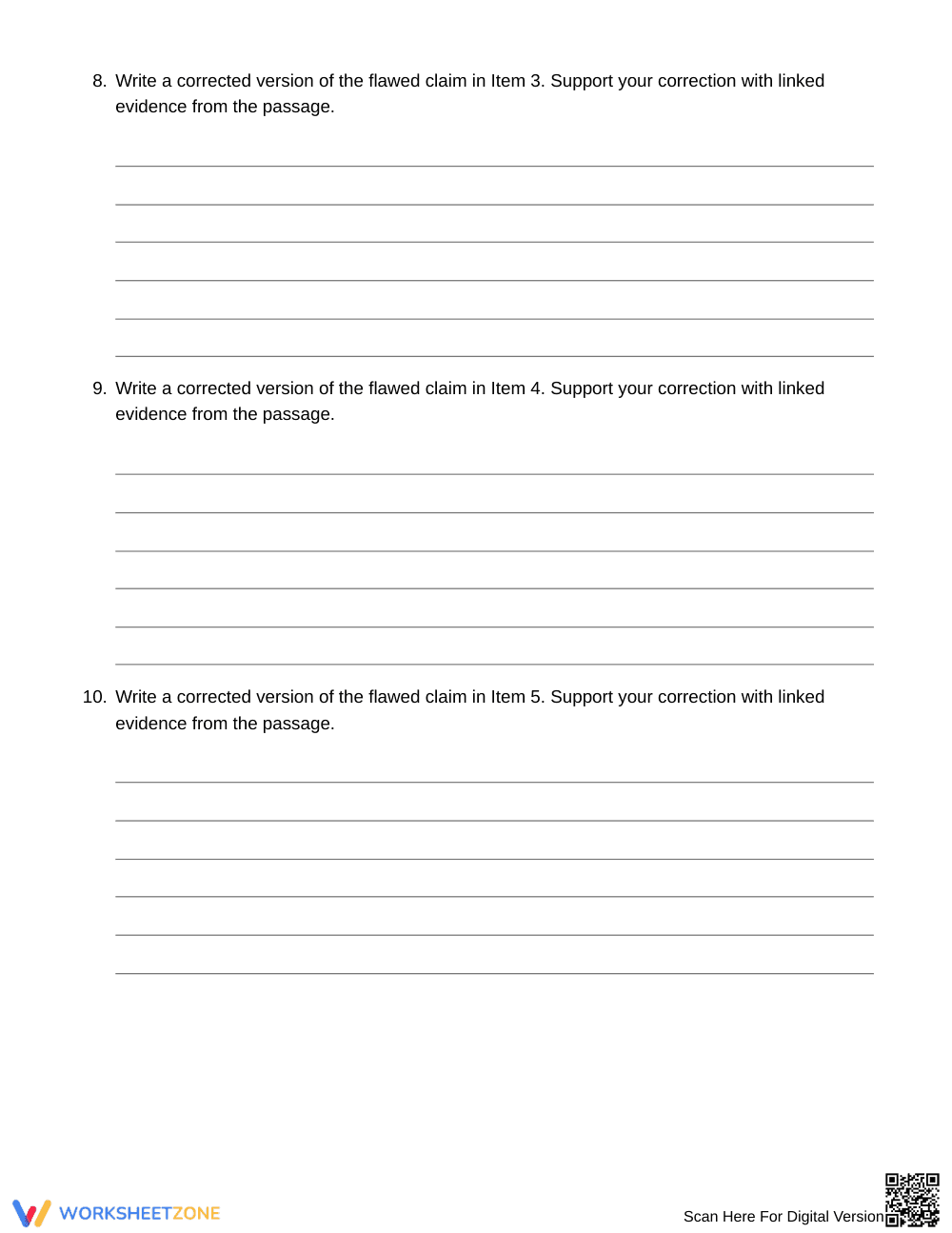
- Independent practice (Items 6–10): In Part B, students write 5 formal, evidence-based corrections that establish valid connections and synthesize textual evidence across multiple paragraphs.
This structured progression reflects the gradual release of responsibility model, ensuring students master error detection before drafting independent analytical revisions.
Standards Alignment
This worksheet directly targets RI.7.3: Analyze the interactions between individuals, events, and ideas in a text (e.g., how ideas influence individuals or events, or how individuals influence ideas or events). In addition, it supports RI.7.1 by demanding strong text evidence for every analytical claim. Both standard codes can be copied directly into lesson plans, IEP goals, or district curriculum mapping tools.
How to Use It
Implement this activity during close reading units after direct instruction on informational text structures. It functions effectively as a partner investigation or as an independent mid-unit mastery check. During instruction, circulate to observe whether students confuse chronological sequence with causal influence in Part A. Expect students to complete the 10 tasks in approximately 40 to 50 minutes.
Who It's For
Designed for general Grade 7 English Language Arts classrooms, this resource also provides targeted support for tier-2 reading intervention and striving readers who oversimplify informational logic. Pair this activity with an interactive anchor chart on informational text structures or a guided mini-lesson on distinguishing correlation from causation.
Mastering complex informational reading requires students to evaluate not merely isolated facts, but the structural connections that bind individuals, decisions, and outcomes together. According to research by Fisher & Frey (2014) on close reading and text-dependent analysis, teaching middle school students to actively interrogate and repair faulty textual interpretations builds essential evaluative thinking skills that transfer across content areas. This 5-page curriculum resource provides direct practice with standard RI.7.3 by presenting middle school learners with 10 structured analytical tasks. Students systematically diagnose misattributed causes, clarify distorted sequences, and cite multi-paragraph evidence to establish valid informational connections. By moving from guided error diagnosis to rigorous evidence-backed revision, the worksheet deepens reading comprehension, strengthens disciplinary literacy, and ensures students meet rigorous grade-level expectations for informational text analysis.


