


























Views
Downloads




Essential Delayed Consequences Plot Worksheet | Grade 8 ELA
Paste this activity's link or code into your existing LMS (Google Classroom, Canvas, Teams, Schoology, Moodle, etc.).
Students can open and work on the activity right away, with no student login required.
You'll still be able to track student progress and results from your teacher account.
Help eighth-grade students analyze how dialogue and incidents drive narrative action with this rigorous analytical worksheet. Learners read paired dramatic scenes, track how an early rehearsal dispute creates causal constraints, and explain delayed consequences on opening night. Students evaluate competing interpretations and defend evidence-based claims about character decisions.
At a Glance
- Grade: 8 · Subject: ELA
- Standard:
RL.8.3— Analyze how dialogue or incidents propel action, reveal character, or provoke decisions- Skill Focus: Small incidents with delayed causal consequences
- Format: 5 pages · 8 problems · Answer key included · PDF
- Best For: Close reading and narrative analysis
- Time: 40–50 minutes
This 5-page resource includes an analytical framework and two paired dramatic scenes. Students complete 8 focused tasks featuring short constructed responses, multiple-choice items on competing interpretations, and structured argument defenses. A 3-page answer key provides paragraph-level evidence and sample responses.
Skill Progression
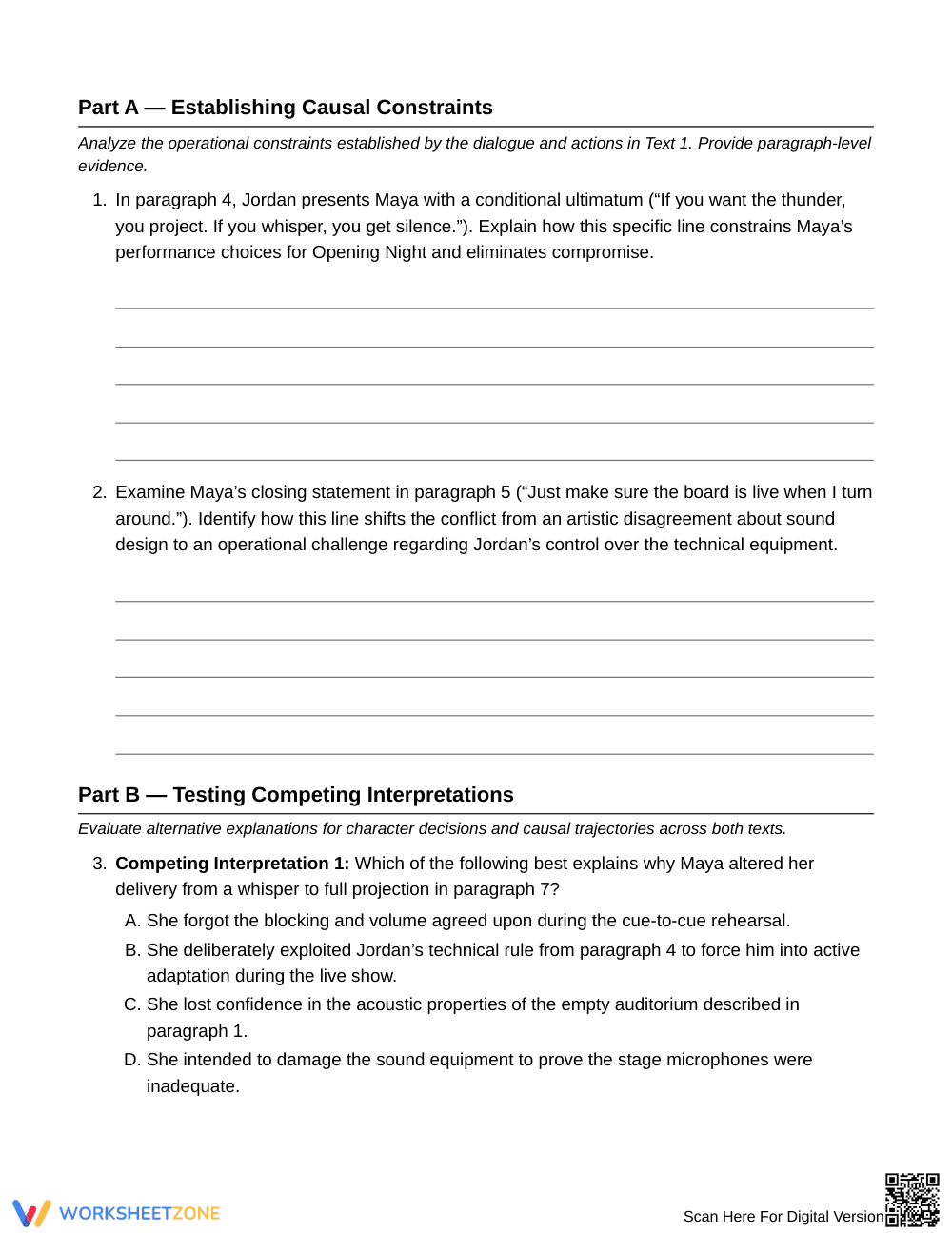
- Guided practice (Part A): 2 constructed-response items guide students to examine paragraph 4 dialogue and identify how Jordan's ultimatum constrains Maya's opening night choices.
- Supported practice (Part B): 4 targeted items prompt students to evaluate competing interpretations of character motives and analyze symbolic stage blocking.
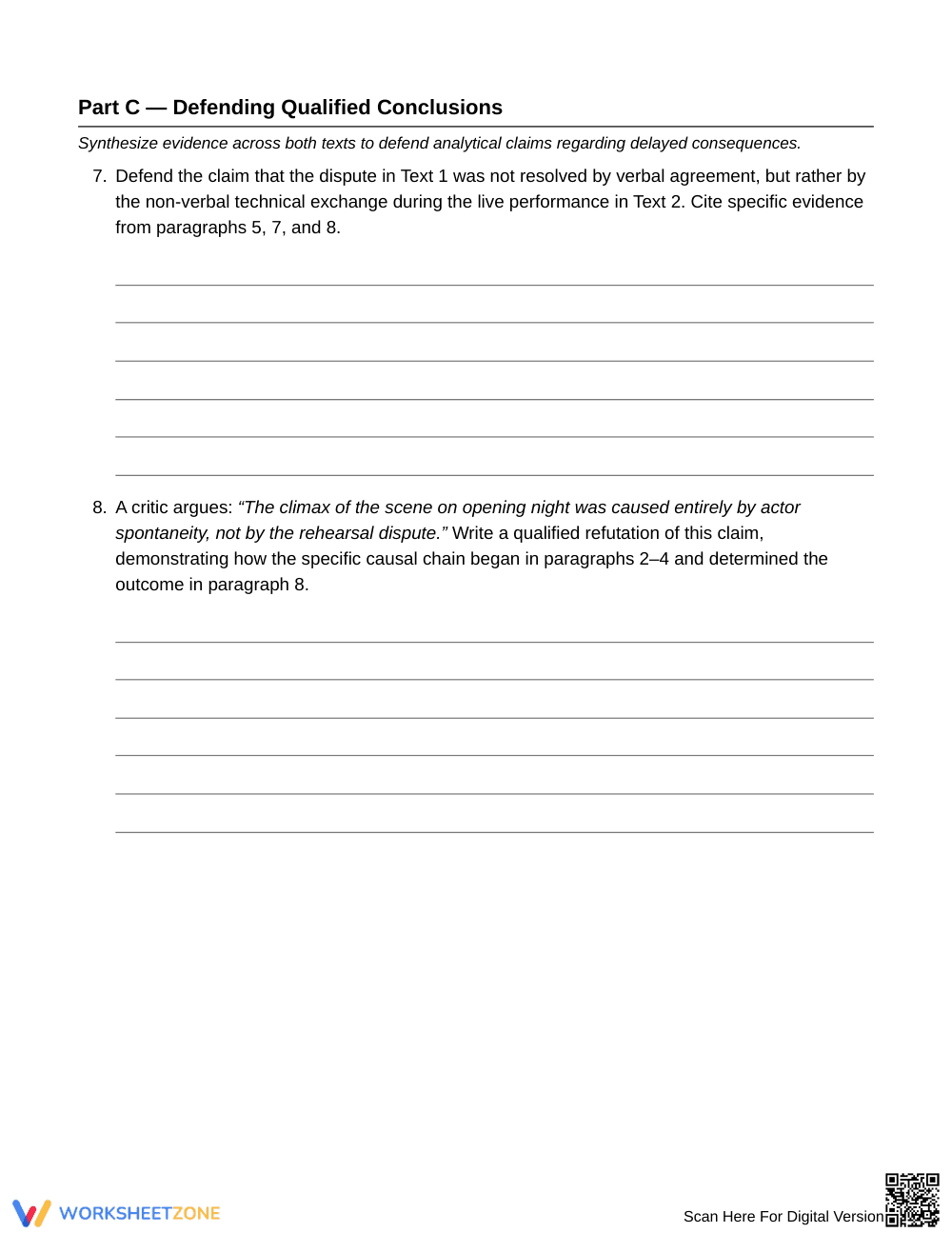
- Independent practice (Part C): 2 extended-response prompts require students to synthesize both texts, defend a causal claim, and write a qualified refutation.
This sequence follows a gradual-release model, advancing from text-dependent identification to independent literary synthesis.
Standards Alignment
This worksheet aligns to RL.8.3: "Analyze how particular lines of dialogue or incidents in a story or drama propel the action, reveal aspects of a character, or provoke a decision." Students evaluate how technical conflicts constrain choices and cause delayed consequences. Both standard codes can be copied directly into lesson plans, IEP goals, or district curriculum mapping tools.
How to Use It
Use this worksheet after direct instruction on plot structure and narrative causality. Model Part A with the whole class before having students complete Parts B and C in pairs or independently. For formative assessment, check whether students connect Jordan's sound adjustments in paragraph 8 to Maya's defiance in paragraph 7. Expected completion time is 40 to 50 minutes.
Who It's For
This resource supports Grade 8 ELA students mastering complex literary analysis. Provide sentence stems for English learners and students in Tier 2 intervention. Pair this worksheet with an anchor chart on causal plot chains or an introductory lesson on theatrical dialogue.
According to Fisher & Frey (2014), structured close-reading tasks that require students to evaluate competing interpretations and trace causal relationships across complex texts foster deeper comprehension and higher-order analytical reasoning. When eighth-grade students analyze how specific narrative incidents provoke latent decisions and establish delayed plot consequences under standard RL.8.3, they develop critical text-interrogation habits essential for high school literary analysis. Rather than viewing plot events as isolated occurrences, learners discover how authorial choices establish underlying operational constraints that dictate character trajectories across scenes. By scaffolding text-dependent questions from paragraph-level constraint identification to qualified refutations, this resource reinforces the gradual transfer of analytical responsibility. The integrated five-page sequence ensures students build rigorous, evidence-based argumentation habits that meet national benchmark expectations for middle school English language arts instruction.


