




























Views
Downloads


Essential Cosmological Models Worksheet | Grade 12 Science

Paste this activity's link or code into your existing LMS (Google Classroom, Canvas, Teams, Schoology, Moodle, etc.).
Students can open and work on the activity right away, with no student login required.
You'll still be able to track student progress and results from your teacher account.
This high school Earth and space science worksheet equips Grade 12 students to compare cosmological model predictions using observational astronomical data. Learners evaluate metric expansion against static tired-light hypotheses across 10 structured analytical problems, calculating redshift, time dilation, and elemental abundances to substantiate Big Bang cosmology through physical evidence.
At a Glance
- Grade: 12 · Subject: Earth & Space Science
- Standard: High School Earth and Space Science — Evaluate competing cosmological models and cosmic expansion using quantitative astronomical evidence
- Skill Focus: Compare Cosmological Model Predictions
- Format: 5 pages · 10 problems · Answer key included · PDF
- Best For: Advanced astrophysics practice and exam review
- Time: 45–60 minutes
What's Inside
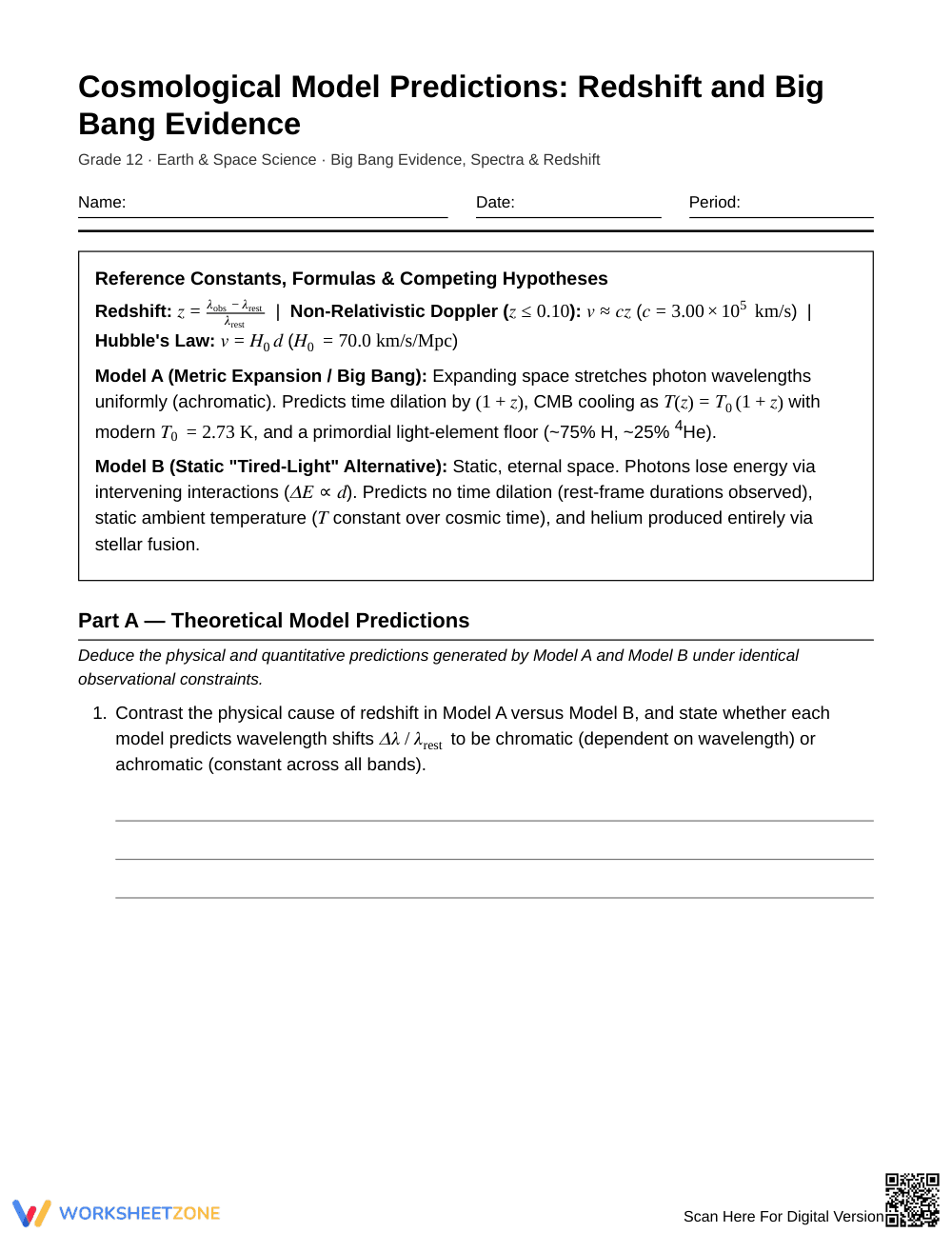
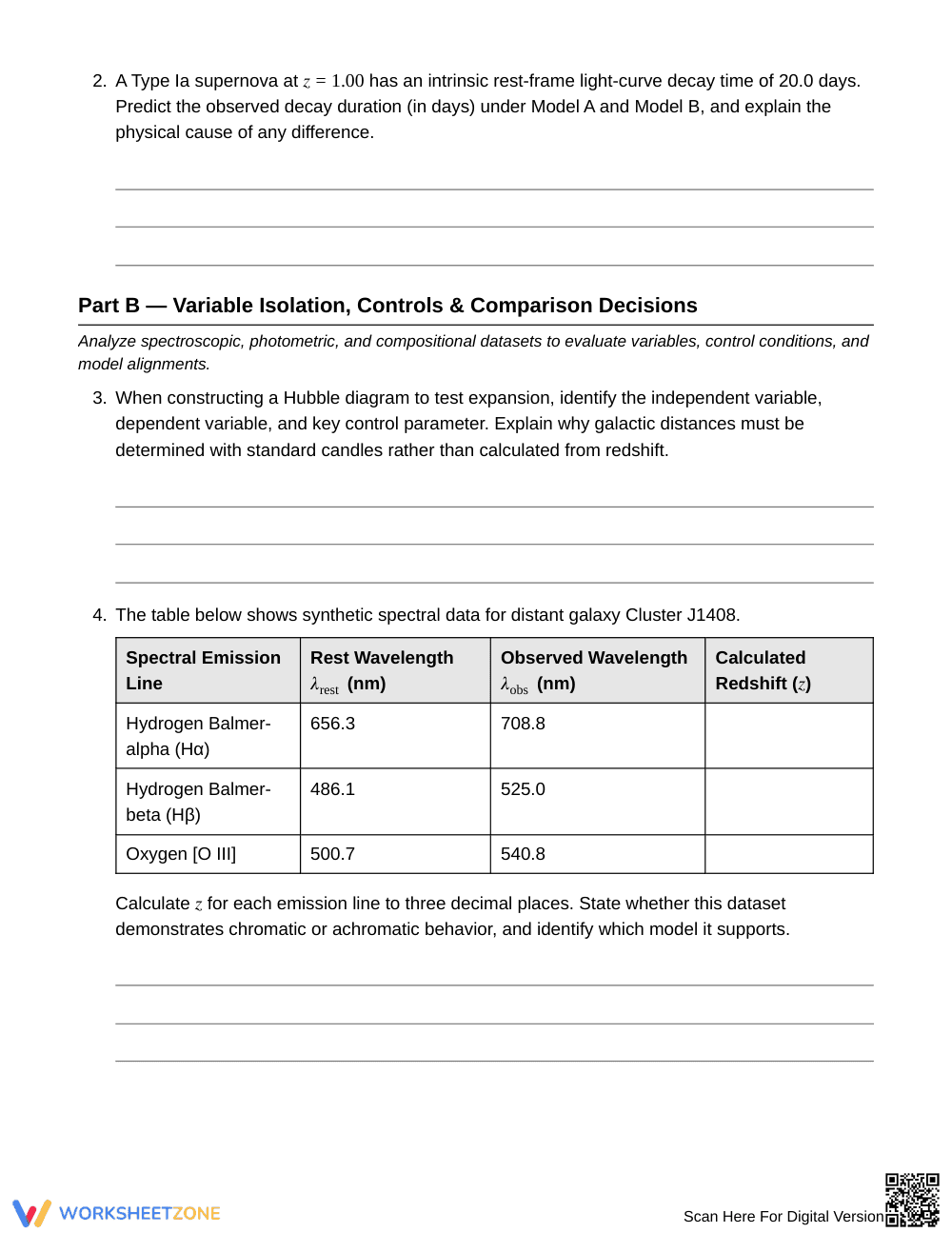
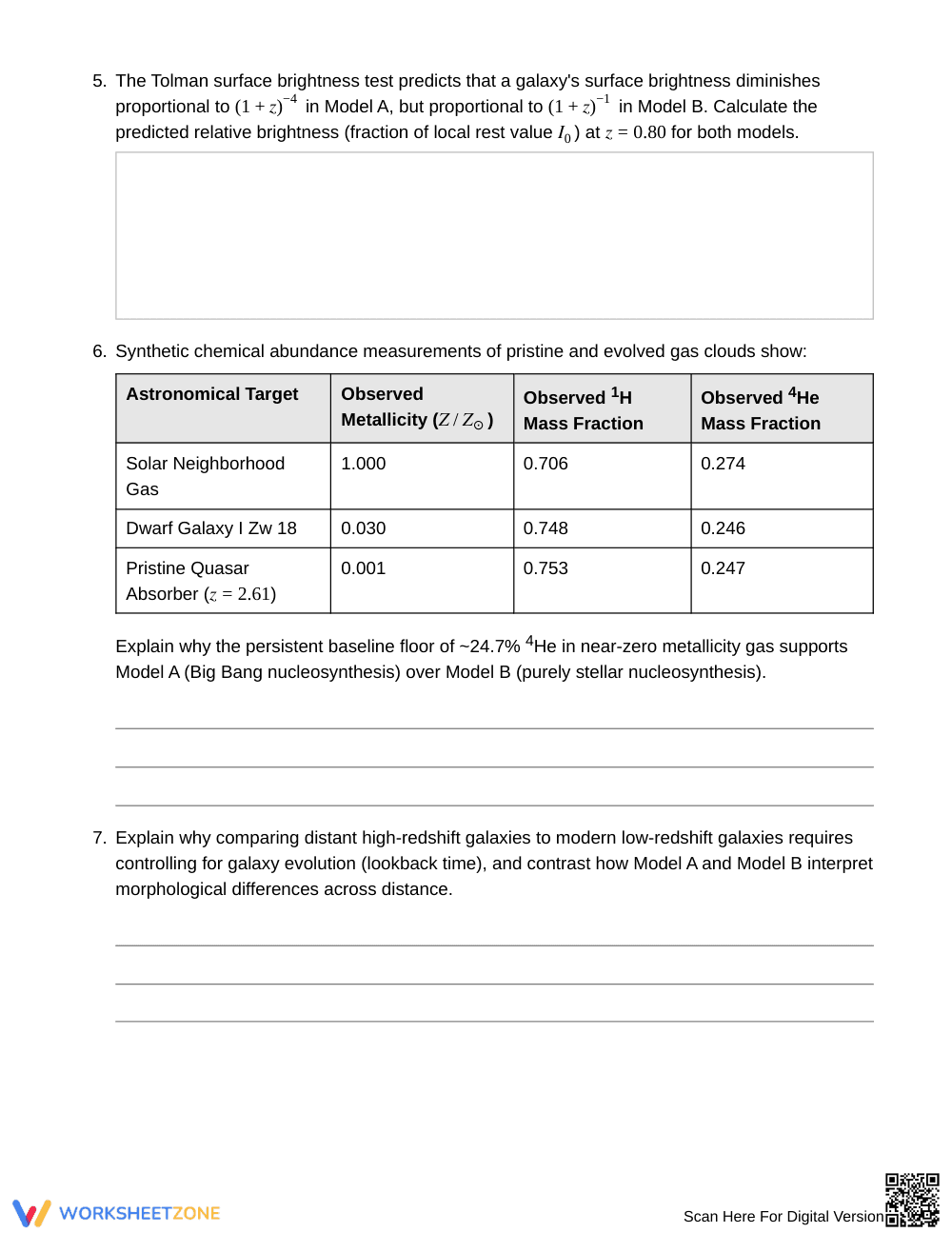
This 5-page instructional resource contains 10 rigorous analytical problems alongside a 3-page worked answer key. A formula reference header defines redshift, non-relativistic Doppler velocity, Hubble's Law, and core hypotheses for Model A (metric expansion) and Model B (tired light). Students analyze synthetic spectral line data for Cluster J1408, calculate Tolman surface brightness scaling, interpret primordial helium baselines, and evaluate cosmic microwave background cooling.
Skill Progression
- Guided practice (Problems 1–2): Students deduce theoretical predictions from reference equations, contrasting chromatic versus achromatic shifts and computing supernova time dilation under both cosmic hypotheses.
- Supported practice (Problems 3–8): Learners analyze multi-parameter datasets, calculating redshift across spectral lines, evaluating surface brightness dimming, and explaining primordial helium floors.
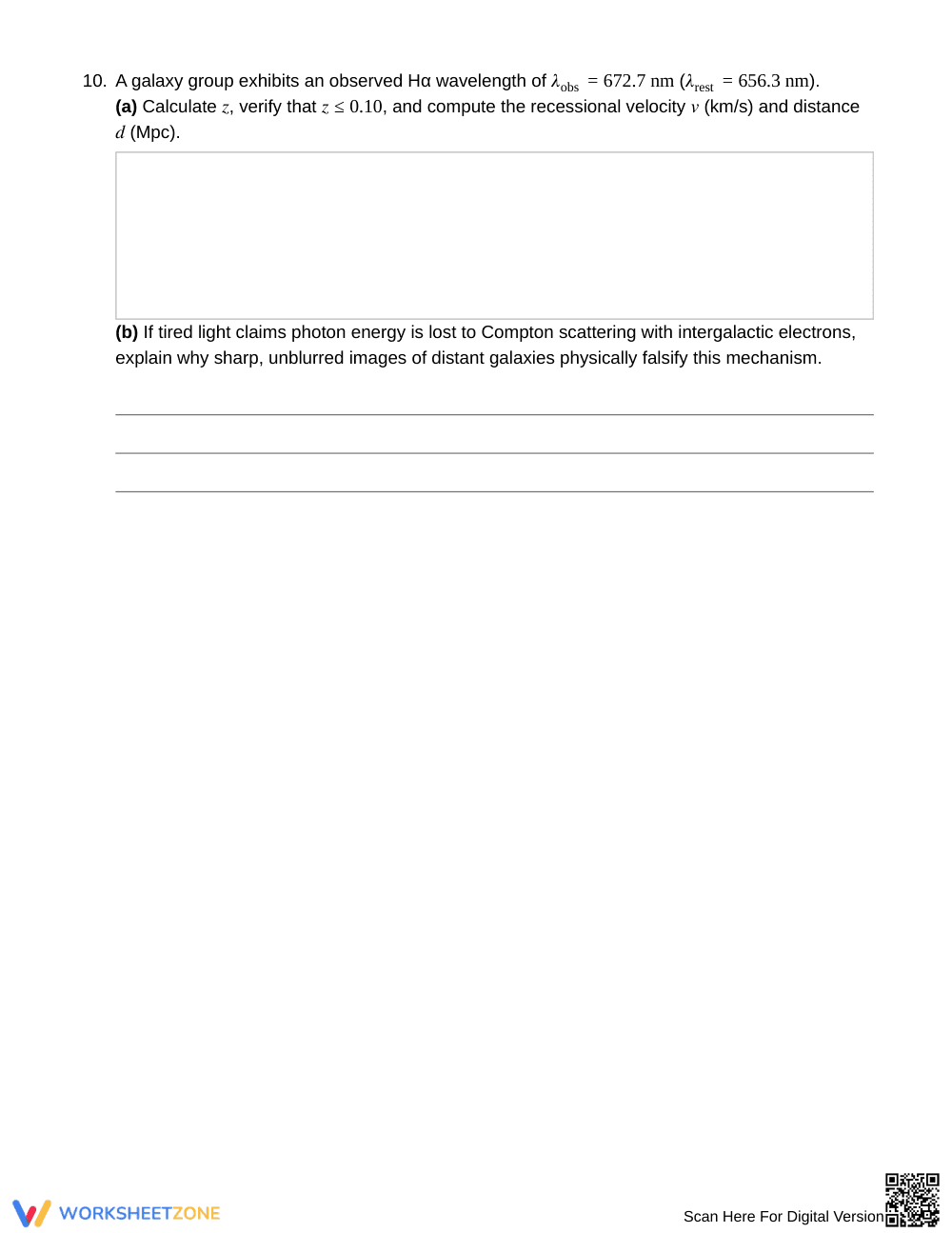
- Independent practice (Problems 9–10): Students synthesize multi-wavelength observations, executing formal model falsification and calculating recessional velocity and distance.
This sequence follows a gradual-release model, building analytical rigor from foundational predictions to complex multi-dataset falsification.
Standards Alignment
This lesson aligns with high school Earth and space science standards requiring learners to evaluate astronomical evidence of light spectra, cosmic expansion, and primordial element distributions supporting the Big Bang theory. Students apply scientific reasoning to evaluate competing models against observational data. Both standard codes can be copied directly into lesson plans, IEP goals, or district curriculum mapping tools.
How to Use It
Assign this worksheet following direct instruction on cosmological redshift and Hubble's Law. It serves effectively as a structured partner activity or an advanced formative assessment. During class, monitor student calculations on the Tolman surface brightness test in Problem 5 to verify proper exponent application. Expected completion time is 45 to 60 minutes.
Who It's For
This material is designed for Grade 12 Earth and Space Science or introductory astronomy students. Provide struggling learners with an annotated formula sheet and a completed Doppler calculation example, while offering advanced students opportunities to explore relativistic redshift extensions. Pair this worksheet directly with an introductory lesson on the Cosmic Microwave Background.
Comparing cosmological model predictions requires upper secondary students to synthesize quantitative spectral data, mathematical scaling relationships, and empirical astrophysics evidence. According to Fisher & Frey (2014), purposeful instructional design that scaffolds complex disciplinary tasks through structured gradual release significantly enhances student mastery of abstract scientific models. This Grade 12 cosmology worksheet puts that research into practice by leading students from explicit hypothesis deduction through data analysis and multi-variable model falsification. Learners do not merely memorize the Big Bang theory; they actively test metric expansion against competing static tired-light hypotheses using empirical observations of time dilation, achromatic spectral line shifts, Tolman surface brightness scaling, and primordial helium baselines. The accompanying 3-page worked solution key ensures accurate feedback, making this 5-page classroom resource an exemplary model for fostering evidence-based argumentation, quantitative scientific literacy, and rigorous conceptual understanding in secondary earth and space science curricula.


