




























Views
Downloads



Essential Cosmic Expansion Word Search | Grades 7–8 Science

Paste this activity's link or code into your existing LMS (Google Classroom, Canvas, Teams, Schoology, Moodle, etc.).
Students can open and work on the activity right away, with no student login required.
You'll still be able to track student progress and results from your teacher account.
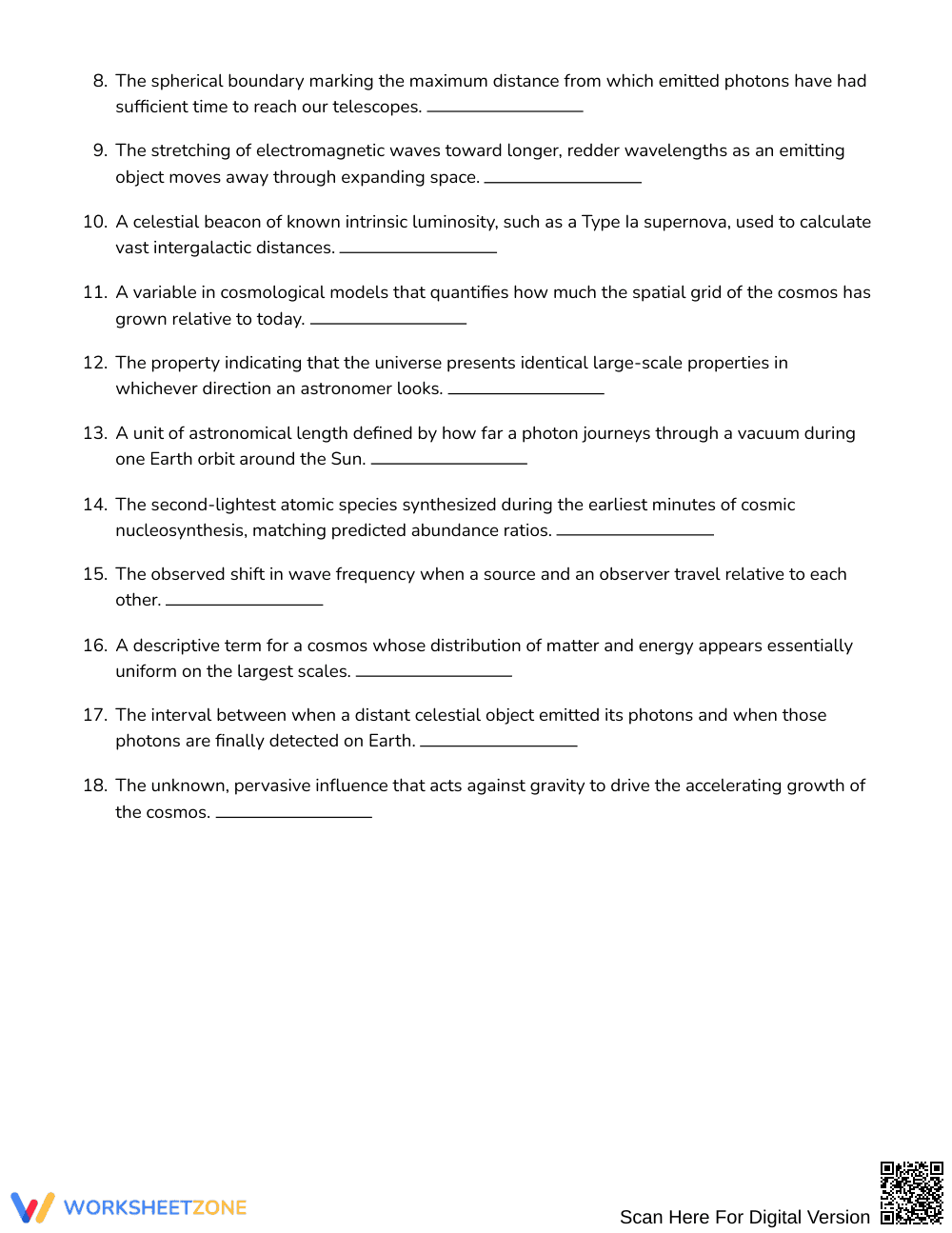
This astronomy word search reinforces student understanding of cosmic expansion by connecting 18 scientific clues directly to core cosmology terms. Designed for Grades 7–8 science classrooms, this activity challenges learners to read rigorous definitions of evidence for the Big Bang Theory and locate each term within a dense puzzle grid.
At a Glance
- Grade: Grades 7–8 middle school · Subject: Science (Astronomy)
- Standard: Not standards-assessed — vocabulary enrichment and scientific definition retrieval
- Skill Focus: Comparing evidence for cosmic expansion and Big Bang Theory
- Format: 3 student pages · 18 words · 4-page answer key included · Printable PDF
- Best For: Cumulative unit review, post-lesson reinforcement, or astronomy sub plans
- Time: 25–35 minutes of focused student engagement
What's Inside
This 3-page printable science resource contains an 18-word search puzzle accompanied by full contextual clues and a shuffled word bank. Rather than relying on simple letter-matching, students read in-depth astronomical descriptions, covering redshift, cosmic microwave background, and Hubble's law, to identify terms before finding them in the puzzle. A detailed 4-page answer key displays complete grid solutions with letter coordinates, enabling rapid self-checking or teacher grading.
Puzzle Architecture and Mechanics
The word search is built around a 20 × 20 grid engineered to develop spatial reasoning and terminology recall. Hidden words run across all eight compass directions: north, northeast, east, southeast, south, southwest, west, and northwest. To complete the activity, students read 18 conceptual clues to deduce each cosmological term, cross-reference their answers against the shuffled word bank, and track the vocabulary across horizontal, vertical, and diagonal paths.
Standards Alignment
This resource serves as vocabulary enrichment and cumulative review; it is not aligned to a specific standard. Instead, it supports middle school science curricula by reinforcing specialized terminology related to cosmological models, Doppler shifts, and universal expansion evidence.
How to Use It
Deploy this word search immediately after direct instruction on the Big Bang Theory as a post-lesson review or as an independent station during exam preparation. While students work, circulate to observe which clues prompt hesitation—confusion surrounding terms like metric expansion versus Doppler effect often highlights misconceptions about cosmic stretching. Middle school learners will typically complete the 18 clues and puzzle grid in 25 to 35 minutes.
Who It's For
This puzzle is tailored for Grades 7–8 science students studying astronomy and cosmic evolution. To differentiate for striving readers, teachers can highlight initial letters or provide a targeted reference glossary before puzzle searching begins, while advanced students can write original summary sentences connecting two discovered terms. Pair this activity directly with an anchor chart detailing the electromagnetic spectrum and galactic redshifts.
Designed for middle school astronomy units, this vocabulary enrichment resource focuses on comparing evidence for cosmic expansion through clue-based terminology retrieval rather than a formal standard code. According to research on disciplinary literacy by Fisher & Frey (2014), structured exposure to domain-specific language within meaningful contexts directly enhances secondary students' conceptual comprehension in science. By pairing 18 rigorous definitions, spanning metric expansion, cosmic microwave background, and standard candles, with an engaging 20 by 20 search grid, this activity bridges academic reading and active recall. Learners must evaluate complex astronomical principles before locating target words across eight compass directions, reinforcing orthographic memory and conceptual associations. The accompanying four-page answer key provides clear coordinate keys that support immediate corrective feedback, establishing an evidence-based vocabulary routine that strengthens student readiness for advanced astrophysical study across middle school science classrooms.


