


























Views
Downloads


Essential Cooling-Pack Analysis Worksheet | Grade 7 Science
Paste this activity's link or code into your existing LMS (Google Classroom, Canvas, Teams, Schoology, Moodle, etc.).
Students can open and work on the activity right away, with no student login required.
You'll still be able to track student progress and results from your teacher account.
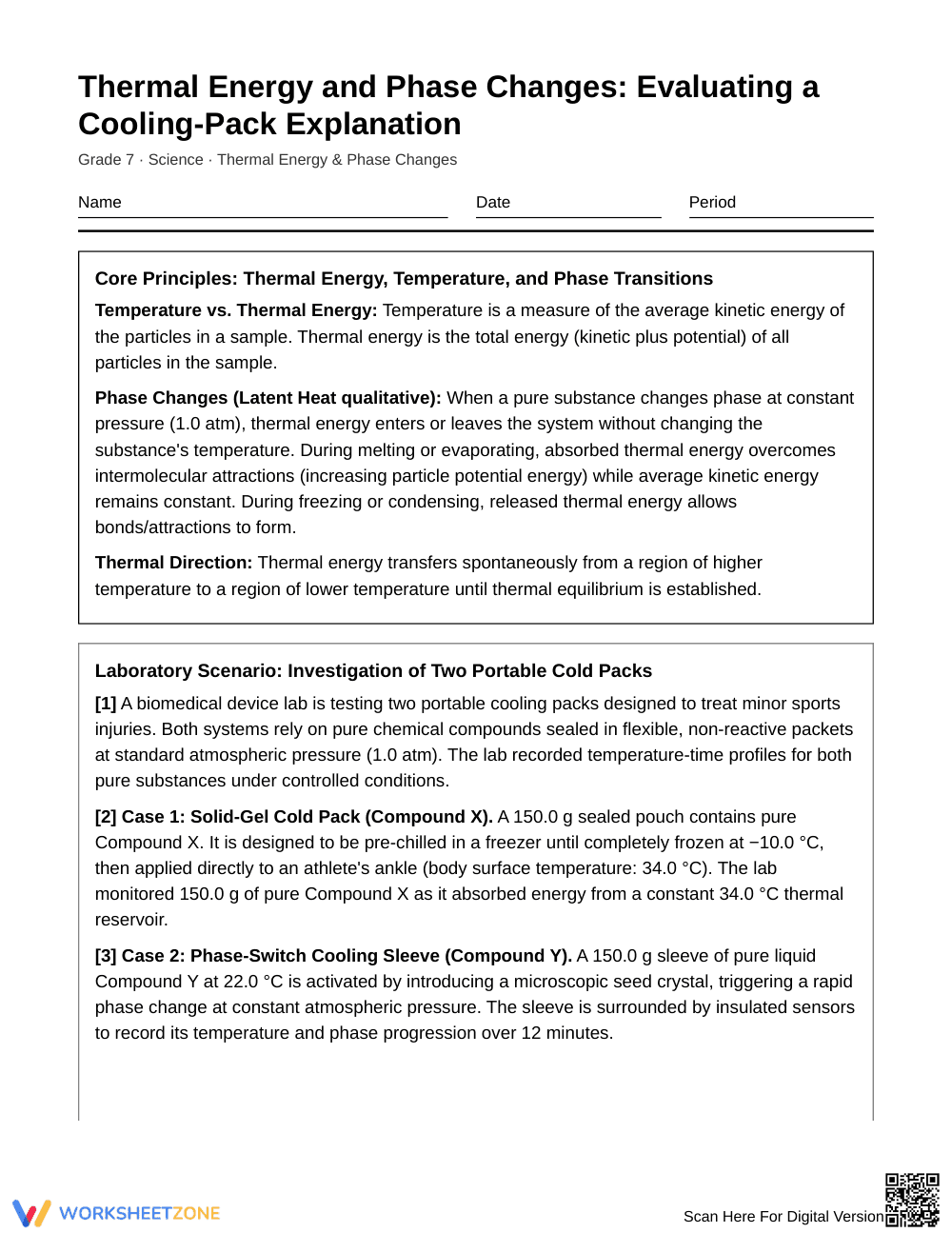
This Grade 7 physical science worksheet trains students to analyze thermal energy transfer and phase changes using laboratory data. Learners evaluate temperature plateaus, contrast kinetic and potential energy during state transitions, and critique scientific explanations across 10 targeted problems to build rigorous conceptual understanding.
At a Glance
- Grade: 7 · Subject: Science
- Standard: Thermal Energy Transfer — Relate temperature, thermal energy, and particle motion during phase changes
- Skill Focus: Evaluate a Cooling-Pack Explanation
- Format: 5 pages · 10 problems · Answer key included · PDF
- Best For: Mid-unit lab analysis and formative assessment
- Time: 40–50 minutes
What's Inside
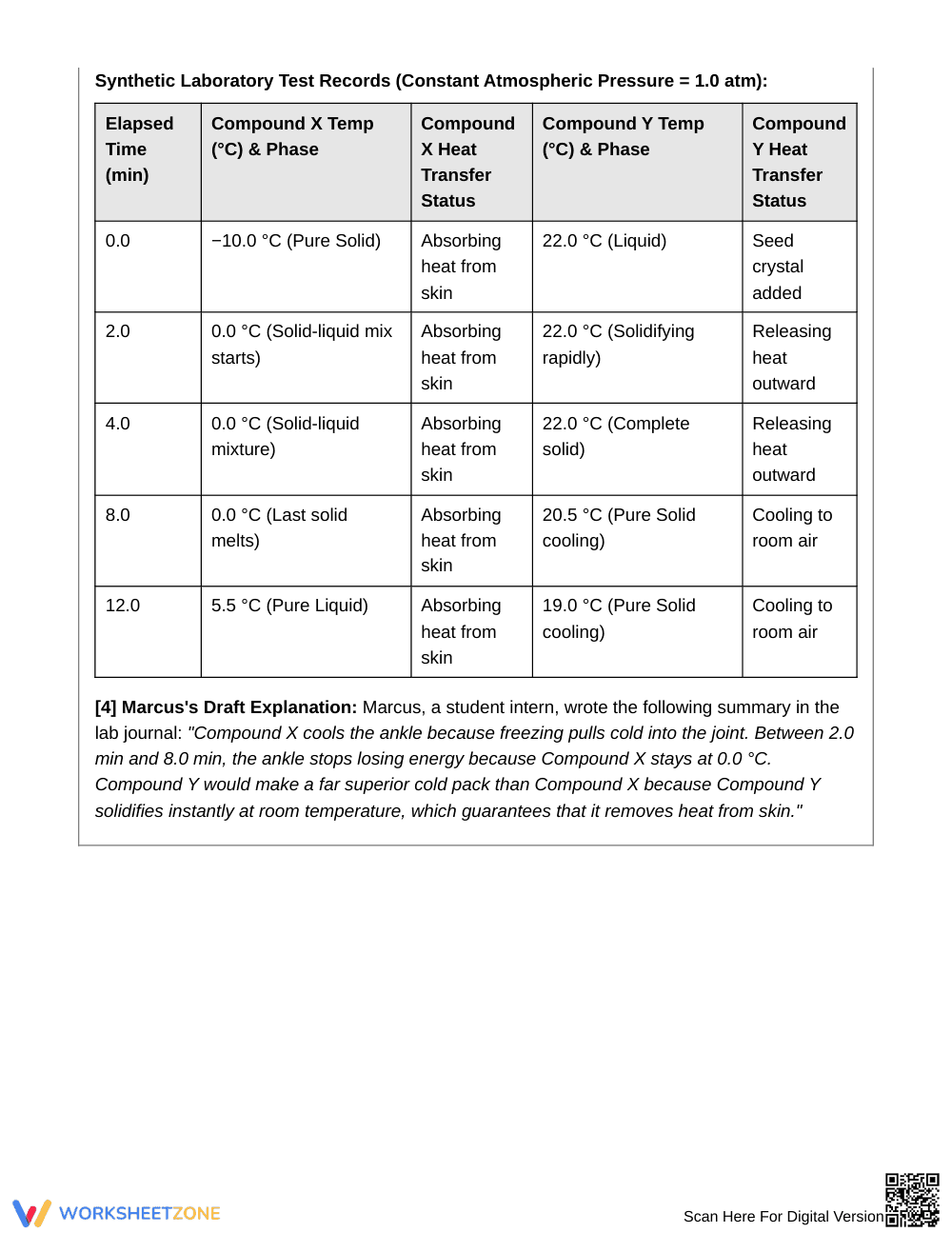
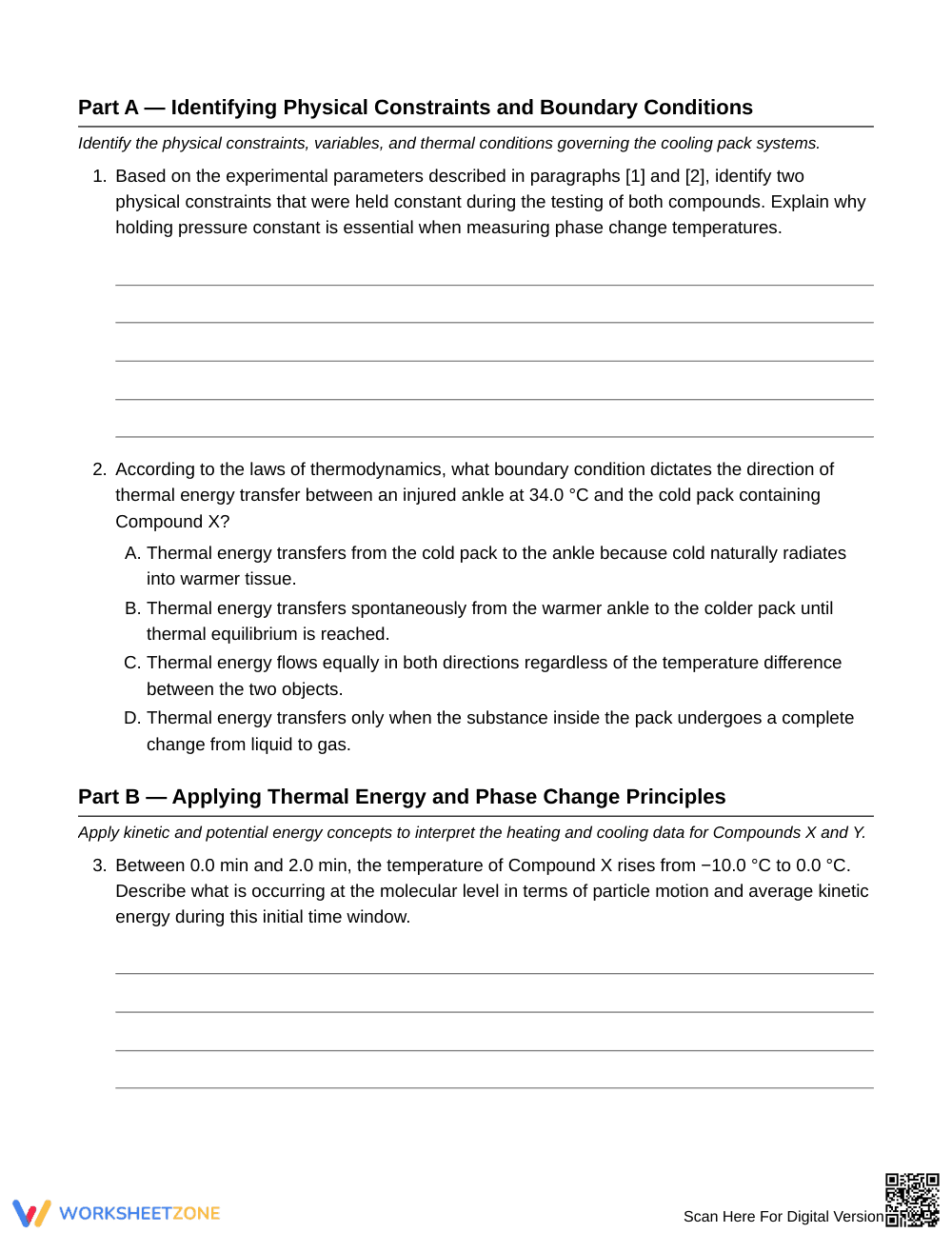
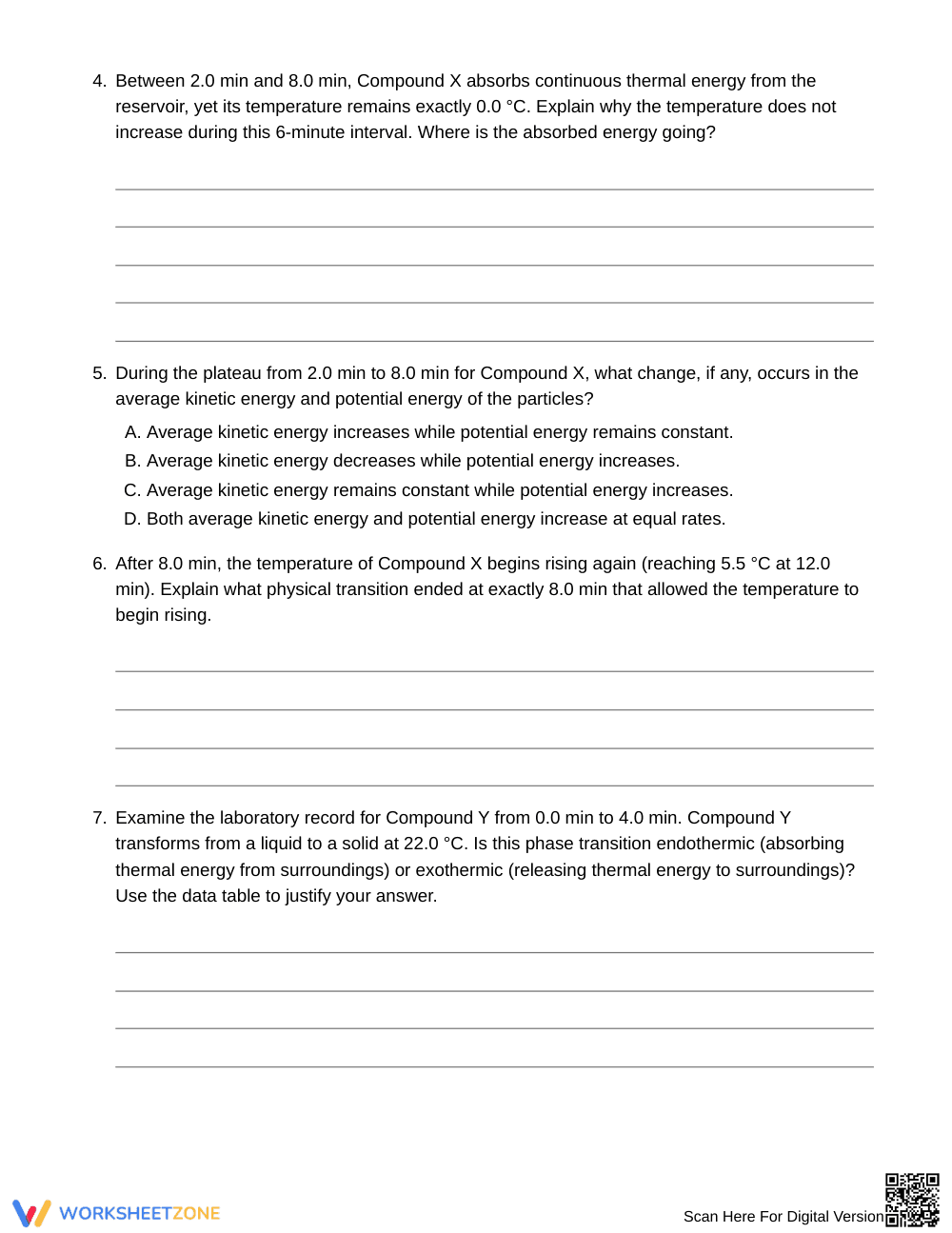
This 5-page printable resource includes a foundational reference box detailing core principles, a synthetic laboratory scenario with tabular time-temperature data, and a thorough 3-page answer key with model explanations. Students engage with 10 problems comprising selected-response checks, multi-step graphical data interpretations, and evidence-based scientific critiques.
Skill Progression
- Guided practice (Part A, 2 tasks): Students identify experimental constants and boundary conditions governing heat flow using reference definitions.
- Supported practice (Part B, 6 tasks): Learners apply kinetic and potential energy concepts to interpret heating curves, latent heat plateaus, and mass variations.
- Independent practice (Part C, 2 tasks): Students evaluate an intern's scientific claims, citing empirical data to refute misconceptions.
This structure follows an explicit gradual-release model, moving learners from foundational constraints to independent error correction.
Standards Alignment
This worksheet aligns directly with middle school physical science standards requiring students to develop and use models to describe how thermal energy affects particle motion and phase changes. It emphasizes distinguishing between temperature and thermal energy during phase transitions. Both standard descriptions can be copied directly into lesson plans, IEP goals, or district curriculum mapping tools.
How to Use It
Implement this resource immediately after direct instruction on latent heat. Use Part A and Part B as a collaborative partner activity, followed by Part C as an independent exit ticket. During instruction, circulate while students complete Part B to verify they understand that temperature remains constant during phase changes. Completion takes 40 to 50 minutes.
Who It's For
This activity is designed for Grade 7 science students studying energy transfer and phase changes. Built-in reference boxes support emerging bilingual learners and students requiring scaffolds, while Part C offers high-level analytical challenge. Pair this resource with a hands-on chemical cold pack demonstration or heating curve simulation.
According to Fisher & Frey (2014), structured opportunities to evaluate authentic scientific arguments accelerate conceptual mastery and disciplinary literacy in middle school classrooms. This 10-task thermal energy resource targets students' ability to evaluate a cooling-pack explanation by requiring them to coordinate empirical laboratory data with kinetic-molecular theory. Rather than memorizing definitions in isolation, learners actively differentiate between temperature and thermal energy, analyze endothermic versus exothermic phase transitions, and dismantle common misconceptions regarding cold transfer. In a comprehensive 5-page format featuring an explicit 3-page explanatory answer key, this resource embeds targeted scaffolds alongside rigorous analytical critique. Students synthesize quantitative time-temperature profiles with qualitative energy models, ensuring robust retention of physical science principles. Teachers can readily measure student progression through guided parameter checks, supported heating-curve analyses, and independent argument evaluations that reflect foundational science and engineering practices across 40 to 50 minutes of instructional time.


