


























Views
Downloads



Essential Cell Functions Worksheet | Grade 6 Science
Paste this activity's link or code into your existing LMS (Google Classroom, Canvas, Teams, Schoology, Moodle, etc.).
Students can open and work on the activity right away, with no student login required.
You'll still be able to track student progress and results from your teacher account.
This Grade 6 life science worksheet develops student mastery of core cell structures and their specialized functions. Through structured comparison tables, investigative lab scenarios, and tissue-matching challenges, learners analyze how organelles like the nucleus, cell membrane, and chloroplasts sustain plant and animal life across 12 targeted tasks.
At a Glance
- Grade: 6 · Subject: Science
- Standard: Cell Structure and Function — Describe how specialized cell parts support essential life processes
- Skill Focus: Basic Cell-Function Check
- Format: 5 pages · 12 problems · Answer key included · PDF
- Best For: Formative assessment and concept review
- Time: 35–45 minutes
Students engage with a built-in quick reference organelle anchor chart before moving through three distinct sections: foundational multiple-choice and organelle comparison tables, six real-world laboratory scenarios (including turgor pressure and photosynthesis failures), and an evidence-based synthetic data analysis matching unknown tissues to plant and animal sources. A comprehensive 3-page answer key provides complete model explanations.
Skill Progression
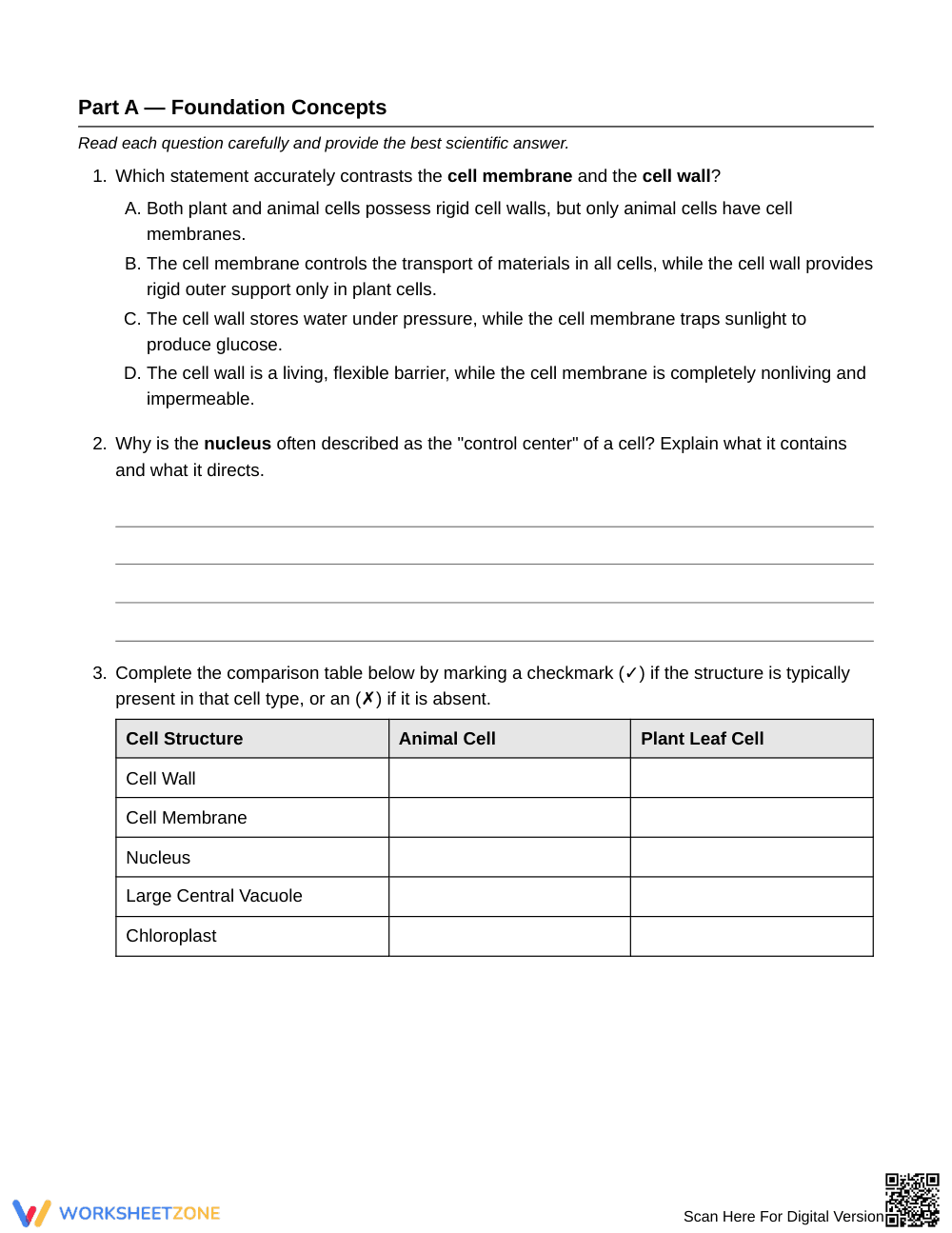
- Guided Practice: Tasks 1–3 ground understanding through a reference organelle chart, conceptual contrast questions, and a structured animal vs. plant cell comparison matrix.
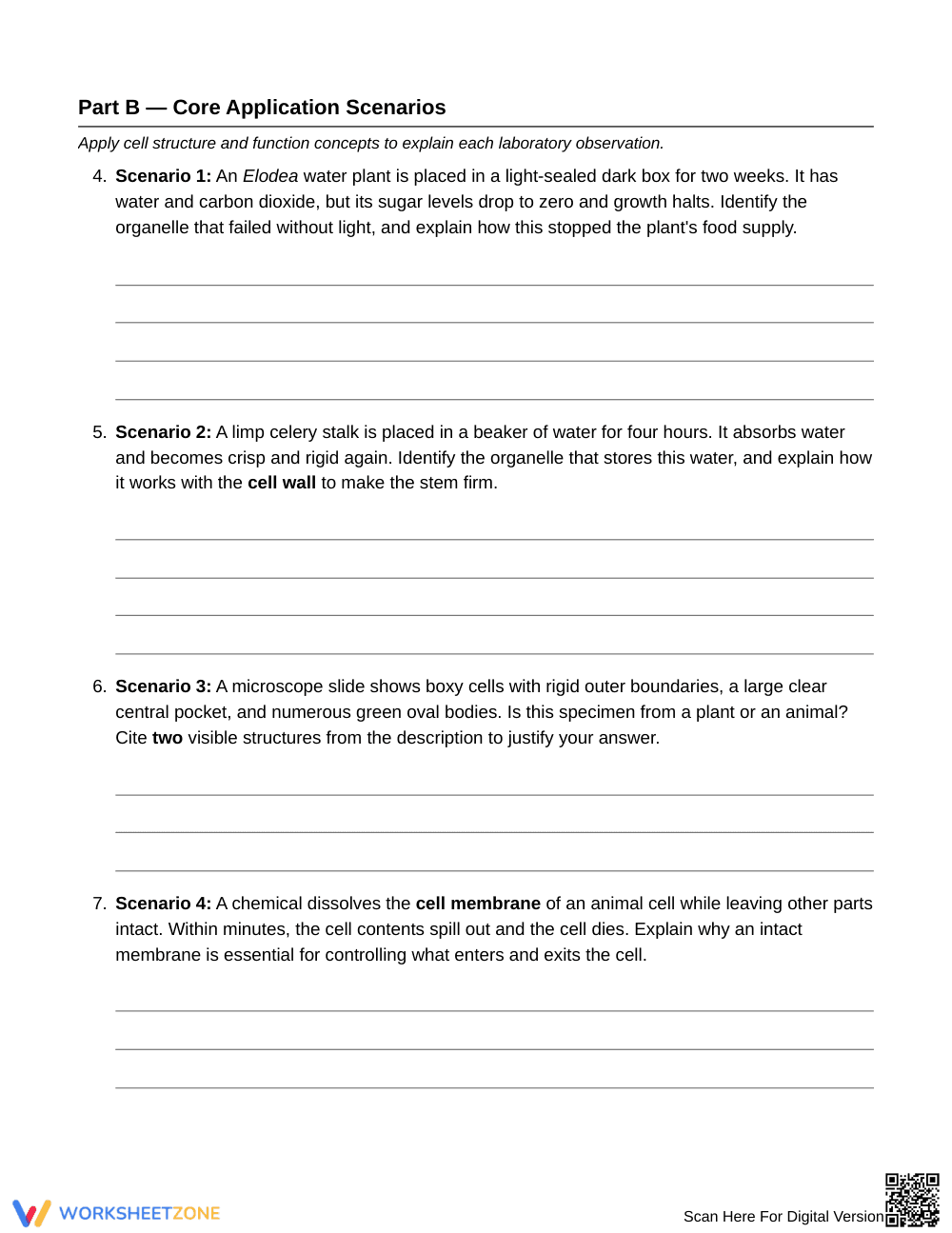
- Supported Practice: Tasks 4–9 present six authentic laboratory scenarios requiring students to apply organelle functions to real phenomena like celery turgidity and amoeba cytoplasm transport.
- Independent Practice: Tasks 10–12 challenge students to evaluate synthetic tissue data, critique common scientific misconceptions, and construct multi-part arguments.
This sequence follows a gradual-release framework, shifting students systematically from foundational recall to evidence-based biological reasoning.
Standards Alignment
This resource aligns with middle school life science standards covering the structure and function of cells. Students provide evidence that living things are made of cells and demonstrate how specialized organelles perform key life functions. This alignment supports core middle school science units, IEP accommodations, and district curriculum mapping objectives.
How to Use It
Administer this 5-page packet during mid-unit review or immediately following direct instruction on cell anatomy. As a formative check, observe how accurately students differentiate cell walls from cell membranes in Part B, noting whether students confuse organelle presence in non-green plant tissues like carrot roots. Students typically complete all 12 tasks within 35 to 45 minutes of focused class time.
Who It's For
This activity is designed for Grade 6 general science classrooms, introductory biology units, and students needing structured scaffolding in cellular biology. The built-in reference chart supports English learners and students with 504 plans. Pair this worksheet with compound microscope slide labs or interactive cell model building activities for maximum concept retention.
Middle school science proficiency requires students to move beyond rote organelle memorization toward functional, evidence-based systems thinking. According to Fisher & Frey (2014), structuring science instruction around gradual release of responsibility—moving deliberately from quick-reference foundational checks to complex data interpretation—significantly increases conceptual retention and academic discourse in STEM disciplines. This 12-task worksheet reinforces cellular structure and function through rigorous, inquiry-based scenarios rather than isolated vocabulary drills. By analyzing synthetic lab data, contrasting plant and animal tissues, and explaining physiological phenomena such as turgor pressure and cytoplasmic streaming, Grade 6 learners establish foundational scientific reasoning skills that bridge elementary life science observations with high school biological concepts. Teachers can rely on this systematic progression to assess cell biology readiness and support diagnostic remediation.


