


























Views
Downloads




Essential Cell Function Data Worksheet | Grade 6 Science
Paste this activity's link or code into your existing LMS (Google Classroom, Canvas, Teams, Schoology, Moodle, etc.).
Students can open and work on the activity right away, with no student login required.
You'll still be able to track student progress and results from your teacher account.
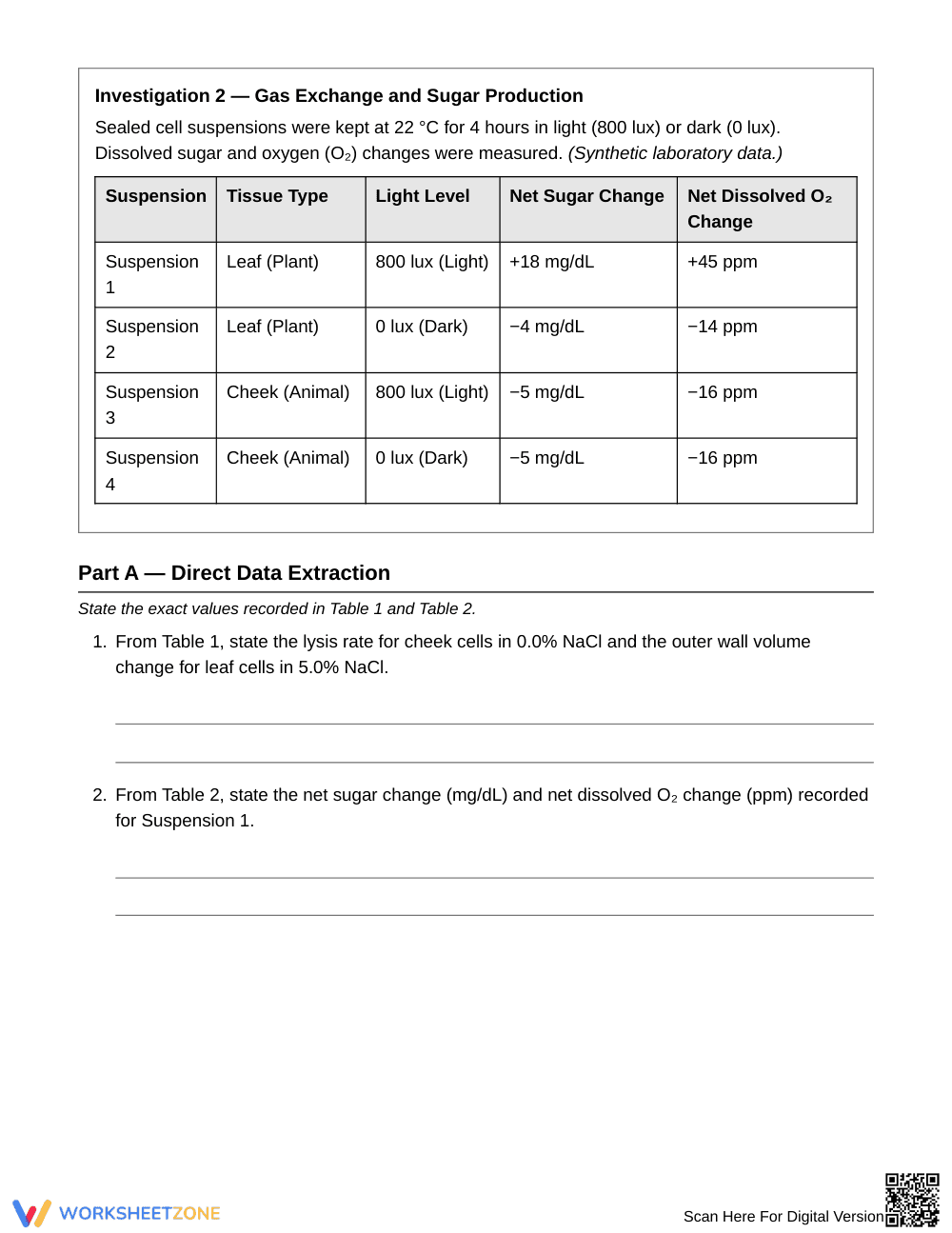
This cell biology worksheet trains middle school students to interpret empirical cell-function observations and connect experimental data to organelle roles. Students evaluate two authentic investigation tables detailing osmotic stability and metabolic gas exchange in plant and animal tissues. Learners directly extract quantitative metrics, explain structural mechanisms, and evaluate experimental validity to build scientific reasoning skills.
At a Glance
- Grade: 6 · Subject: Science
- Standard: Interpret empirical evidence to explain cellular structures, osmosis, and metabolic functions
- Skill Focus: Interpret Simple Cell-Function Observations
- Format: 5 pages · 10 problems · Answer key included · PDF
- Best For: Lab analysis and scientific evaluation
- Time: 40–50 minutes
What's Inside
This 5-page resource includes an introductory organelle reference box, two synthetic laboratory data tables detailing osmotic volume changes and dissolved gas exchange, and 10 targeted analytical questions across three progressive sections. A complete 2-page answer key provides expected scientific rationales, sample calculation checks, and model responses for quick grading.
Skill Progression
- Guided Practice (Part A, Problems 1–2): Students complete direct data extraction tasks from both investigation tables, locating exact values for cheek cell lysis rates, plant cell wall stability, and net sugar or oxygen changes with structured prompts.
- Supported Practice (Part B, Problems 3–8): Learners analyze patterns and structure-function relationships across six multi-part items, explaining how the rigid cell wall prevents plant bursting, evaluating chloroplast light dependency, and diagnosing an unknown tissue sample.
- Independent Practice (Part C, Problems 9–10): Students critically evaluate experimental limitations, identifying untested variables, confounding factors, and the boundaries of short-term observational claims.
This structured sequence reflects the gradual-release model, moving learners intentionally from basic data retrieval to rigorous mechanistic analysis and experimental evaluation.
Standards Alignment
This resource aligns with middle school life science standards requiring students to develop models or analyze evidence showing how cell structures contribute to cellular function. Students examine how membranes, walls, vacuoles, and chloroplasts govern water movement and energy production. Supporting standards encompass experimental evaluation and identifying scientific design flaws. Both standard codes can be copied directly into lesson plans, IEP goals, or district curriculum mapping tools.
How to Use It
Assign this worksheet after direct instruction on cell organelles and before an in-person wet-mount microscope lab. During the 40 to 50 minutes of instructional time, circulate while students complete Part B to identify whether they confuse cell walls with cell membranes during osmotic events. For quick formative assessment, check Problem 8 as an exit ticket to confirm students can differentiate plant and animal cells using quantitative evidence.
Who It's For
This resource serves sixth-grade general science classrooms, introductory life science courses, and targeted intervention groups needing structured data analysis practice. Visual learners and striving readers benefit from the reference guide at the top of page 1. Pair this worksheet with an interactive cell membrane transport simulation or an anchor chart showing plant versus animal organelle structures.
According to Fisher & Frey (2014), structured data interpretation activities that transition deliberately from factual extraction to explanatory synthesis solidify conceptual transfer in middle school science. This Grade 6 life science worksheet guides students through 10 targeted tasks where they interpret simple cell-function observations, contrast plant and animal tissue reactions under varying osmotic pressures, and connect organelle structures to cellular behaviors. Rather than relying on simple recall, learners evaluate quantitative changes in cell volume, dissolved oxygen, and sugar production across controlled light and saline conditions. By integrating an organelle reference anchor alongside rigorous experimental evaluation, the worksheet equips sixth-grade students to read scientific tables critically, justify causal claims with empirical evidence, and identify experimental constraints, providing educators with concrete, formative evidence of student conceptual understanding.


