




























Views
Downloads




Essential Big Bang Evidence Worksheet | Grade 12 Science

Paste this activity's link or code into your existing LMS (Google Classroom, Canvas, Teams, Schoology, Moodle, etc.).
Students can open and work on the activity right away, with no student login required.
You'll still be able to track student progress and results from your teacher account.
Mastery of modern cosmology requires high school seniors to connect spectroscopic data directly to universal expansion. This Grade 12 Earth and Space Science worksheet guides students through 12 rigorous problems evaluating the foundational pillars of Big Bang cosmology, from redshift calculations and Hubble's Law to cosmic microwave background radiation and primordial nucleosynthesis ratios.
At a Glance
- Grade: 12 · Subject: Earth & Space Science
- Standard: Construct explanations of cosmic expansion using astronomical spectra and observational data
- Skill Focus: Big Bang Evidence & Redshift
- Format: 6 pages · 12 problems · Answer key included · PDF
- Best For: Quantitative astrophysics review and assessment
- Time: 45–60 minutes
What's Inside
This 6-page printable worksheet includes reference formulas, cosmological constants, and a 4-page comprehensive answer key with full mathematical derivations. Students interpret real-world spectral absorption lines, calculate recessional velocities, analyze light-element mass fractions, and complete a synthetic observational data table for multiple astronomical targets.
Skill Progression
- Guided Practice (Problems 1–3): Students review core mechanisms, differentiate cosmological from Doppler redshift with formula scaffolds, and calculate baseline redshift values from laboratory rest wavelengths.
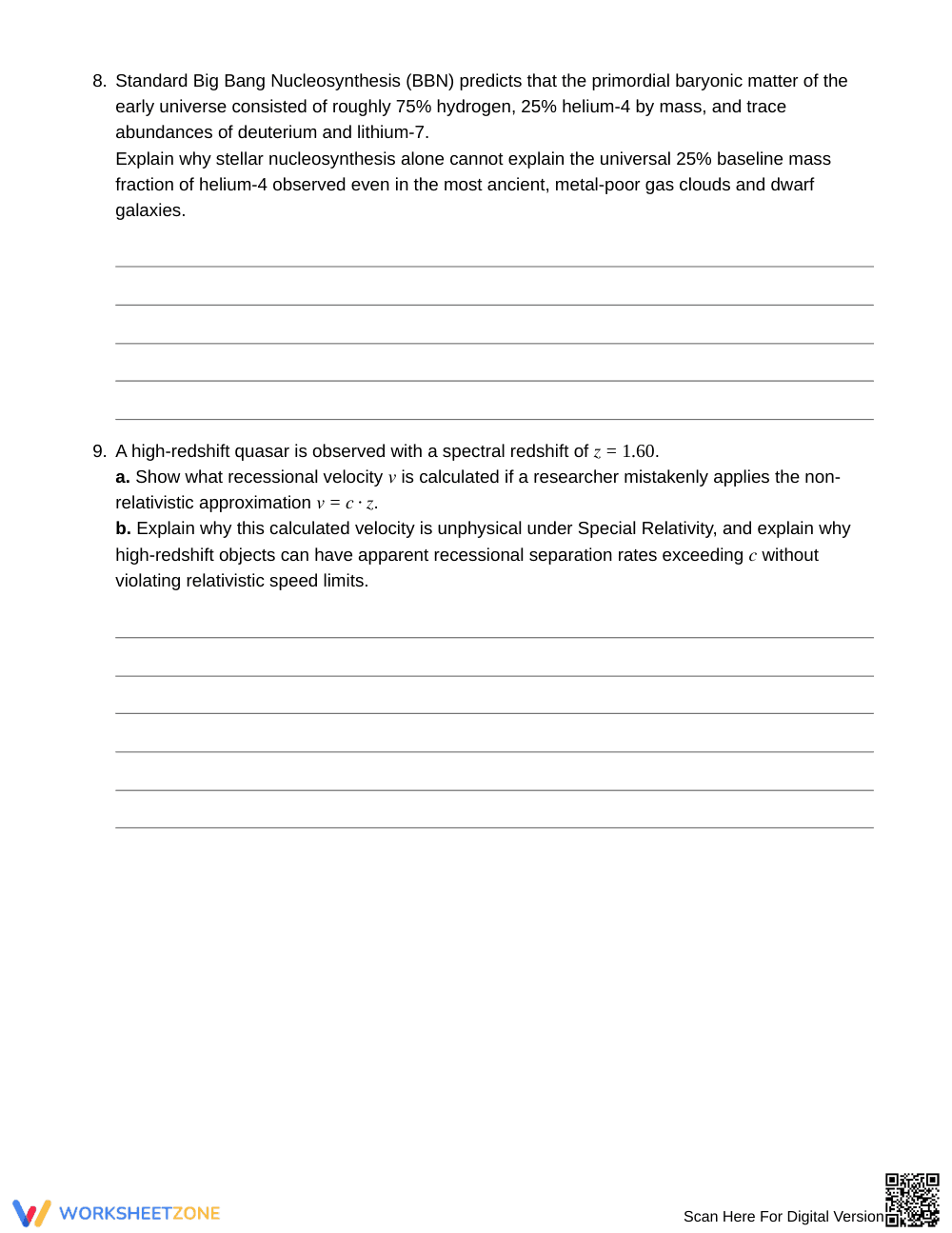
- Supported Practice (Problems 4–9): Learners apply Hubble-Lemaître law calculations, evaluate Cosmic Microwave Background cooling, and analyze Big Bang nucleosynthesis ratios across multi-step astrophysical prompts.
- Independent Practice (Problems 10–12): Students complete target wavelength tables, quantify thermal evolution at high redshift, and synthesize the three primary observational pillars in comprehensive free-response arguments.
This structured gradual-release sequence ensures learners move methodically from foundational principles to advanced quantitative synthesis.
Standards Alignment
This resource aligns with high school Earth and Space Science standards requiring students to construct explanations of the Big Bang theory based on astronomical evidence, light spectra, and cosmic background radiation. It also reinforces cross-cutting concepts of scale, proportion, and energy transfer. These learning objectives can be copied directly into lesson plans, IEP goals, or district curriculum mapping tools.
How to Use It
Deploy this worksheet after direct instruction on astronomical spectra and cosmic expansion to solidify quantitative problem-solving. During class, check student work on Part B to ensure proper unit conversion and significant figures before they advance to the theoretical synthesis in Part C. The complete task sequence takes 45 to 60 minutes.
Who It's For
Designed for Grade 12 Earth and Space Science, Astronomy, or AP Physics students, this worksheet provides structured formula reference boxes to support developing learners while challenging advanced students with relativistic speed boundaries. Pair this resource with a spectroscope laboratory or galaxy redshift simulation for maximum conceptual reinforcement.
Synthesizing astronomical data through structured quantitative analysis solidifies high-level scientific reasoning in secondary classrooms. As documented in research by Fisher & Frey (2014), explicit gradual-release frameworks allow students to bridge conceptual astrophysics with complex mathematical modeling, moving systematically from basic formula substitution to independent empirical evaluation. This Grade 12 resource operationalizes these findings by organizing 12 targeted problems across three progressive tiers: defining physical mechanisms, calculating recessional velocities via Hubble's Law, and synthesizing evidence from primordial nucleosynthesis and cosmic microwave background temperatures. By integrating comprehensive reference constants and step-by-step answer keys, the worksheet equips educators to diagnose misconceptions regarding spacetime expansion versus localized Doppler motion. Students gain rigorous practice evaluating spectroscopic evidence, fostering empirical literacy and preparing them for college-level astrophysics and physical science coursework.


