


























Views
Downloads


Printable Word Sorting Worksheet | Grade 2 ELA
Paste this activity's link or code into your existing LMS (Google Classroom, Canvas, Teams, Schoology, Moodle, etc.).
Students can open and work on the activity right away, with no student login required.
You'll still be able to track student progress and results from your teacher account.
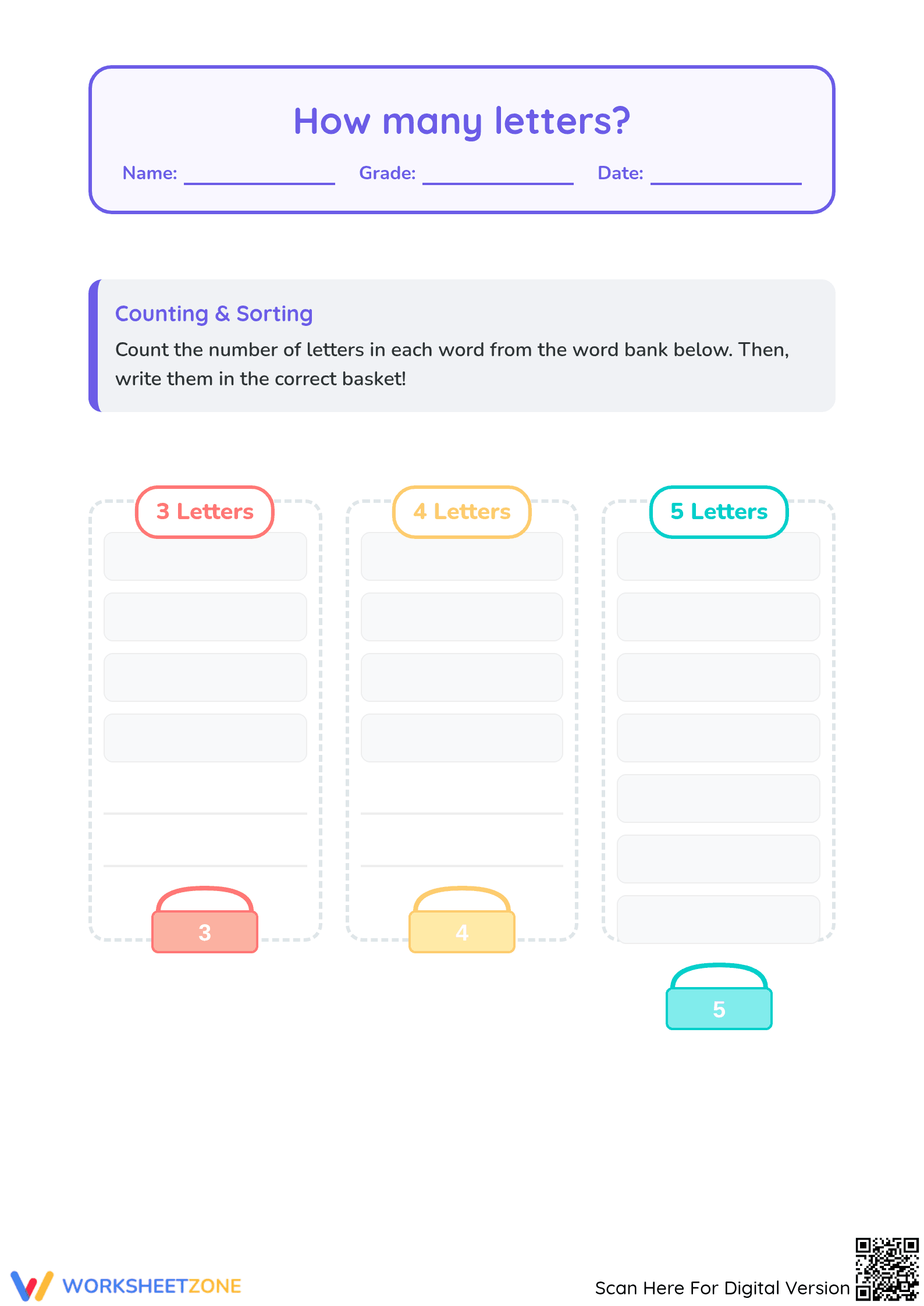
This Grade 2 English worksheet helps students build foundational spelling and orthographic mapping skills by counting and sorting words based on their length. Students analyze a provided word bank and categorize each word into the correct basket, reinforcing their visual recognition of three-, four-, and five-letter spelling patterns.
At a Glance
- Grade: 2 · Subject: English
- Standard:
CCSS.ELA-LITERACY.RF.2.3— Apply grade-level phonics and word analysis skills- Skill Focus: Word Sorting and Letter Counting
- Format: 2 pages · 15 problems · Answer key included · PDF
- Best For: Independent practice or literacy centers
- Time: 10–15 minutes
This resource features a highly visual, two-page layout designed for young learners. The first page contains three distinct sorting baskets labeled for three-letter, four-letter, and five-letter words. The second page provides a clear, easy-to-read word bank containing fifteen grade-appropriate vocabulary words. A complete answer key is also included to ensure quick and accurate grading for teachers.
Zero-Prep Workflow
- Print (1 minute): Simply print the two-page PDF and the included answer key. No special materials or cutting required.
- Distribute (1 minute): Hand out the sorting page and the word bank page to each student. The instructions are completely self-explanatory.
- Review (3 minutes): Use the provided answer key to quickly check student work or project it on the board for self-correction.
With a total teacher prep time of under two minutes, this activity is an excellent addition to any emergency sub plan or busy morning routine.
This activity aligns with CCSS.ELA-LITERACY.RF.2.3, requiring students to know and apply grade-level phonics and word analysis skills in decoding words. By actively counting letters and categorizing words, students strengthen their orthographic memory and structural analysis capabilities. Both standard codes can be copied directly into lesson plans, IEP goals, or district curriculum mapping tools.
Teachers can utilize this worksheet during independent literacy centers or as a quiet morning work assignment before direct instruction begins. As a formative assessment tip, observe whether students are counting letters one by one or if they are beginning to recognize word lengths automatically through sight. Expected completion time ranges from 10 to 15 minutes, making it a perfect transition activity.
This resource is primarily designed for second-grade students developing their spelling and vocabulary skills. It serves as an excellent differentiation tool for visual learners who benefit from graphic organizers like sorting baskets. Pair this worksheet with a phonics anchor chart or a direct instruction lesson on spelling patterns to maximize student comprehension and engagement.
Developing strong orthographic mapping skills is a critical component of early literacy. This worksheet aligns with CCSS.ELA-LITERACY.RF.2.3, focusing on the ability to apply grade-level phonics and word analysis skills. According to Fisher & Frey (2014), providing students with structured, visual categorization tasks significantly enhances their vocabulary retention and structural word analysis. By requiring learners to actively count letters and sort vocabulary into specific categories, this activity moves beyond passive reading and encourages active orthographic processing. Such targeted practice helps solidify the visual representation of words in a student's memory, which is essential for fluent reading and accurate spelling. This evidence-based approach ensures that foundational literacy skills are reinforced through meaningful, independent practice, ultimately supporting broader reading comprehension goals in the elementary classroom.


