


























Views
Downloads
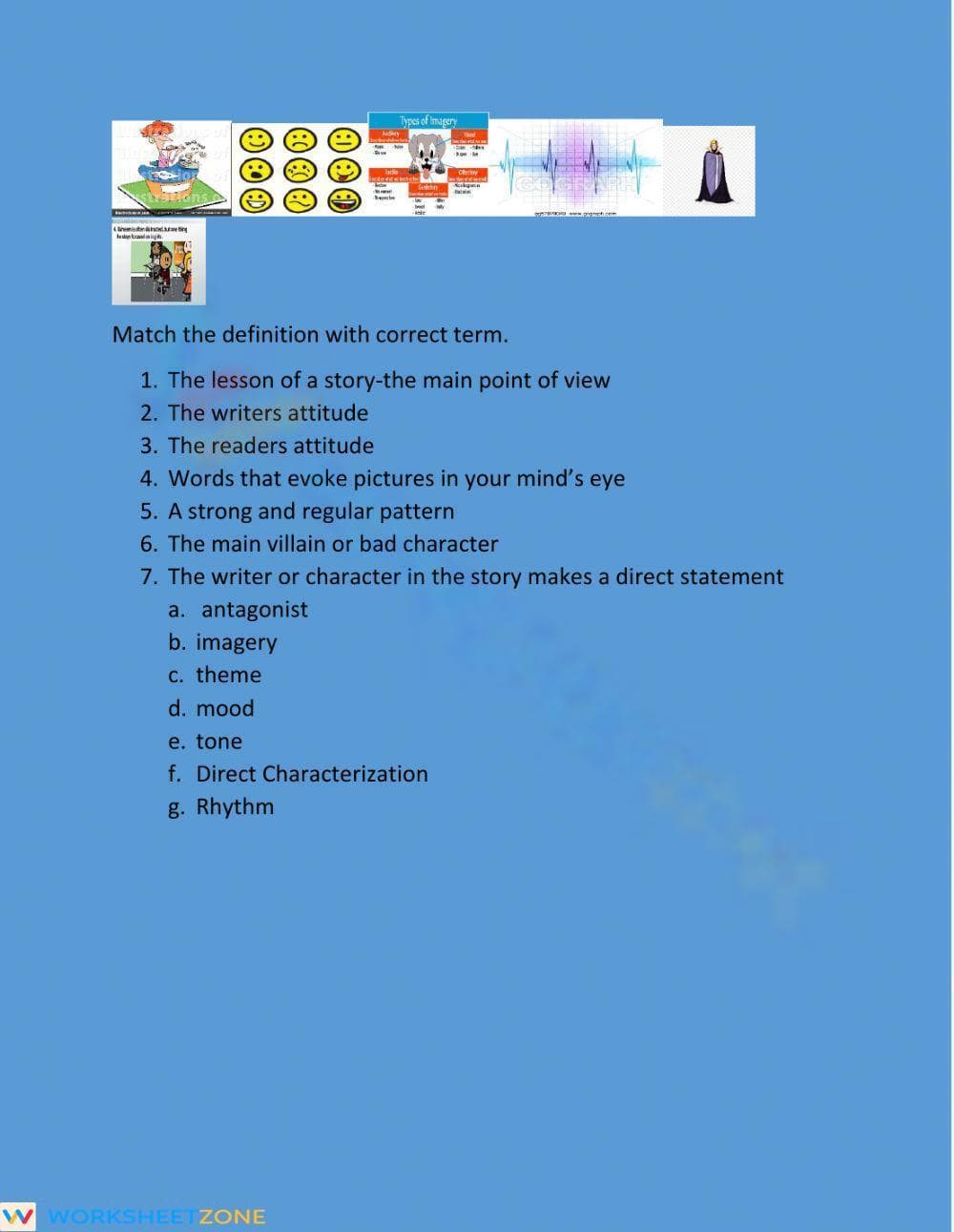

Essential Literary Terms Review Worksheet | Grade 9 ELA
Paste this activity's link or code into your existing LMS (Google Classroom, Canvas, Teams, Schoology, Moodle, etc.).
Students can open and work on the activity right away, with no student login required.
You'll still be able to track student progress and results from your teacher account.
This essential vocabulary review worksheet targets foundational literary terms for high school English Language Arts students. By matching precise definitions to seven core literary concepts, learners strengthen their ability to analyze authorial craft and text structure. This resource ensures students can accurately distinguish between the writer's attitude and the reader's emotional response in any narrative.
At a Glance
- Grade: 9 · Subject: English Language Arts
- Standard:
CCSS.ELA-LITERACY.RL.9-10.4— Determine the meaning of words and phrases used in literature and analyze word choice.- Skill Focus: Literary Elements and Vocabulary
- Format: 1 page · 7 problems · Answer key included · PDF
- Best For: Secondary ELA bell-ringers and vocabulary review
- Time: 10–15 minutes
What's Inside
The worksheet contains a single, focused page featuring seven matching items designed to test student recall and application of literary terminology. Students must link definitions—such as patterns of rhythm or the evocation of mental imagery—to their corresponding academic terms. The layout includes a clear list of definitions and a word bank for efficient student interaction, accompanied by a comprehensive answer key for immediate teacher feedback.
Skill Progression
- Guided practice: Initial matching of foundational terms like 'antagonist' and 'rhythm' with clear definitions (2 problems).
- Supported practice: Distinguishing between subtle differences in attitudes via 'tone' and 'mood' (3 problems).
- Independent practice: Synthesizing complex concepts like 'direct characterization' and 'theme' without scaffolding (2 problems).
Students move through a gradual-release model that solidifies their grasp of essential literary devices and authorial techniques.
Standards Alignment
This resource is aligned to CCSS.ELA-LITERACY.RL.9-10.4, requiring students to determine the meaning of words as used in literature. It supports the analysis of how specific word choices shape meaning or tone. Both standard codes can be copied directly into lesson plans, IEP goals, or district curriculum mapping tools.
How to Use It
Implement this worksheet as a quick bell-ringer to activate prior knowledge before a literary analysis session. It also functions effectively as a formative exit ticket to gauge student understanding of terminology following a direct instruction lesson. Educators should observe whether students struggle with the nuance between tone and mood to identify specific areas for reteaching. Completion time is approximately 10 to 15 minutes.
Who It's For
Designed for Grade 9 through Grade 12 ELA classrooms, this worksheet supports diverse student populations including general education, ESL, and students with IEP accommodations. It provides a helpful scaffold for those building academic vocabulary before tackling complex literature. Pair this resource with a short story passage or a literary devices anchor chart to provide a robust, multi-modal learning experience.
The CCSS.ELA-LITERACY.RL.9-10.4 standard requires students to determine the meaning of words as they are used in a text, specifically focusing on how word choice impacts tone and mood. According to Fisher & Frey (2014), the acquisition of academic and domain-specific vocabulary is most effective when students engage in active retrieval practice and matching exercises that bridge the gap between abstract definitions and concrete examples. This worksheet facilitates that process by requiring students to distinguish between closely related concepts like mood and tone, or direct characterization and antagonist. By reinforcing these seven critical literary terms through a structured review, educators provide the foundational linguistic tools necessary for high-level textual analysis and literary criticism. This resource serves as a vital bridge for secondary students as they move from basic reading comprehension to the complex interpretive demands of high school English curricula, ensuring they can accurately identify and discuss the craft and structure of various literary works.


