


























Views
Plays
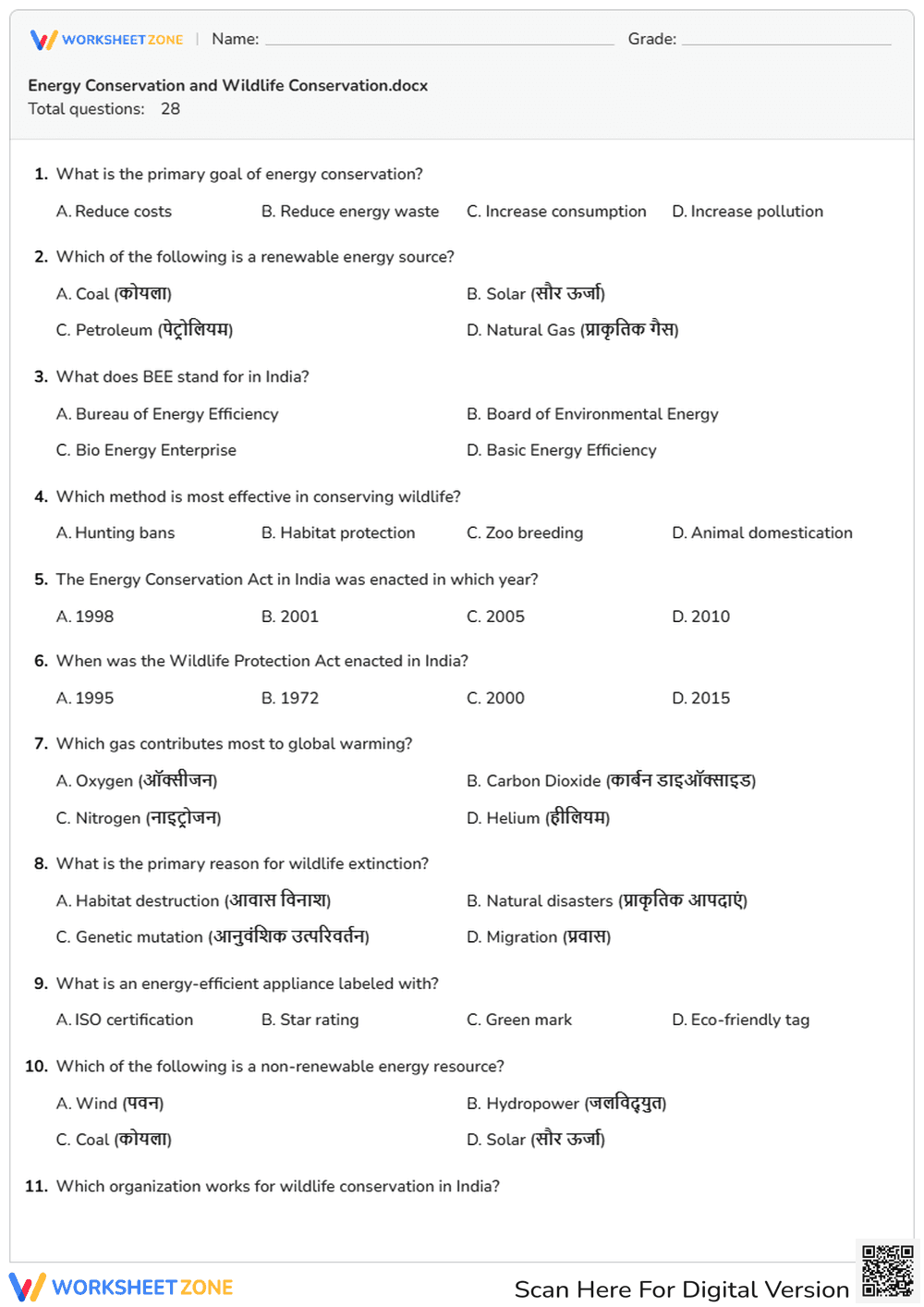


Energy Conservation & Wildlife Quiz | Grade 4 Essential
Paste this activity's link or code into your existing LMS (Google Classroom, Canvas, Teams, Schoology, Moodle, etc.).
Students can open and work on the activity right away, with no student login required.
You'll still be able to track student progress and results from your teacher account.
This Grade 4 science worksheet provides a comprehensive assessment of student knowledge regarding natural resource management and environmental protection. Students evaluate their understanding of renewable energy, conservation legislation, and biodiversity threats through 28 targeted multiple-choice questions. It serves as an effective tool for measuring mastery of human impact on Earth's systems.
At a Glance
- Grade: 4 · Subject: Science
- Standard:
4-ESS3-1— Describe how energy and fuels are derived from natural resources and affect environments- Skill Focus: Resource Conservation
- Format: 3 pages · 28 problems · Answer key included · PDF
- Best For: End-of-unit assessment or sub plans
- Time: 30–45 minutes
The PDF contains three pages featuring 28 multiple-choice questions. The content covers a broad range of environmental topics, including the distinction between renewable and non-renewable energy, specific conservation acts, and the primary causes of species extinction. The layout is clean and professional, with clear numbering and bilingual support for key scientific terms to assist diverse learners in understanding complex vocabulary.
Zero-Prep Workflow
- Print: Generate the three-page set in less than 1 minute using standard black-and-white settings.
- Distribute: Hand out the assessment for a 40-minute independent work session or a quiet testing environment.
- Review: Use the included answer key to grade the 28 tasks rapidly, providing immediate feedback to students.
This resource requires zero additional setup, making it an ideal choice for emergency substitute folders or scheduled testing days.
Standards Alignment
This worksheet aligns with `4-ESS3-1`, requiring students to obtain and combine information to describe that energy and fuels are derived from natural resources and their uses affect the environment. It also supports 5-ESS3-1 by addressing how individual communities use science ideas to protect Earth’s resources and environment. Both standard codes can be copied directly into lesson plans, IEP goals, or district curriculum mapping tools.
How to Use It
Use this quiz as a summative assessment after completing a unit on ecology or natural resources. It can also function as a pre-test to gauge prior knowledge before beginning a conservation project. During the session, observe which students struggle with the distinction between renewable and non-renewable sources to guide future small-group interventions. Completion typically takes 30 to 45 minutes depending on reading speed.
Who It's For
This resource is tailored for upper elementary students in Grades 3, 4, and 5. It is particularly beneficial for classrooms focusing on environmental stewardship or global citizenship. The inclusion of Hindi translations for complex terms makes it a supportive resource for English Language Learners (ELL) or bilingual programs. Pair this with an anchor chart on the water cycle or energy types for a complete instructional block.
According to the RAND AIRS 2024 report, high-quality science assessments that integrate real-world policy and conservation facts significantly improve student retention of environmental concepts. This 28-question worksheet addresses the 4-ESS3-1 standard by challenging students to identify the origins of energy and the legislative frameworks designed to protect wildlife. By focusing on the plain-English skill of identifying human impacts on natural systems, the resource provides a structured pathway for students to demonstrate scientific literacy. Research from Fisher & Frey (2014) emphasizes that multiple-choice assessments, when used as part of a gradual release of responsibility, allow teachers to pinpoint specific misconceptions in ecological understanding. This worksheet offers a robust data point for educators tracking progress toward state and national science benchmarks, ensuring that students are prepared for higher-level environmental science coursework in middle school.


