


























Views
Downloads


DBT Pros and Cons Worksheet | Essential Grade 6-7 SEL
Paste this activity's link or code into your existing LMS (Google Classroom, Canvas, Teams, Schoology, Moodle, etc.).
Students can open and work on the activity right away, with no student login required.
You'll still be able to track student progress and results from your teacher account.
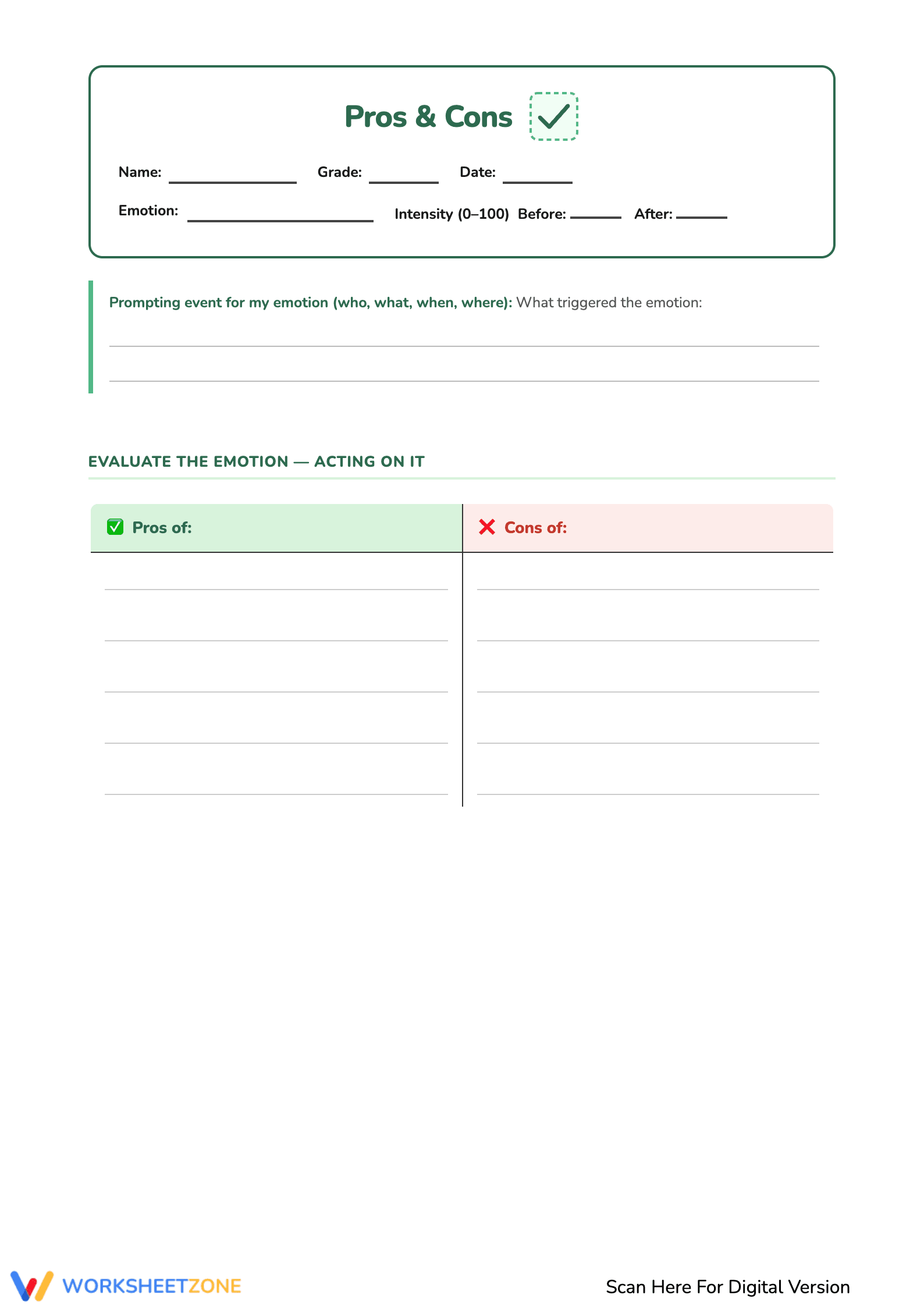
This Grade 6-7 behavior worksheet provides a structured framework for students to manage intense emotions using the DBT Pros and Cons technique. By analyzing the consequences of both acting on and resisting emotional urges, students develop the self-regulation skills necessary to make informed, value-aligned decisions during moments of distress.
At a Glance
- Grade: 6-7 · Subject: Behavior Worksheets
- Standard:
CCSS.ELA-LITERACY.W.7.10— Write routinely over extended time frames for reflection and self-analysis- Skill Focus: Emotional Regulation & DBT Pros/Cons
- Format: 3 pages · 8 tasks · Template format · PDF
- Best For: Individual counseling or SEL classroom reflection
- Time: 15–25 minutes
This 3-page PDF includes a comprehensive emotion-tracking header with intensity scales (0-100), a prompting event analysis section, and two distinct decision-making tables. Students compare the pros and cons of acting on an urge versus resisting it. The final pages offer five deep-reflection questions, including a "Wise Mind" check to balance logic and emotion.
Skill Progression
- Guided Identification: Students begin by naming a specific emotion and identifying the "who, what, when, and where" of the triggering event.
- Supported Analysis: Two structured tables guide students through a four-way analysis of consequences, ensuring they see the short-term and long-term impact of their choices.
- Independent Reflection: The final section requires students to synthesize their findings, identifying a "small step" that honors both their feelings and long-term wellbeing.
This sequence follows a gradual-release model, moving from external observation to internal cognitive restructuring.
Standards Alignment
This resource aligns with `CCSS.ELA-LITERACY.W.7.10`, which requires students to write routinely for a range of discipline-specific tasks, purposes, and audiences. By engaging in written self-reflection, students practice the metacognitive skills necessary for academic and personal success. This standard code can be copied directly into lesson plans, IEP goals, or district curriculum mapping tools.
How to Use It
Use this worksheet during a Tier 1 SEL lesson on decision-making or as a Tier 2 intervention for students struggling with impulse control. Teachers should introduce the "Wise Mind" concept before distribution. As a formative assessment, observe if students can distinguish between short-term relief and long-term consequences in their tables. Completion typically takes 20 minutes.
Who It's For
This template is designed for middle school students in Grades 6 and 7, particularly those participating in DBT-informed skills groups or individual counseling. It pairs naturally with an anchor chart on "Wise Mind" or a direct instruction lesson on emotional triggers and physiological responses.
According to the RAND AIRS 2024 report on social-emotional learning, structured reflection tools like the DBT Pros and Cons matrix significantly improve student self-regulation by creating a "cognitive pause" between stimulus and response. This worksheet targets the CCSS.ELA-LITERACY.W.7.10 standard by requiring students to engage in routine reflective writing to analyze complex internal states. Research from Fisher & Frey (2014) emphasizes that providing students with graphic organizers for decision-making helps scaffold higher-order thinking during periods of high emotional cognitive load. By utilizing this 3-page template, educators provide a repeatable framework that students can eventually internalize, moving from paper-based tracking to independent mental regulation. This evidence-based approach ensures that behavioral interventions are grounded in both clinical best practices and academic literacy standards, supporting holistic student development across middle school environments.


