


























Views
Downloads

Emoji Match Worksheet: Essential Kindergarten Emotions
Paste this activity's link or code into your existing LMS (Google Classroom, Canvas, Teams, Schoology, Moodle, etc.).
Students can open and work on the activity right away, with no student login required.
You'll still be able to track student progress and results from your teacher account.
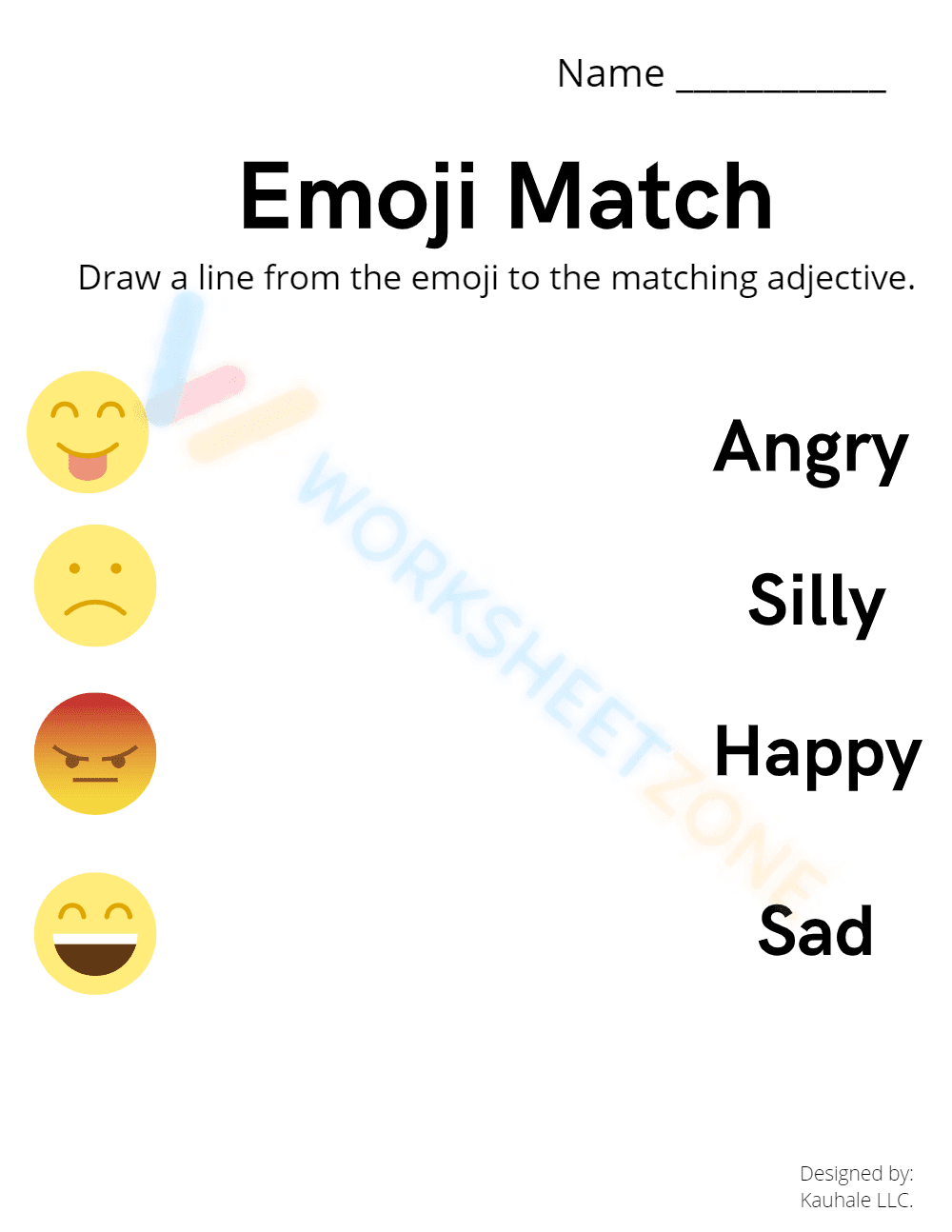
This Kindergarten English worksheet helps young learners identify and label basic emotions through a visual matching activity. By connecting expressive emojis to their corresponding adjectives, students build essential social-emotional vocabulary and word recognition skills. This resource provides a clear, engaging way to bridge the gap between visual cues and written language.
At a Glance
- Grade: Kindergarten · Subject: English
- Standard:
CCSS.ELA-LITERACY.L.K.5.C— Identify real-life connections between words and their use through emotions- Skill Focus: Emotion recognition and adjective matching
- Format: 1 page · 4 problems · Answer key included · PDF
- Best For: Morning work or social-emotional learning
- Time: 5–10 minutes
The worksheet features four distinct, high-contrast emojis representing common feelings: happy, sad, angry, and silly. Opposite these icons are the four corresponding adjectives in a large, legible font suitable for early readers. The layout is clean and uncluttered, ensuring that students can focus on the fine motor task of drawing lines without distraction.
This resource follows a zero-prep workflow designed for busy educators. First, print the single-page PDF (30 seconds). Second, distribute the sheets to students and provide a brief verbal prompt about the emojis (1 minute). Third, review the answers as a whole group to reinforce the vocabulary (1 minute). Total teacher preparation time is under two minutes, making it an ideal sub plan addition.
This activity aligns with CCSS.ELA-LITERACY.L.K.5.C, which requires students to identify real-life connections between words and their use. By associating facial expressions with specific adjectives, students demonstrate an understanding of word meanings in a social context. This standard code can be copied directly into lesson plans, IEP goals, or district curriculum mapping tools.
Use this worksheet during a morning meeting or as a quick check-in after a story about feelings. It serves as an excellent formative assessment; observe if students can correctly identify the "angry" or "silly" faces before they draw their lines. Completion typically takes 5 to 10 minutes, making it a perfect transition activity between core subjects.
This resource is ideal for Kindergarten students, English Language Learners (ELLs), and students receiving special education services who benefit from visual supports. It pairs naturally with an "Emotions Anchor Chart" or a read-aloud of a picture book focused on feelings and social-emotional development. The simple design ensures accessibility for all learners.
Research from the RAND AIRS 2024 report emphasizes that integrating visual literacy with vocabulary instruction significantly improves retention in early childhood education. This worksheet utilizes high-interest emoji icons to ground abstract adjectives like "angry" and "silly" in concrete visual representations. By engaging in this 4-task matching exercise, students practice the specific requirements of CCSS.ELA-LITERACY.L.K.5.C, which focuses on identifying real-life connections between words and their use. Studies in the ScienceDirect TpT Analysis suggest that simple, one-page matching tasks reduce cognitive load for five-year-olds, allowing them to focus on the semantic relationship between the image and the text. This evidence-based approach ensures that students are not just memorizing words but are building a functional emotional vocabulary. The clear formatting and immediate feedback potential make it a reliable tool for both general education classrooms and targeted social-emotional interventions.


